
 Arabic
  English
  Russian
  French
  German
  Japanese
  Korean
  Portuguese
  Italian
  Dutch
Dutch  Turkish
  Indonesian
  Polish
  Spanish
You know that sinking feeling when you walk into the test lab and see a puddle of blue or pink fluid under your prototype battery pack?
Yeah. I’ve been there. It’s a nightmare.
For automotive engineers working on the bleeding edge of EV development, thermal management isn’t just a box to check. It is literally the difference between a high-performance vehicle and a thermal runaway headline on the evening news.
We used to get away with standard EPDM rubber in the ICE (Internal Combustion Engine) days. But let’s be honest with ourselves—putting heavy, bulky rubber hoses inside a high-voltage battery pack is becoming an outdated practice. It’s like trying to cool a supercomputer with garden plumbing.
Today, I’m going to walk you through why خرطوم مموج من مادة PTFE is quietly taking over the EV sector, specifically for coolant lines. We’ll talk about flow rates, why Nylon isn’t always the answer, and I’ll even share some math that actually works in the real world.
The Problem: Why Your Current Hoses Might Fail
Look, I get it. EPDM is cheap. PA12 (Nylon) is stiff and predictable. But electric vehicles have changed the game rules.
In an EV battery pack, you are dealing with a “Goldilocks” zone. The battery cells need to stay between 15°C and 35°C for optimal life. If they get too hot, degradation accelerates. Too cold, and range drops off a cliff.
Here is where traditional materials struggle:
- Permeation Issues: Rubber is permeable. Over 5 to 10 years, water vapor creeps out, and coolant concentration changes. That messes with your thermal conductivity.
- The “Space” War: You are fighting for every millimeter inside that chassis. Rubber hoses require thick walls and massive bend radii. You try to bend a 1-inch EPDM hose 90 degrees in a tight spot? Good luck. It kinks.
- Chemical Attacks: Modern coolants (usually a 50/50 water-glycol mix) run hot. Over time, they can hydrolyze certain plastics or leach plasticizers out of rubber, gumming up your micro-channels in the cooling plate.
This is where تفلون X comes in. We realized a while ago that the industry needed something that bends like a slinky but handles chemicals like a lab beaker.

خرطوم تيفلون مموج مقاوم للهب ومقاوم للعوامل الجوية
تم تصميمه ليكون متينًا، هذا خرطوم مموج من التفلون يجمع مثبطات اللهب و القدرة على مقاومة الطقس لتحمل الظروف الخارجية القاسية. سطح غير لاصق يمنع تراكم الزيت والحطام، مما يجعله مناسبًا لأنظمة نقل السوائل في السيارات والطائرات ودرجات الحرارة العالية.
Why PTFE Corrugated Hose is the Engineer’s Choice
Let’s strip away the marketing fluff. Why are OEMs actually switching to خرطوم مموج من مادة PTFE?
It comes down to the molecular bond. The Carbon-Fluorine bond is one of the strongest in organic chemistry. It basically ignores everything you throw at it.
1. Temperature Range that Actually Matters
EVs generate heat, but they also sit in freezing parking lots in Norway.
Our PTFE hoses handle من -70 درجة مئوية إلى +260 درجة مئوية.
PA12 (Nylon) usually taps out around 120°C before it starts losing mechanical strength. If you have a localized hot spot or a pump failure, Nylon can deform. PTFE won’t even blink.
2. Flexibility vs. Kink Resistance
This is the big one.
A smooth bore PTFE tube is stiff. But once we corrugate it (specifically with a helical or concentric profile), the bend radius drops significantly.
Comparison of Bend Radius (10mm ID Hose):
| مادة | Min Bend Radius (approx) | Risk of Kinking |
|---|---|---|
| مطاط EPDM | 60 – 80 mm | High at tight angles |
| PA12 Smooth | 80 – 100 mm | عالية جدًا |
| Teflon X PTFE Corrugated | 18 – 25 mm | Near Zero |
Table 1: Bend radius comparison based on standard industry specs.
You can snake a خرطوم مموج من مادة PTFE through the complex geometry of a battery module without adding stress to the connectors. That is huge for longevity.
Chemical Resistance: The Glycol Factor
We had a client (let’s call them “Company A” to keep the lawyers happy) who was using a specialized elastomer for their coolant lines. They found that after 2,000 cycles of thermal shock with Ethylene Glycol, the hoses started to swell.
Swelling = restricted flow = hotter batteries.
PTFE is chemically inert to all standard automotive fluids.
- Ethylene Glycol? No problem.
- Automatic Transmission Fluid (for direct cooling)? Easy.
- Dielectric fluids? Yep.
It doesn’t age. You could probably dig these hoses up in 50 years and they’d still be mechanically sound.
The Math Section: Calculating Flow & Pressure Drop
Okay, grab your calculator. This is where some engineers get nervous about corrugated hoses.
“But doesn’t the corrugation destroy my flow rate?”
Yes and no. It creates turbulence. But turbulence actually aids heat transfer in some parts of the system, though mostly we are concerned with pressure drop (Delta P) in the transfer lines.
Because WordPress doesn’t like fancy LaTeX code, I’m going to write these formulas out in text so you can copy-paste them into your engineering notes.
The Friction Factor
In a smooth tube, we use the Darcy-Weisbach equation. For corrugated hoses, the friction factor (f) is higher.
Pressure Drop Formula:
Delta_P = f * (L / D) * (rho * v^2 / 2)
Where:
- Delta_P: Pressure Drop (Pa)
- f: Friction factor (dimensionless)
- L: Length of hose (m)
- D: Internal Diameter (m)
- rho: Density of coolant (kg/m^3)
- v: Flow velocity (m/s)
The Trick with Corrugations:
For خرطوم مموج من مادة PTFE, the friction factor isn’t constant. It depends on the pitch of the corrugation.
A rough rule of thumb we use at تفلون X for preliminary sizing: assume the pressure drop will be 1.5x to 2.0x higher than a smooth tube of the same ID.
If you are running a high-flow system, you simply step up one size. If you calculated a 10mm smooth tube, use a 12mm or 14mm corrugated hose. The weight penalty is negligible because PTFE is so light.

أنبوب مموج من مادة PTFE – خرطوم تفلون مرن للضغط العالي
أنابيب PTFE المموجة، المصنوعة من تفلون X عالي الجودة، توفر مرونة ومتانة فائقتين لصناعات مثل السيارات، والمواد الكيميائية، والمعدات الطبية. تتميز هذه الخراطيم المرنة المموجة بكفاءتها العالية في تصريف السوائل بفضل جدارها الداخلي الأملس، مما يقلل من عمق الوادي لسهولة التنظيف. هذه الأنابيب البلاستيكية المموجة السوداء، المقواة بسلك فولاذي حلزوني، تقاوم الالتواء ودرجات الحرارة العالية، وهي مثالية للأحجام المخصصة والبيئات القاسية.
Case Study: The “Spaghetti Monster” Battery Pack
I want to share a quick story about a project we worked on last year. A startup EV maker (B-sample stage) had a battery pack design that was dense. I mean, really dense.
They tried pre-formed rubber hoses. The tooling costs alone were looking to be $50k because every bend required a unique mandrel. Plus, installation was a nightmare; workers had to lube the hoses to slide them into tight gaps, which created a mess.
The Solution:
We switched them to تفلون X conductive PTFE corrugated hoses.
- No Tooling Costs: Since the hose is flexible, they didn’t need pre-formed shapes. They just cut to length and routed it.
- Static Dissipation: We used a carbon-lined PTFE (black) to prevent static charge buildup from the high-velocity non-conductive coolant.
- Routing: They routed the lines like “spaghetti” (in a organized way) around the modules.
The Result:
They saved 40% on prototyping costs and shaved 1.2kg off the total pack weight.
Installation & Connections: Don’t Screw It Up
You can have the best hose in the world, but if the connection fails, you leak.
For EV battery cooling, we usually see two types of connections:
- SAE J2044 Quick Connectors: These are standard. You need a cuff on the end of the corrugated hose to fit the barb. We can thermoform smooth cuffs onto the ends of the corrugated hose. This gives you a leak-proof seal with standard automotive connectors.
- Crimp Fittings: For higher pressures (though coolant loops are usually low pressure, < 2-3 bar), a stainless steel crimp collar is best.
نصيحة احترافية: When routing, ensure you leave a little “slack” for thermal expansion. Even though PTFE doesn’t expand much, the aluminum battery casing does. If the hose is pulled tight like a guitar string, something will snap when the car hits 60°C.
A Controversial Opinion: Is Rubber Dead?
Some of my peers might yell at me for this, but I think for in-pack cooling, rubber is on its way out.
External to the pack? Sure, use EPDM. It’s cheap and exposed to rock strikes where thick rubber helps.
But inside the delicate, high-voltage environment of a battery module? Rubber is too risky. It outgasses, it ages, and it takes up too much room.
If you are building a budget city car, maybe you stick with rubber. But if you are building a performance EV or a heavy-duty truck where reliability is key, you need fluoropolymers.
Specification Cheat Sheet
If you are drafting a print right now, here are the specs you should be looking for in a quality supplier (like us):
- مادة: 100% Virgin PTFE (Teflon) resin.
- Wall Thickness: Usually 0.5mm to 1.0mm depending on pressure needs.
- Corrugation Profile: Omega style (better flexibility) or U style (easier cleaning).
- Burst Pressure: Should be at least 4x your operating pressure.
- Conductivity: < 10^6 Ohms for conductive requirements (to meet SAE J1645).
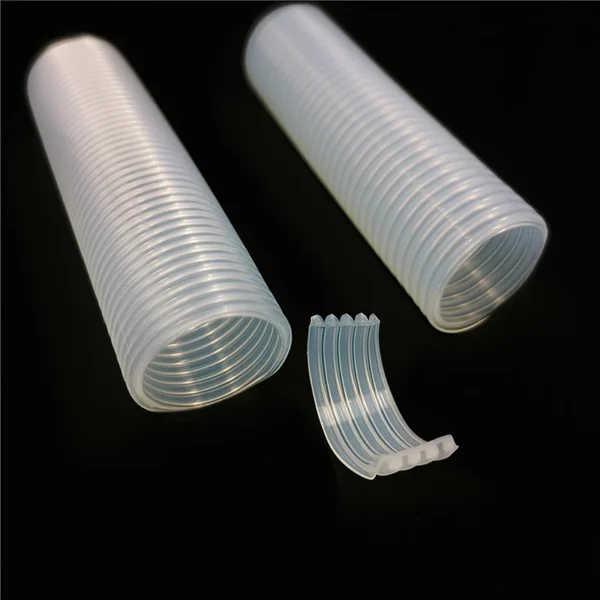
خرطوم PTFE مموج داخلي وخارجي مقاوم للتآكل للمختبرات
يوفر خرطوم PTFE المموج الداخلي المسطح الخارجي المقاوم للتآكل سطحًا داخليًا مستويًا لتوصيل دقيق للسوائل المخبرية، وطبقة خارجية مموجة لسهولة المناورة. يوفر هذا الأنبوب المموج الداخلي المسطح الخارجي المصنوع من PTFE مقاومة فائقة للأحماض والمذيبات في بيئات المختبرات.
يعد الأنبوب المموج الخارجي المسطح الداخلي ضروريًا لمرافق البحث، حيث يحافظ على سلامة العينة أثناء النقل.
اعتمد على أنبوب PTFE الخارجي المموج ذو الثقب الداخلي الأملس للحصول على نتائج متسقة؛ حيث يعمل تصميمه، الذي يحاكي أنبوب PTFE الخارجي المموج ذو الثقب الداخلي المسطح، على تعزيز كفاءة المختبر.
Why Work With Teflon X?
We aren’t just a warehouse pushing boxes. We are engineers.
When you send an inquiry to أليسون يي@teflonx.com, you aren’t getting a bot. You’re getting a team that understands fluid dynamics.
We test our coolant lines rigorously. We pressure test every batch. We don’t guess.
الأسئلة الشائعة
Q1: Is PTFE corrugated hose significantly more expensive than EPDM?
أ: The raw material cost is higher, yes. However, when you factor in the elimination of tooling costs for pre-formed shapes, the reduction in fittings (because you can bend the hose instead of using elbows), and the lifespan (zero replacement), the Total Cost of Ownership is often comparable or lower for complex EV applications.
Q2: Can I use standard worm-gear clamps on corrugated hoses?
أ: Please don’t. A worm gear clamp on a corrugated surface is a recipe for a leak. The clamp can crush the ridges. You need a hose with “cuffs” (smooth ends) if you want to clamp it, or use specific crimp fittings designed for corrugated walls. We provide those cuffed solutions.
Q3: Does the corrugation trap sediment or sludge?
أ: In a properly maintained cooling loop, this is rarely an issue because the flow velocity keeps particulates suspended. However, PTFE is non-stick (it’s Teflon, after all). Sludge has a very hard time adhering to the walls compared to rubber, which can get tacky over time.
Ready to Upgrade Your Thermal Management?
Look, the EV market is moving fast. You don’t have time to deal with leaks or thermal failures six months into production.
You need a cooling line solution that is flexible, tough, and chemically invincible.
Don’t leave your battery cooling to chance.
Check out our full range of خراطيم PTFE المموجة here: https://teflonx.com/product-category/ptfe-corrugated-hoses/
Or better yet, send us your CAD drawings or rough sketches. We can help you figure out the routing and bend radii.
Contact Teflon X:
- Web: https://teflonx.com/contact-us/
- بريد إلكتروني: أليسون يي@teflonx.com
Let’s build something that runs cool and lasts forever.
