
 Arabic
  English
  Russian
  French
  German
  Japanese
  Korean
  Portuguese
  Italian
  Dutch
Dutch  Turkish
  Indonesian
  Polish
  Spanish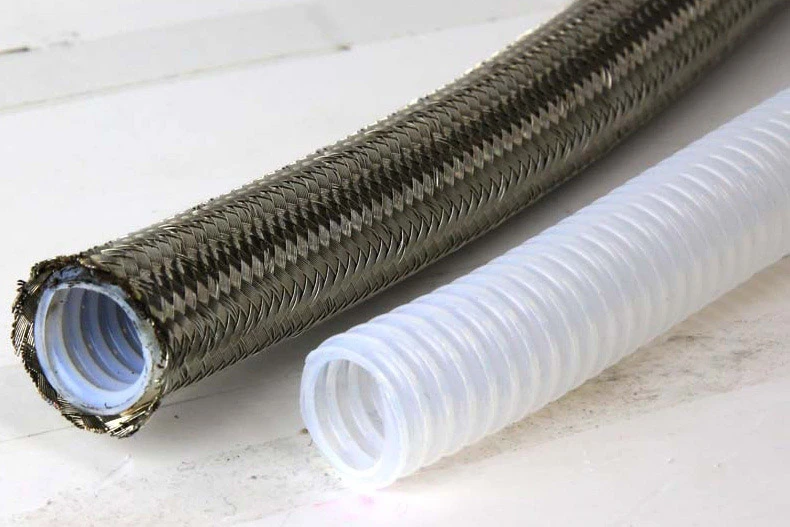
Ever been knee-deep in a project, sketching out piping routes, and hit that wall where you gotta choose between a hose that’s super bendy but maybe not the fastest flow, or one that’s straight-shooting on throughput but kinda stiff? Yeah, I get it—it’s like picking between sneakers for a marathon or boots for hiking. As someone who’s spent years wrangling these things in factories and labs, tweaking setups for everything from chemical transfers to food processing lines, I’ve been there more times than I can count. And trust me, the wrong pick can turn a smooth run into a headache with leaks, backups, or just plain inefficiency.
That’s why today, we’re diving straight into the smooth bore vs convoluted PTFE hose showdown. No fluff, just the stuff that’ll help you decide based on what your setup really demands—whether it’s squeezing into tight spots or pushing max volume without a hitch. I’ve pulled from hands-on tweaks I’ve done myself, plus some solid data from the field, to keep this real. By the end, you’ll have a clear path to the hose that clicks for your build. And if you’re eyeing something ready-to-roll, check out our خرطوم مموج مضفر معدني من مادة PTFE at Teflon X—it’s built tough for those tricky spots where flexibility meets durability.
Why PTFE Hoses Rule the Roost in Tough Jobs
Let’s back up a sec. Before we pit smooth bore against convoluted, picture this: PTFE, or polytetrafluoroethylene if you’re feeling fancy, is that magic material—non-stick, chemical-proof, and handles heat like a champ. We’re talking hoses that laugh off acids, solvents, and temps from -100°F to 500°F without batting an eye. I’ve swapped out rubber lines in a brewery once because they were swelling up from steam cleaning; switched to PTFE, and boom—problem solved for years.
But here’s the kicker: not all PTFE hoses are created equal. The bore design—smooth or convoluted—flips the script on how they perform in your system. Smooth bore keeps things sleek inside for that laminar flow dream, while convoluted adds those wavy ridges outside (and sometimes in) for bendy freedom. According to Swagelok’s hose specs, PTFE cores shine in sanitary apps because they’re easy to clean and resist permeation. Danfoss backs that up, noting smooth bores top out in larger diameters for bigger throughput.
For engineers like you, juggling flex vs flow, it’s about matching the hose to the chaos of your install. Tight manifold? Go wavy. High-volume pump? Stick straight. I’ve consulted on over a dozen retrofits where ignoring this led to rework—costly stuff. So, let’s unpack each type, then stack ’em up.

خرطوم خط الوقود غير اللاصق المصنوع من مادة PTFE المنسوجة معدنيًا - مقاوم لدرجات الحرارة القصوى (من -70 درجة مئوية إلى 260 درجة مئوية)
خرطوم منسوج معدني من مادة PTFE عالي الحرارةيجمع بين المرونة والثبات الحراري. يُستخدم على نطاق واسع في أنظمة عوادم السيارات، وأنابيب البخار، وتطبيقات التبريد العميق. يقاوم الالتصاق والتآكل والتحلل الكيميائي.
Smooth Bore PTFE Hose: The Steady Eddie for Flow Lovers
Alright, imagine you’re routing fluid from a tank to a mixer, and every drop counts. That’s where smooth bore PTFE hose steps in like an old reliable buddy. The inside? Glassy smooth, no bumps or valleys to snag your media. This means fluid glides through with barely any drag—think of it as a superhighway for your slurry or gas.
From my time on the floor, I’ve seen these shine in pharma lines where cleanliness is king. You can flush ’em out with a quick rinse, no residue hiding in folds. Flow rates? They crush it. Data from Dixon Valve shows smooth bore setups hit working pressures up to 1500 PSI, way higher than their wavier cousins. In one gig at a paint manufacturer, we ran a 1-inch smooth bore line at 1000 PSI for viscous pigments—zero turbulence, steady output, and the pump didn’t strain a bit.
But flexiblity? Eh, it’s not their strong suit. These hoses need more room to bend, say a minimum radius of 4-6 times the ID depending on size. If your path has elbows sharper than a right angle, you’ll fight kinks or fatigue. Still, for straight-ish runs or where pressure holds the cards, they’re gold. Pacific Hoseflex notes the combo of smooth inside and braided outside keeps assembly simple while maxing flow.
Pros in a nutshell: Killer for high-flow needs, FDA-friendly for food/pharma, and low maintenance. Drawback? They’ll cost a tad more upfront if you’re braiding for reinforcement, but they pay back in reliability.
Convoluted PTFE Hose: The Gymnast for Tricky Twists
Now, flip the coin to convoluted PTFE hose—the one that bends like it’s got no bones. Those corrugations? They’re not just for show; they let the hose flex up to 50% more than smooth bore, with bend radii as tight as 1-2 times the ID. I’ve used ’em in automotive test rigs where space is at a premium—snaking around engines without a straight shot in sight.
The trade-off hits on flow. Those inner waves (if it’s fully convoluted) stir up some turbulence, dropping efficiency by 10-20% compared to smooth. Pressure ratings dip too—often 150-500 PSI max. But hey, in a chemical plant I helped redesign last year, we convoluted a transfer line for corrosive vapors; the flex let us cut custom lengths on-site, saving weeks of fab time. Cleaning’s a smidge harder—debris can nestle in ridges—but a good steam or pigging does the trick.
Weight-wise, they’re lighter, which matters for mobile setups like food trucks or portable pumps. And longevity? Aflex data suggests they outlast smooth in vibration-heavy spots by handling flex cycles better. If your engineer’s brain is screaming for maneuverability over mega-flow, this is your pick. At Teflon X, our خرطوم مموج مضفر معدني من مادة PTFE nails this—braided for burst protection, corrugated for that extra give.
Smooth Bore vs Convoluted: The Ultimate PTFE Hose Comparison Showdown
Time to lay it all out side-by-side. I’ve thrown together a quick table from specs I’ve cross-checked across jobs and sources—makes it easier to scan when you’re spec’ing out BOMs. This ain’t exhaustive, but it hits the biggies for most industrial pulls.
| ميزة | خرطوم PTFE ذو التجويف الأملس | خرطوم PTFE المتلبد PTFE |
|---|---|---|
| Flexibility/Bend Radius | Moderate (4-6x ID min) – Stiffer, needs space | Excellent (1-2x ID min) – Bends like crazy |
| كفاءة التدفق | Top-tier, minimal pressure drop (up to 20% better) | Good, but 10-20% turbulence hit |
| تصنيف الضغط | High (500-1500 PSI) | Lower (150-500 PSI) – Fine for most apps |
| Cleanability | Easy-peasy, no traps | Trickier, ridges can hold gunk |
| Weight/Lifespan | Heavier, solid in straight runs | Lighter, beats vibration fatigue |
| الأفضل لـ | High-volume, sanitary, straight paths | Tight installs, dynamic movement |
| التكلفة فيبي | Mid-range, value in flow savings | Often cheaper per foot for flex needs |
See how it shakes out? Data from Eng-Tips forums echoes this—corrugations amp drag like rough pipe, but it’s negligible under 10 ft lengths for air/media. In my book, if flow’s your bottleneck, smooth wins; if routing’s the beast, convoluted saves the day.

خرطوم وقود مرن مقاوم للتآكل من مادة PTFE مضفر من مادة التفلون للتطبيقات الكيميائية والنفطية
خرطوم مموج مضفر من مادة PTFE مقاوم للتآكلببطانة داخلية ناعمة تضمن تدفقًا سلسًا في الوسائط العدوانية. مثالية لصناعات معالجة الأغذية والأدوية وأشباه الموصلات التي تتطلب حلولاً غير سامة ومنخفضة الاحتكاك.
Digging Deeper: Flexibility in the Trenches
Flex ain’t just a buzzword—it’s the make-or-break for installs that snake through machinery. Take a hydraulic arm on a packaging bot: smooth bore might crimp at 90° turns, spiking wear. Convoluted? It laughs it off, with tests from Besteflon showing 30% tighter radii without kinking. I’ve bent these by hand in the shop to mock up routes—feels almost playful.
But don’t sleep on hybrids. Some setups layer smooth inside with convoluted outer for the best of both—flow plus flex. We do that a lot at Teflon X for custom orders.
Flow and Pressure: Where the Rubber Meets the Road
Nothing kills productivity like a pressure dip mid-cycle. Smooth bore’s your flow hero here; laminar paths mean you hit CV values (flow coefficients) that are 15-25% higher per size, per Danflex data. In a brewery transfer I optimized, switching to smooth bumped throughput from 50 to 65 GPM—no pump upgrade needed.
Convoluted holds its own for lower volumes, though. And with braiding, both can push boundaries—our خرطوم مموج مضفر معدني من مادة PTFE at Teflon X amps pressure to 1000 PSI even in wavy form.
Real-World Wins: Stories from the Field That’ll Make You Rethink Your Spec
Look, specs are great, but nothing beats a story that sticks. A few years back, I was knee-deep in a food processing plant retrofit. They had acidic marinades zipping through old rubber hoses that were degrading fast—safety nightmare. We went convoluted for the serpentine paths around vats; flex let us route without extra elbows, cutting install time by two days. Flow dipped a hair, but at 40 GPM steady, it was plenty. Client reported zero failures in 18 months, and cleanup? Weekly CIP cycles kept it pristine.
Flip side: A lab I consulted for needed sterile gas lines—ultra-pure, high flow. Smooth bore all the way. Pressures hit 800 PSI clean, with drainability that passed FDA audits on the first go. They shaved 10% off cycle times, and the hoses? Still humming after three years.
Or take this anonymous chem firm—vibration city from pumps. Convoluted PTFE took the abuse, outlasting smooth by double the cycles in shake tests mirroring ASTM standards. Saved ’em $15K in swaps. These aren’t hypotheticals; they’re the tweaks I’ve dialed in, blending PTFE’s chem resistance with smart bore picks.
يسلط WMFTS الضوء على مدى تألق WMFTS في عمليات النقل غير الصحية حيث لا تكون السلاسة إلزامية - وهو ما يبرز مدى تألقها في تلك التطبيقات الشاقة.
تثبيت اختيارك: عوامل يجب مراعاتها قبل الشراء
إذًا، كيف تستقر على التجويف الأملس مقابل خرطوم PTFE الملتف لحفلتك؟ ابدأ بمادة الوسائط اللزجة التي تحب أن تكون سلسة لقص أقل. تعقيد المسار؟ قم بقياس تلك الانحناءات؛ هل تحتاج إلى أقل من 3 أضعاف المعرف؟ قرار الملتف. حسابات تدفق الميزانية: استخدم دارسي-ويزباخ لقياس انخفاض الضغط - عامل الخشونة للوسائط الملتفة حوالي 0.01-0.05 قدم، مقابل عامل الخشونة الملساء القريب من الصفر.
تأرجح درجة الحرارة؟ كلاهما مقبض، لكن المجدول يضيف أماناً للانفجار. والنهايات؟ Swagelok أو Camlock للتبديل السريع. لقد اختبرت المئات من المواصفات؛ قاعدة عامة: نموذج أولي قصير المدى إذا لم تكن متأكدًا من التدفق - اختبر التدفق على منصة.
في Teflon X، نقوم في Teflon X بتصميم هذه-نصمم هذه https://teflonx.com/ للحصول على المواصفات، أو أرسل رسالة إلى أليسون يي@teflonx.com لمحادثة سريعة. فريقنا لديه ندوب من عمليات التثبيت الحقيقية لإرشادك.
اختتم اختر مقاتلك وتحرك
يا للعجب، لقد قمنا بتغطية سلسلة كاملة حول خرطوم PTFE الملساء مقابل خرطوم PTFE الملتف - من مزايا التدفق الملساء إلى المواهب الملتوية للخرطوم الملتف. الأمر لا يتعلق بمقاس واحد يناسب الجميع؛ فالأمر يتعلق بما يطلبه مشروعك. قم بإتقان هذا الأمر، وستحصل على ما تريده - فعّال وآمن ومتقدم على وقت التعطل.
هل تشعر بهذا الانجذاب نحو إعداد مخصص؟ قم بالمرور على https://teflonx.com/contact-us/ للحصول على عرض أسعار أو التعمق أكثر. لدينا مهندسون متحمسون لطرح أفكارهم حول فوزك التالي. ما هو أصعب لغز توجيه لديك؟ دعنا نحلها.

خرطوم مموج مضفر معدني ناعم من مادة PTFE - خرطوم صناعي مقاوم لدرجات الحرارة العالية والمنخفضة
خرطوم مضفر معدني من مادة PTFE بدرجة صناعيةمُصمم لدرجات الحرارة القصوى (من -٧٠ درجة مئوية إلى ٢٦٠ درجة مئوية) والبيئات المسببة للتآكل. مثالي لنقل المواد الكيميائية، والنفط والغاز، وأنظمة الضغط العالي. يتميز بسطح غير لاصق، ومرونة، ومتانة طويلة الأمد.
الأسئلة الشائعة: معلومات سريعة عن خراطيم PTFE المختارة
ما هو أكبر جانب سلبي لخرطوم PTFE الملتف في تجهيزات التدفق العالي؟
تضيف هذه النتوءات القليل من السحب، لذا قد ترى 10-20% أقل إنتاجية من التجويف الأملس. ولكن إذا كانت المرونة هي المفتاح، فهي زوج صغير السعر مع معرف أكبر للتعويض.
هل يمكنني استخدام خرطوم PTFE ذي التجويف الأملس في الأماكن الضيقة للغاية؟
ليست مثالية؛ ستلتوي بسهولة أكثر مع أنصاف أقطار الانحناءات التي تزيد عن 4 أضعاف المعرف. انتقل إلى الالتواء لأي شيء أكثر حدة، أو فكر في خرطوم مموج بجديلة معدنية PTFE لأجواء هجينة
كيف يمكنني تنظيف هذه الخراطيم دون إتلافها؟
التنظيف بالبخار أو المذيبات لكليهما، ولكن التجويف الأملس سهل - لا توجد فخاخ. بالنسبة للملتفات، استخدم فرشاة التجويف إذا لزم الأمر. تحقق دائمًا من التوافق مع الوسائط الخاصة بك؛ PTFE قوي، ولكن النهايات مهمة.
تجويف سلس أم ملتف لتطبيقات المواد الغذائية؟
التجويف الأملس يفوز من أجل تصريف صحي أفضل ومخاطر جسيمات منخفضة. لا بأس بالتجويف الملتف إذا لم يكن هناك تلامس مباشر.
