
 German
  English
  Russian
  French
  Japanese
  Korean
  Portuguese
  Arabic
  Italian
  Dutch
Dutch  Turkish
  Indonesian
  Polish
  Spanish
If you’re an engineer scratching your head over which convoluted tubing to pick for your next project, you’re not alone. I’ve been in those meetings where we debate forever about bend radius, flow restrictions, and how the thing holds up under pressure. Convoluted PTFE tubing is awesome for tough spots – chemicals, high temps, tight spaces – but the pitch design makes a big difference. Open pitch or closed pitch? Let’s break it down without all the fluff.
Convoluted tubing, basically that wavy PTFE stuff (Teflon if you wanna call it that), gives you way more flex than straight smooth bore tubes. The waves – or convolutions – let it snake around corners without kinking. But the spacing of those waves, that’s the pitch, changes everything. Open pitch means wider spacing between the convolutions, while closed pitch packs ’em tighter.
What Exactly is Pitch Design in Convoluted Tubing?
Pitch design is just how close or far apart those helical or annular waves are on the tube. Industry folks often call tighter spacing “close convolution” or closed pitch, and wider “open pitch.”
From what I’ve seen in real setups, open pitch has fewer convolutions per inch. That makes the tube smoother inside for better flow, and it’s great for self-draining – no pockets for stuff to hang out in. Closed pitch crams more waves in, so you get insane flexibility and a super tight bend radius.
Think about it like this: open pitch is like a loosely coiled spring, easier to clean and push fluid through. Closed pitch? Tighter spring, bends like crazy but might add a bit more turbulence.
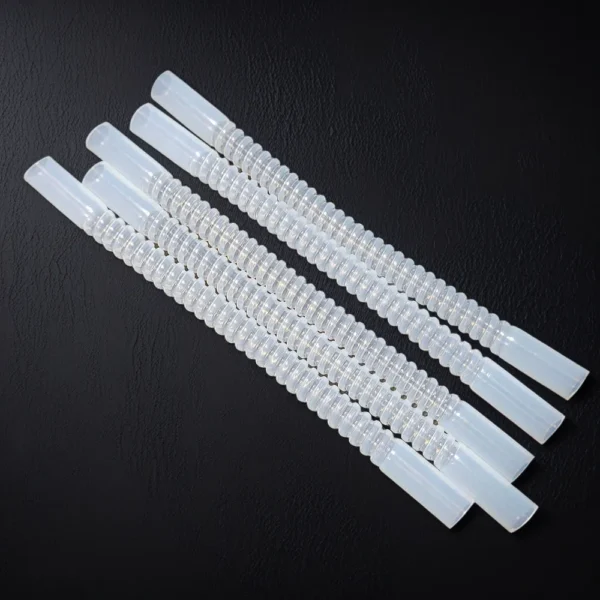
Gewellter Kraftstoffschlauch für Industriemaschinen
Der gewellte Kraftstoffschlauch aus PTFE-Wellschlauch unterstützt Industriemaschinen mit elektromagnetischer Abschirmung und thermischer Stabilität. Die Teflon-Kraftstoffschlauchstruktur widersteht extremen Temperaturen und Chemikalien. Das flexible Design gleicht Fehlausrichtungen aus und bietet geringen Wartungsaufwand und eine längere Lebensdauer.
Key Differences in Pitch Design
- Open Pitch: Wider convolutions, often helical. Better for high flow rates and easy cleaning. Common in food, pharma, and chemical transfer where you steam clean or need quick drain.
- Closed Pitch: Tighter convolutions per inch. Extreme flex, smaller bend radius. Perfect for cramped machinery or constant moving parts.
At Teflon X, we’ve supplied both types for industrial apps, and the choice usually boils down to space vs. flow needs.
Flexibility vs Flow Rate: The Big Trade-Off
This is where engineers get stuck – flexibility vs flow rate. You want it to bend sharp without crimping, but you don’t wanna choke the flow.
Closed pitch wins hands down on flexibility. More convolutions mean it can loop tighter without collapsing. For example, some closed pitch PTFE tubes hit bend radii as low as 0.5 inches on smaller sizes, while open pitch might need double that.
But flow rate? Open pitch takes the cake. Wider spacing means less interruption inside the tube, so lower pressure drop. In tests from manufacturers like Parker and Titeflex, open pitch designs support higher flow with minimal restriction, especially in larger IDs.
Here’s a quick table to compare typical performance (based on standard 1/2″ ID convoluted PTFE specs from industry data):
| Aspekt | Open Pitch | Closed Pitch |
|---|---|---|
| Bend Radius (typical) | 1.5-3 inches | 0.5-1.5 inches |
| Flexibilität | Good, but stiffer | Excellent, super tight bends |
| Durchflussmenge | Higher, smoother internal profile | Slightly restricted due to waves |
| Pressure Drop | Untere | Higher in tight bends |
| Self-Draining/Cleaning | Exzellent | Good, but more pockets |
| Crush Resistance | Solid with reinforcement | Better in dynamic flex |
Real-world numbers vary by wall thickness and braid, but open pitch often shows 10-20% better flow in straight runs per some hose catalogs.
Convoluted PTFE Specifications You Should Know
Standard convoluted PTFE meets stuff like SAE 100R14 for smooth bore, but convoluted versions go beyond. Temps up to 500°F continuous, chemical resistance to almost everything – acids, solvents, you name it.
Wall thickness matters too. Heavy wall for vacuum or high pressure (up to 3000 psig braided), low profile for bigger ID and flow.
We’ve got options like our Gewelltes Brennstoffrohr at Teflon X – it’s built tough for machinery, with great flex and flow balance. It’s more open-style pitch for industrial fuel lines, holds up great under vibration.

Hochdruck-Teflon-Geflechtschlauch – PTFE-ausgekleideter flexibler Schlauch für den industriellen Einsatz
Das PTFE-ausgekleideter flexibler Schlauch widersteht kurzzeitigen Temperaturen von 300 °C und kryogenen Bedingungen. Wellschläuche Das Design reduziert Vibrationsbelastungen und eignet sich daher für Hydrauliksysteme, Kraftstoffleitungen und den Transport geschmolzenen Salzes. Die Antihaft-Oberfläche reduziert Verschmutzungen, während transparente Optionen die Durchflussüberwachung ermöglichen.
Pros and Cons: Open Pitch Convoluted Tubing
Open pitch shines when you need cleanability and flow.
Pros:
- Easier flushing and self-draining – big in pharma and food.
- Less pressure drop, higher flow rates.
- Good for thermal cycling, won’t delaminate easy.
- Often lighter and simpler to install.
Cons:
- Less flexible, bigger bend radius.
- Might need more space in tight setups.
I remember a project where a client switched to open pitch for a chlorine transfer line – flow improved, and cleaning time dropped cuz it drained fully.
Pros and Cons: Closed Pitch Convoluted Tubing
Closed pitch if you’re routing through crowded equipment.
Pros:
- Crazy tight bends, perfect for robotics or harness protection.
- Better fatigue resistance in constant flex.
- Stronger against crush in some designs.
Cons:
- Potential higher flow restriction.
- Harder to clean thoroughly if not helical.
- Sometimes higher cost for the extra convolutions.
One anonymous case: an automotive setup with vibrating engines – closed pitch lasted longer without cracking, where smoother open ones fatigued quicker.
When to Choose Open Pitch vs Closed Pitch
If your priority is flow and cleanliness, go open. Like fuel lines, steam, or high-purity fluids.
Closed if space is tight or lots of movement – wire harnesses, robot arms, compact machinery.
A lot depends on convoluted PTFE specifications too: size, braid (stainless for pressure), conductive if static is an issue.
In flexibility vs flow rate debates, test samples if you can. We’ve sent out tons at Teflon X for folks to try.
Real Applications and Quick Stories
In industrial machinery, open pitch convoluted tubes handle fuels and chemicals smooth. One client in chem processing saw less downtime switching to open for better drain.
Closed pitch saved space in a medical device assembly – bent around components without kinking.
Unser Gewelltes Brennstoffrohr has been a go-to for similar setups, reliable flex without sacrificing flow.
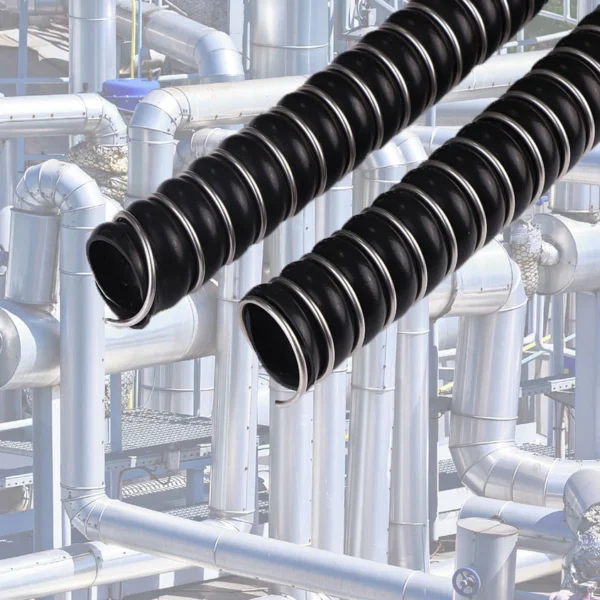
Teflon X PTFE-Schlauch – Gewelltes flexibles Rohr für Maschinen
Teflon X PTFE-Schläuche bieten unübertroffene Flexibilität und Festigkeit für den Maschinenbau, die Chemieindustrie und die digitale Hardwareindustrie. Diese flexiblen Wellrohre verfügen über eine glattere Innenwand für verbesserten Flüssigkeitsfluss und einfache CIP/SIP-Reinigung. Dieser schwarze Wellschlauch ist für Vakuum- und Hochdruckbeständigkeit verstärkt und passt sich individuellen Anforderungen an.
Häufig gestellte Fragen
What’s the main difference between open pitch and closed pitch convoluted tubing?
Open has wider spaced waves for better flow and draining, closed has tighter for max flexibility and small bends.
How does pitch design affect flexibility vs flow rate?
Tighter pitch (closed) boosts flexibility but can add flow restriction. Wider (open) keeps flow high but needs more room to bend.
Are there standard convoluted PTFE specifications for pitch?
Not super strict, but many follow AMS-T-81914 for aerospace, or SAE for general. Varies by maker – check bend radius and pressure ratings.
Which is better for high-pressure apps?
Both can be braided for pressure, but open often handles higher flow under pressure without much drop.
If you’re still weighing options, drop us a line. We at Teflon X can chat specifics, send samples, or quote custom stuff. Head over to our Kontaktseite oder E-Mail Allison.Ye@teflonx.com. Or check more on the site at teflonx.com.
We’ve helped tons of engineers nail the right choice – might save you some headaches too.
