
 French
  English
  Russian
  German
  Japanese
  Korean
  Portuguese
  Arabic
  Italian
  Dutch
Dutch  Turkish
  Indonesian
  Polish
  Spanish
Écoutez, si vous travaillez dans la R&D des énergies nouvelles, plus précisément avec les piles à combustible PEM (Membrane à Échange de Protons), vous connaissez la difficulté. Vous construisez un empilement magnifique, tout semble parfait sur le modèle CAO, puis vous passez au banc d'essai.
Chute de pression.
L'hydrogène fuit. Encore une fois.
C’est la plus petite molécule de l’univers. Elle veut s’échapper. Et si vous utilisez encore des élastomères de caoutchouc standard ou des solutions d’étanchéité bon marché, elle s’échappera. J’ai vu des projets retardés de plusieurs mois simplement parce que l’équipe d’ingénierie avait sous-estimé l’« étanchéité » de l’hydrogène gazeux.
Aujourd'hui, je vais vous expliquer pourquoi Joints en PTFE pour piles à combustible à hydrogène sont pratiquement la seule option sérieuse pour une durabilité à long terme. Nous allons aborder la chimie, les problèmes de « fluage » (et comment les résoudre), et examiner des données réelles. Pas de blabla, juste ce qui fonctionne.
L'ennemi invisible : Comprendre la perméation de l'hydrogène
Avant de parler de Téflon X, nous devons parler du gaz lui-même. L'hydrogène ($H_2$) est délicat. Il ne fuit pas seulement par les interstices ; il traverse par perméation à travers le matériau lui-même.
Imaginez un joint en caoutchouc comme une éponge. Pour l'eau, il semble solide. Pour l'hydrogène, ce caoutchouc ressemble à un grillage. Les molécules d'hydrogène se faufilent simplement à travers les chaînes polymères.
Voici les calculs mathématiques de base sur la perméation que nous utilisons pour calculer l'intégrité de l'étanchéité. Je n'utilise pas de code complexe ici afin que vous puissiez copier cela directement dans vos notes :
Flux de perméation (J) = P * (p1 – p2) / d
Où :
- J est le flux (quantité de gaz traversant).
- P est le coefficient de perméabilité du matériau.
- p1 – p2 est la différence de pression de part et d'autre du joint.
- d est l'épaisseur du joint.
Le facteur critique ici est P (Perméabilité). La plupart des élastomères ont une valeur P élevée pour l'hydrogène. Le PTFE, cependant, possède une structure moléculaire beaucoup plus dense. La liaison Carbone-Fluor est l'une des plus fortes en chimie organique, et la manière dont ces chaînes s'assemblent rend extrêmement difficile le passage de l'hydrogène.
Lorsque nous testons cela à Téflon X, nous constatons systématiquement que joints en PTFE offrent des taux de perméation qui sont de plusieurs ordres de grandeur inférieurs à ceux des silicones standards ou de l'EPDM.

Joint PTFE haute température pour vannes à boisseau sphérique | Solutions d'étanchéité en Téflon
Les joints en PTFE (joints en Téflon) offrent une résistance chimique exceptionnelle pour les systèmes d'étanchéité des vannes à boisseau sphérique. Conçus pour les fluides corrosifs à haute pression, ces joints en PTFE maintiennent leur intégrité à 260 °C. Ils sont idéaux comme joints de vannes à boisseau sphérique en PTFE dans les usines pétrochimiques. Nos feuilles de joints en PTFE permettent une découpe sur mesure pour les séparateurs à cyclone et les machines industrielles. Disponibles sous forme de bagues plates, de chemises ou de joints en Téflon 3D.
Pourquoi ne pas simplement utiliser des joints métalliques ?
Bonne question. Les joints métalliques sont excellents pour arrêter la perméation. Mais les empilements de piles à combustible, particulièrement dans les applications automobiles, vibrent. Beaucoup.
Les joints métalliques n'ont aucune souplesse. Si votre empilement se dilate et se contracte (cyclage thermique) ou vibre, un joint métallique peut perdre le contact ou endommager les plaques bipolaires délicates. Vous avez besoin de quelque chose qui peut se comprimer légèrement mais qui bloque les gaz comme un mur. C'est là que le PTFE excelle.
L'épreuve de vérité : survivre à l'environnement PEM
C'est là que les choses se corsent. À l'intérieur d'une PEM pile à combustible, il ne s'agit pas seulement d'hydrogène gazeux. C'est chaud, humide et acide.
La membrane nécessite une hydratation pour conduire les protons. Cela crée un environnement chaud et humide. De plus, la chimie impliquée peut créer des conditions légèrement acides (formation de HF en cas de dégradation de la membrane).
J'ai vu des joints NBR (Nitrile) standards devenir cassants et se fissurer après seulement 500 heures sur un banc d'essai parce qu'ils ne pouvaient pas supporter l'environnement chimique.
Le PTFE (Polytétrafluoroéthylène) est chimiquement inerte. On pourrait pratiquement le faire bouillir dans de l'acide sans que cela ne l'affecte. Dans le contexte de joints pour piles à combustible à hydrogène, cela signifie :
- Pas de lixiviation : Le joint ne se décompose pas et ne libère pas d'ions dans l'empilement. C'est crucial. Si votre joint libère des ions, vous empoisonnez le catalyseur. C'est la fin de l'efficacité de l'empilement.
- Stabilité à long terme : Il ne se dégrade pas avec le temps sous l'effet d'attaques chimiques.
Voici un tableau de comparaison rapide que j'ai préparé en me basant sur les propriétés générales des matériaux observées en laboratoire :
| Fonctionnalité | Joints en PTFE | FKM (Viton) | Silicone |
|---|---|---|---|
| Résistance à la perméation de l'H2 | Excellent | Modéré | Pauvre |
| Inertie chimique | Élevée (pH 0-14) | Haut | Modéré |
| Risque de lixiviation d'ions | Extrêmement faible | Modéré | Haut |
| Compressibilité | Faible (sauf s'il est expansé) | Haut | Haut |
| Coût | Modéré | Haut | Faible |
Vous pouvez voir pourquoi les équipes de R&D finissent par passer au PTFE. C'est le filet de sécurité contre l'empoisonnement du catalyseur.
La controverse sur le « fluage » : Gérer l'écoulement à froid
Pour être honnête, le PTFE vierge ordinaire présente un défaut. Il flue.
Si vous le serrez sous une charge élevée, le matériau s'éloigne de la pression avec le temps. C'est ce qu'on appelle l'« écoulement à froid » ou le « fluage ». Dans une pile à combustible, si votre joint flue, vous perdez la charge du boulon. Si vous perdez la charge du boulon, vous avez des fuites.
C'est pourquoi certains ingénieurs craignent le PTFE. Ils l'ont essayé une fois en 1995, il y a eu une fuite au bout d'une semaine, et ils l'ont définitivement abandonné.
Mais la technologie a évolué.
Voici le PTFE expansé (ePTFE) et les nuances chargées
À Téflon X, nous recommandons rarement le PTFE vierge pur et tranché pour les empilements de piles à combustible à haute compression. À la place, nous utilisons des versions modifiées.
PTFE expansé (ePTFE) change la donne. En étirant le matériau de manière contrôlée pendant la fabrication, nous créons une structure fibreuse multidirectionnelle.
- C'est souple : Il épouse la forme des plaques bipolaires (qui peuvent ne pas être parfaitement planes).
- Il cesse de fluer : La structure se verrouille en place.
- L'étanchéité est assurée avec moins de force : Il n'est pas nécessaire de serrer les boulons jusqu'à la rupture.
Si vous recherchez des spécifications de produits précises à ce sujet, consultez notre catégorie de joints en PTFE. Nous proposons des qualités spécifiquement conçues pour résister au fluage tout en maintenant cette barrière critique à l'hydrogène.
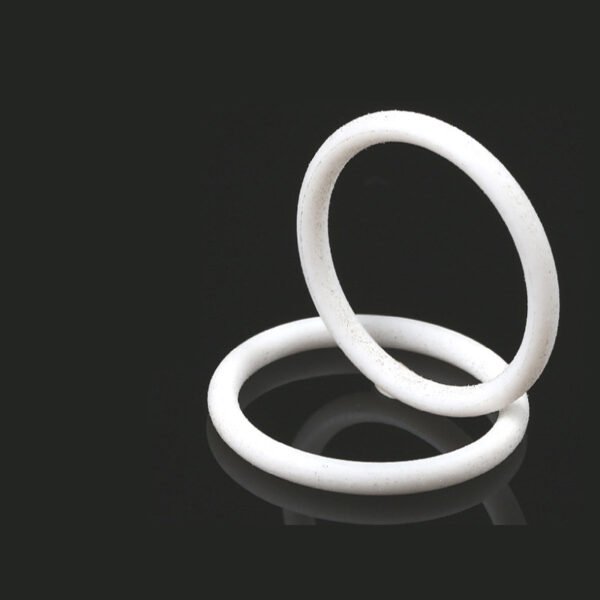
Joint PTFE haute température et joint torique en Téflon | Joint PTFE pour une résistance chimique
Le joint en PTFE haute température et le joint torique en Téflon offrent une excellente étanchéité à des températures extrêmes et en présence de produits chimiques agressifs. Ils résistent à la corrosion et offrent une longue durée de vie. Ils sont parfaits pour les industries chimiques, pharmaceutiques et agroalimentaires nécessitant des joints sûrs et propres.
Étude de cas : Le projet de pile à combustible de 50 kW
Laissez-moi vous parler d'un projet sur lequel nous avons travaillé l'année dernière. Je ne nommerai pas le client, mais il s'agit d'un acteur de taille moyenne sur le marché des drones à hydrogène.
Le problème :
Ils construisaient une pile de 50 kW pour un drone de transport de charges lourdes. Ils utilisaient des joints en FKM (fluoroélastomère). Les joints fonctionnaient correctement au banc d'essai, mais lors des tests en vol, l'efficacité de la pile diminuait.
Nous avons analysé les MEA (assemblages membrane-électrodes) usagés et avons trouvé des traces de contaminants. Le FKM présentait un léger relargage lors du fonctionnement à haute température (80 °C), et les vibrations provoquaient des micro-fuites.
La solution :
Nous les avons remplacés par un Téflon X joint en ePTFE découpé sur mesure avec une charge spécifique pour améliorer la conductivité thermique.
Le résultat :
- Contamination : Éliminée. Aucune trace de dégradation des joints après 1 000 heures.
- Efficacité : Stabilisée.
- Maintenance : Ils ont en fait prolongé leur intervalle d'entretien car ils ne craignaient plus que les joints ne s'assèchent ou ne se fissurent.
Ce n'est pas de la magie ; il s'agit simplement d'adapter le bon matériau à la physique de l'application.
Conseils pratiques : Concevoir votre joint
Si vous concevez la rainure pour un joint pour pile à combustible à hydrogène, voici quelques conseils issus du terrain.
1. L'état de surface est primordial
L'hydrogène ne pardonne pas. Si votre plaque bipolaire présente une rayure sur la surface d'étanchéité, l'hydrogène la trouvera.
Avec l'ePTFE, vous bénéficiez d'une certaine tolérance car le matériau s'adapte aux imperfections. Cependant, visez un état de surface supérieur à Ra 3,2 micromètres (environ 125 micro-pouces).
2. Ne serrez pas excessivement
Je vois cela tout le temps. Des techniciens avec de grosses clés pensant que « plus c'est serré, mieux c'est ».
Avec le PTFE, une fois la contrainte d'assise minimale atteinte, serrer davantage n'aide pas beaucoup et risque de déformer vos plaques. Utilisez une clé dynamométrique. S'il vous plaît.
3. Calcul de la contrainte d'assise
Vous devez atteindre la « contrainte d'assise minimale » (valeur y dans le code ASME, bien que pour les piles à combustible, nous utilisions des mesures légèrement différentes).
Pour l'ePTFE souple, cela peut descendre jusqu'à 15-20 MPa. Assurez-vous que votre système de serrage peut appliquer cette pression uniformément. Un empilement asymétrique mène à… vous l'avez deviné, des fuites.
Pourquoi Teflon X ?
Il existe de nombreux fournisseurs de joints sur le marché. Pourquoi nous choisir ?
Parce que nous ne vendons pas seulement des feuilles de plastique. Nous comprenons les perméation de l'hydrogène données. Nous savons ce qu'un pile à combustible doit posséder pour supporter 5 000 ou 10 000 heures de fonctionnement.
Notre équipe chez Téflon X travaille directement avec vos fichiers CAO pour découper des prototypes parfaitement ajustés. Nous pouvons gérer les tolérances serrées requises pour les empilements compacts.
De plus, nous sommes rapides. La R&D avance vite. Vous ne pouvez pas attendre six semaines pour un prototype de joint.

Joint torique en Téflon | Joint PTFE et étanchéité en Téflon pour usage industriel
Les joints toriques en Téflon et les joints en PTFE sont largement utilisés pour l'étanchéité industrielle. Ces solutions d'étanchéité en Téflon garantissent un fonctionnement étanche et une résistance aux températures élevées. Les joints en PTFE et en Téflon conviennent aux pompes, vannes et canalisations sensibles dans les secteurs exigeants.
FAQ : Questions courantes sur les joints en PTFE pour piles à combustible à hydrogène
Q1 : Les joints en PTFE peuvent-ils supporter la température des piles à combustible PEM à haute température ?
UN: Absolument. Le PTFE est stable jusqu'à 260 °C (500 °F). La plupart des piles HT-PEM fonctionnent entre 160 °C et 180 °C environ. Le PTFE supporte cela aisément sans se dégrader, contrairement à de nombreux élastomères qui commencent à se détériorer à ces températures.
Q2 : L'ePTFE est-il réutilisable si je démonte l'empilement ?
UN: En général, non. Une fois que l'ePTFE est comprimé, il épouse la forme de la surface et perd définitivement une partie de son épaisseur. Si vous ouvrez l'assemblage pour maintenance, vous devriez toujours remplacer le joints en PTFE pour garantir une étanchéité fiable. C'est une précaution peu coûteuse, n'est-ce pas ?
Q3 : Comment le PTFE se compare-t-il aux joints en graphite pour l'hydrogène ?
UN: Le graphite résiste bien aux hautes températures, mais il est fragile et conducteur. Dans une pile à combustible, le joint doit souvent être un isolant électrique pour éviter les courts-circuits entre les plaques. Le PTFE est un excellent isolant électrique. Le graphite nécessite des étapes d'isolation supplémentaires, ce qui complexifie la conception.
Prêt à stopper les fuites ?
Écoutez, construire une pile à combustible est déjà assez difficile sans avoir à s'inquiéter de la défaillance de vos joints. Vous avez besoin d'un partenaire qui maîtrise la science et peut livrer les composants.
Si vous en avez assez des chutes de pression et souhaitez discuter de la manière dont Téflon X peut sécuriser votre pile, discutons-en.
Vous pouvez consulter notre gamme de solutions sur notre site web : https://teflonx.com/
Ou, si vous avez un plan spécifique ou un casse-tête technique à résoudre immédiatement, envoyez un e-mail directement à Allison.Ye@teflonx.com. Allison est notre responsable sur ces projets et elle maîtrise parfaitement son sujet.
Ne laissez pas un joint à $5 gâcher un prototype à $50,000. Contactez-nous dès aujourd'hui.
Contactez-nous dès maintenant pour obtenir un devis
