
 English
  Russian
  French
  German
  Japanese
  Korean
  Portuguese
  Arabic
  Italian
  Dutch
Dutch  Turkish
  Indonesian
  Polish
  Spanish
If you’ve ever designed boards for AI chips or worked on server racks, you know the headache—those things run hot, like really hot, and you gotta keep ’em insulated without turning everything into a meltdown. That’s where high-performance PTFE films come into play. They’re not some fancy buzzword material; they’re legit game-changers for balancing insulation and heat in modern AI hardware.
I’ve seen it firsthand over the years working with electronic engineers on tough projects. AI processors push crazy power levels, and without the right materials, you’re fighting fires—literally, in terms of thermal runaway risks. PTFE films handle that mess better than most, thanks to their wild combo of low dielectric constant, insane thermal stability, and ability to stay reliable under stress.
Let’s break this down step by step, cuz I wanna share what actually works out there in the real world.
The Heat Problem in AI Hardware Nobody Can Ignore
AI isn’t just chatbots anymore—it’s massive servers crunching data 24/7. Chips like NVIDIA’s H100 or H200 series pull 700 watts or more per GPU. Rack ’em up in a data center, and you’re looking at power densities that have doubled in just a couple years, hitting 17 kW per rack on average now, with some setups pushing way higher.
Cooling eats up 30-40% of a data center’s electricity these days. And with AI workloads exploding, poor thermal management means throttled performance, shorter component life, or outright failures. Engineers are scrambling for ways to dissipate heat while keeping electrical insulation solid—cuz you don’t want shorts in high-voltage setups.
Traditional air cooling struggles here. Lots of places are shifting to liquid cooling, but even then, you need materials that won’t break down at high temps or interfere with signals.
Why Dielectric Materials Matter So Much in AI Server Cooling
In AI servers, dielectric materials sit between conductors, preventing shorts while letting signals fly fast and clean. But with all that heat, they also gotta handle thermal stress without warping or losing properties.
Most dielectrics either conduct heat okay but have high dielectric constants (messing up high-frequency signals), or they’re great insulators but trap heat like a blanket. AI hardware needs both: low signal loss for fast computing and enough thermal paths to avoid hotspots.
That’s the balance electronic engineers chase—insulation for safety and reliability, plus heat management to keep chips at peak.

Low-Friction Skived Teflon Film for Aerospace & Automotive Components
Skived Teflon Film excels in aerospace and automotive applications with its lightweight design and heat resistance up to 260°C[5]. The low friction surface reduces wear in fuel systems and engine components, while dielectric properties enhance performance in high-voltage environments.
Applications: Insulating films for capacitors, circuit boards, and conveyor belts.
What Makes PTFE Film Stand Out as a Dielectric Material
PTFE film—yeah, the stuff Teflon’s made from—has a dielectric constant around 2.0 to 2.1. That’s super low and stays stable across frequencies and temps. Compare that to FR-4 boards at 4.0-4.5, and you see why PTFE cuts signal loss big time in high-speed AI setups.
Thermal conductivity on pure PTFE is low, about 0.25-0.35 W/m·K, so it acts more like an insulator. But it shines in thermal stability—handles continuous ops up to 260°C, with short bursts way higher. No melting or degrading when your AI chip’s throwing off 700W+.
Plus, it’s chemically inert, hydrophobic, and has tiny dissipation factors (like 0.0002 or less). Moisture? Doesn’t absorb it. Chemicals from coolants? Doesn’t care.
For AI server cooling, thin PTFE films layer into PCBs, flexible circuits, or even as barriers in immersion cooling setups. They let you pack components tighter without worrying about electrical breakdowns.
High-Performance Versions Take It Further
Plain PTFE is great, but high-performance PTFE films—often filled with stuff like hBN, glass, or ceramics—bump thermal conductivity up. Some composites hit 0.7-1.0 W/m·K or more, while keeping dielectric constant low (still around 2.1-2.3).
One study on hBN-filled PTFE showed 0.722 W/m·K at 30 vol% filler, with degradation starting at 527°C. Another with hybrid fillers got to 1.04 W/m·K—four times pure PTFE.
These aren’t lab dreams; they’re used in real high-frequency boards for 5G and now AI data centers.
Here’s a quick table comparing common dielectric materials for electronics:
| Material | Dielectric Constant | Thermal Conductivity (W/m·K) | Max Operating Temp (°C) | Key Notes |
|---|---|---|---|---|
| Pure PTFE | 2.0-2.1 | 0.25-0.35 | 260 | Excellent stability, low loss |
| hBN-Filled PTFE | ~2.2-2.5 | 0.7-1.0+ | 500+ | Better heat transfer, still low Dk |
| FR-4 (standard PCB) | 4.0-4.5 | 0.3-0.8 | 130-170 | Cheaper, but higher signal loss |
| Ceramic-Filled Hydrocarbon | 3.0-3.5 | 0.5-1.5 | 200+ | Good for RF, but more brittle |
(Data pulled from sources like Thermtest measurements and composite studies—pure PTFE clocks in at 0.304 W/m·K in some tests.)
Real-World Applications in AI Hardware Thermal Management
Picture a dense AI server rack: GPUs stacked close, power cables everywhere, maybe liquid coolant looping through. PTFE films go into multilayer PCBs as core layers, keeping signals clean at high frequencies while resisting heat from nearby chips.
In flexible interconnects, thin PTFE films bend without cracking, perfect for compact designs. Or as thermal interface barriers—protecting sensitive parts without blocking all heat flow.
One project I recall (keeping it anonymous, client stuff): A team building AI accelerators was hitting insulation failures above 150°C. Swapped in high-performance PTFE films for dielectric layers, and temps stabilized, no more breakdowns even at full load. Extended hardware life by months in testing.
Another case—data center folks using PTFE-based composites in heat spreaders. Cut hotspot temps by 20-30°C compared to older materials, letting them run higher clocks without throttling.
These aren’t rare; with AI power jumping—some forecasts say chips hitting 2000W+ soon—materials like this are becoming must-haves.
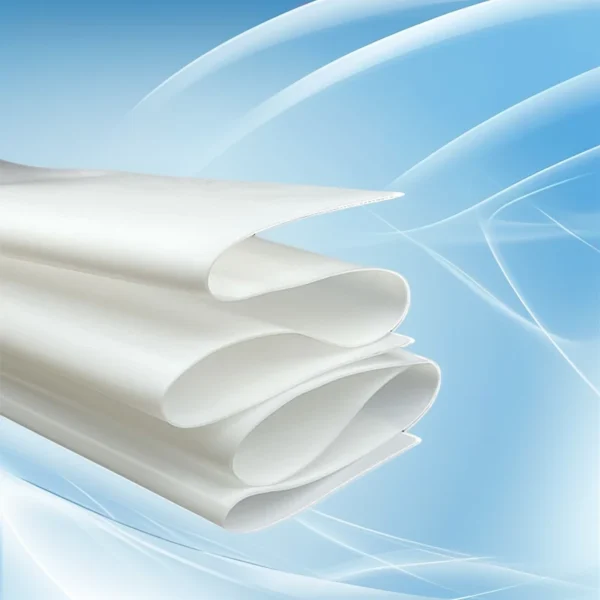
Medical-Grade Skived PTFE Film for Sterile Filtration & Implant Coatings
Medical-grade Skived PTFE Film combines biocompatibility and microporous filtration (0.02–15 μm pore size), meeting stringent pharmaceutical standards. The non-toxic material is used in drug delivery systems and implant coatings, ensuring chemical inertness and thermal stability under sterilization.
Key Features: UV-resistant, FDA-compliant, and adaptable to rapid thermal cycling.
Balancing Insulation and Heat Dissipation—The Engineer’s Tightrope
You want dielectric strength high (PTFE often exceeds 30 kV/mm in thin films) to prevent arcs in high-power AI boards. But you also need some heat path out.
High-performance PTFE films nail this by staying thin—microns thick—so heat moves through the stack easier, while providing that rock-solid insulation. In immersion cooling, they resist fluids and maintain properties.
No more choosing between “safe but hot” or “cool but risky.”
How to Pick the Right PTFE Film for Your AI Project
Depends on your setup. Need max insulation? Go virgin PTFE. Pushing heat density? Look at filled versions.
Thickness matters—thinner for flex, thicker for rigidity. Etched surfaces help bonding if you’re laminating.
At Teflon X, we’ve got options tuned for electronics, including films with those enhanced properties. Check our site for specs.
Getting Started with PTFE Films in Your Designs
If you’re tired of thermal headaches slowing your AI builds, it’s worth testing PTFE. Small changes in materials can unlock denser packs, better efficiency, lower failure rates.
We’ve helped engineers spec this stuff for server projects—happy to chat about yours.
Ready to cool things down properly? Head over to Teflon X and browse our PTFE lineup, like these chemical-resistant Teflon gasket sheets that share similar toughness (great starting point for related apps). For custom films or quotes, hit up our contact page or email Allison.Ye@teflonx.com direct. We’ll sort out samples or advice quick.
Don’t let heat hold your hardware back—let’s fix it.
Frequently Asked Questions About High-Performance PTFE Films in AI Thermal Management
What’s the deal with thermal conductivity in PTFE films— isn’t it supposed to be low?
Yeah, pure PTFE is around 0.25-0.35 W/m·K, which is low, so it insulates well. But that’s often a plus for dielectric layers—you don’t want short-circuiting heat paths. High-performance filled ones bump it up to 1 W/m·K or more without killing the low dielectric constant. Perfect for AI where you need controlled heat flow.
How do PTFE films actually help with AI server cooling?
They let you design tighter, higher-power boards without insulation failing under heat. Stable up to crazy temps, low signal loss for fast AI comms, and compatible with liquid or air setups. Basically, keeps everything running cool and reliable when chips are screaming hot.
Are high-performance PTFE films worth the cost over cheaper dielectrics?
For basic stuff, maybe not. But in AI hardware? Absolutely—fewer failures, longer life, better performance. I’ve seen projects where switching saved big on downtime and rework. Plus, as power densities climb, cheaper materials just can’t keep up.
Can PTFE films handle immersion cooling fluids?
Most yes—super chemically resistant. No swelling or degradation from common coolants. Just check specs for your exact fluid.
What’s a typical thickness for these in electronics?
Anywhere from 25 microns up to a few hundred, depending on voltage needs and flex. Thinner for high-density AI boards.
