
 Japanese
  English
  Russian
  French
  German
  Korean
  Portuguese
  Arabic
  Italian
  Dutch
Dutch  Turkish
  Indonesian
  Polish
  Spanish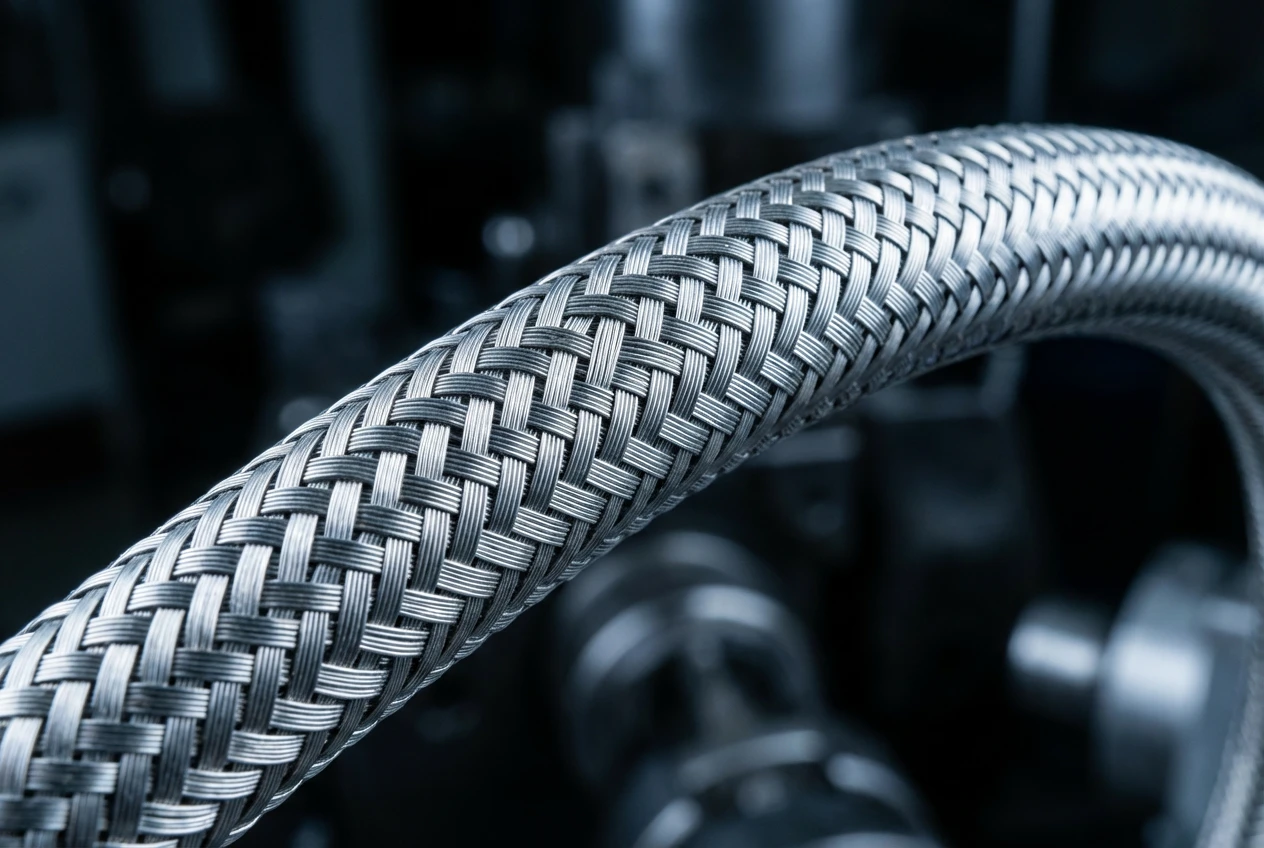
When a driver slams on the brakes at 70 mph because a deer decided to cross the highway, they aren’t thinking about the chemical composition of the hose transfering hydraulic fluid to their calipers.
But you do. As an aftermarket brand or performance shop owner, you obsess over this stuff. And you should.
I’ve been in the fluid transfer game for years, and if there’s one debate that never seems to die, it’s the battle between traditional rubber hoses and the PTFE brake hose. If you are sourcing parts for a performance line or looking to reduce warranty claims on your private label products, understanding the gritty engineering details between these two is non-negotiable.
We aren’t just talking about “feeling” a difference. We are talking about physics, volumetric expansion, and strict DOT compliance.
The Problem with Traditional Rubber (It’s Not Just Age)
Most OEM cars roll off the lot with EPDM (Ethylene Propylene Diene Monomer) rubber hoses. They are cheap, they work fine for Grandma’s grocery getter, and manufacturers love them because they keep costs down.
But here is the issue: Rubber is a sponge. Not literally, but functionally.
Over time, rubber suffers from permeation. Moisture from the atmosphere seeps through the rubber wall and gets into the brake fluid. Since DOT 3 and DOT 4 fluids are hygroscopic (they love water), this is a recipe for disaster. Water lowers the boiling point of your fluid.
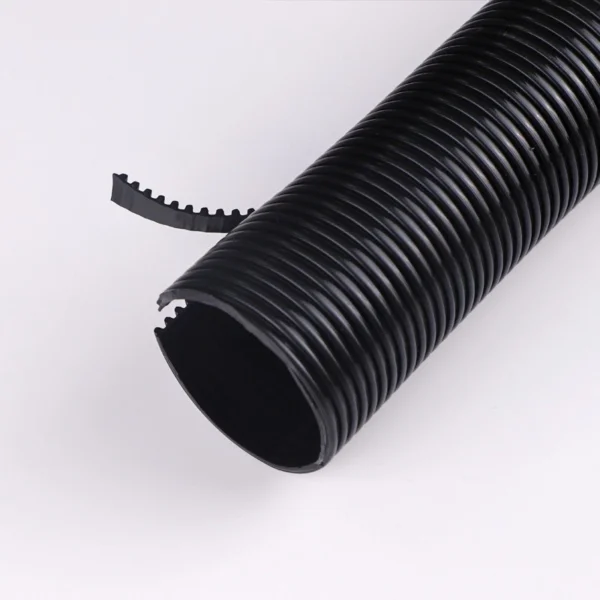
食品加工用フレキシブルPTFE内外フラットコルゲートチューブ
当社のフレキシブルPTFEインナーフラットアウターコルゲートチューブは、洗浄しやすい滑らかな内層と、食品加工ラインにおける柔軟性を高める波形外層を備えています。この内径平滑、外径波形PTFEチューブは、FDA規格に準拠した、食品および飲料の無毒な輸送を保証します。
粘性物質の搬送に最適な PTFE ベローズ チューブ バリアントは、風味の混入を防ぎ、頻繁な洗浄にも耐えます。
この内部フラット外部波形波形パイプをセットアップに組み込んでください。その PTFE 内部フラット外部波形チューブ構造により、衛生と耐久性が保証されます。
The “Mushy Pedal” Physics
When you press the brake pedal, you are generating hydraulic pressure. Let’s look at a simplified formula for Pressure (P):
P = F / A
どこでだ:
- P is Pressure
- F is the Force applied
- あ is the Area
In a perfect world, all that pressure moves the caliper piston. But rubber hoses have a high volumetric expansion rate. When the pressure spikes, the hose walls balloon out.
Instead of that force squeezing the rotor, it’s wasted expanding the hose. This is what drivers call “brake fade” or a “spongy pedal.” It gets worse as the rubber ages and loses its structural integrity. I’ve seen 5-year-old rubber hoses that look fine on the outside but swell like a balloon animal under hard braking.
Why PTFE is the Superior Choice for Performance
So, why are we seeing a massive shift toward テフロンX style solutions in the aftermarket? It comes down to the molecule.
PTFE (Polytetrafluoroethylene) is basically the superhero of materials. The Carbon-Fluorine bond is one of the strongest in organic chemistry. It doesn’t react with brake fluid. It doesn’t rot from ozone exposure. And most importantly for your customers, it doesn’t stretch.
The Stainless Steel Braided Factor
A raw PTFE tube is great, but it needs armor. That’s where the stainless steel braided hose design comes in. We wrap the PTFE core in 304 or 316 stainless steel wire.
This does two things:
- Physical Protection: It stops road debris from nicking the line.
- Pressure Containment: It mechanically prevents the PTFE from expanding.
When you swap rubber for a braided PTFE line, you are essentially reducing the volumetric expansion to near zero. The driver feels immediate feedback. It’s not just marketing fluff; it is measurable fluid dynamics.
Deep Dive: DOT Compliance and Safety Standards
If you are selling parts in the US, you can’t ignore the Department of Transportation (DOT). Specifically, FMVSS 106.
I talk to a lot of startup brands who think they can just buy generic hose off Alibaba, crimp some fittings, and sell it. Do not do this.
DOT compliance isn’t a sticker you buy; it’s a rigorous testing protocol. To be street legal, a brake hose assembly must pass FMVSS 106 standards, which include:
- Whip Test: The hose is flexed and vibrated for roughly 35 hours while pressurized. It mimics years of suspension travel.
- Burst Strength: The hose must withstand pressures well above 4,000 psi (though we test much higher at テフロンX).
- 抗張力: You have to pull the fitting away from the hose with significant force to ensure the crimp holds.
Rubber hoses struggle to maintain these standards as they age. A PTFE hose, assuming the crimp is good, will pass these tests on day 1 and day 1,000 with almost identical results. That consistency is what you are selling to your B2B clients.
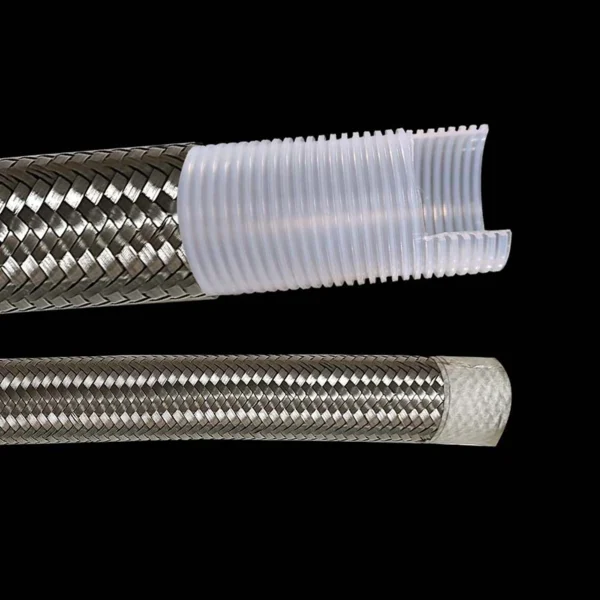
PTFEベローズチューブ:内側はフラット、外側は波形、医薬品用途
内側が平らで外側が波形のPTFEベローズチューブは、医薬品用途において衛生的で汚染のない性能を実現します。この内径平滑、外径波形PTFEチューブは、強力な消毒剤への耐性を持ちながら、スムーズな製品移送を可能にします。
無菌環境に適した内部フラット外部波形波形パイプは、医薬品製造プロセスにおける純度を維持し、強度を損なうことなく柔軟性を提供します。
効率を高めるには、この PTFE インナー フラット アウター コルゲート チューブを選択してください。PTFE インナー フラット アウター コルゲート パイプに似たベローズのような構造により、厳格な業界標準への準拠が保証されます。
Technical Comparison: PTFE vs. Rubber
I put together this table to break down the differences. If you are building a pitch deck for a distributor, feel free to use this data.
| 特徴 | EPDM Rubber Hose | PTFE (Teflon) Braided Hose |
|---|---|---|
| Core Material | Ethylene Propylene Diene Monomer | Polytetrafluoroethylene |
| 拡大率 | High (Increases with age) | Negligible (Constant) |
| Fluid Compatibility | DOT 3, 4, 5.1 | All fluids (including DOT 5 Silicone) |
| 温度範囲 | -40°F to +250°F | -94°F to +500°F |
| 耐摩耗性 | Low (requires rubber bumpers) | High (Stainless braid protection) |
| 一般的な寿命 | 4-6 Years | Lifetime of the vehicle |
| 料金 | 低い | 中程度から高い |
You see the temperature range? That matters. If your customer is tracking their car, rotor temps can soar, radiating heat to the lines. Rubber gets soft when hot. PTFE doesn’t care.
Case Study: The “Soft Pedal” Fix
Let me share a quick story (names changed to protect the client). We had a performance shop, let’s call them “Apex Tuners,” reach out to us. They were building a line of big brake kits for the Subaru WRX platform.
They had amazing calipers and rotors, but they were packaging them with standard rubber lines to save $15 per kit.
The feedback was terrible. Customers complained that despite the expensive calipers, the pedal felt “mushy.”
Apex Tuners came to テフロンX. We engineered a custom PTFE brake hose kit with a smoke-black PVC cover (to protect the braid and look cool).
結果
- Pedal firmness increased by roughly 30% (subjective driver feedback).
- Warranty claims regarding leaks dropped to zero over 12 months.
- They were able to market the “Stainless Steel Lines Included” as a premium upsell feature.
It turns out, the hose was the weakest link in their $2,000 braking system. Don’t let a cheap hose ruin your premium product.
Manufacturing: What Goes Into a Teflon X Hose?
We don’t just buy hose; we engineer solutions. Whether it is brake line durability or industrial applications, the process matters.
At our facility, we focus on:
- バージンPTFE: We don’t use regrind. Regrind introduces impurities that can lead to microscopic stress cracks.
- Controlled Braiding: The tension on the stainless steel strands must be uniform. If one strand is loose, it creates a weak point where the inner liner can herniate.
- 100% Pressure Testing: Every single assembly that leaves the line gets pressure tested. No sampling. 100%.
While we are discussing different hose types, it is worth noting that we also specialize in other fluid transfer solutions. For applications requiring extreme flexibility (like fuel return lines or complex routing), you might look at our PTFEコルゲートホース. While not typically used for high-pressure braking, understanding the difference between smooth bore (for brakes) and corrugated (for flexibility) shows you know your stuff.
The Economics of Durability
Sure, PTFE costs more upfront. But calculate the TCO (Total Cost of Ownership).
If a rubber hose fails, you have towing costs, repair labor, brake fluid flushes, and potential bodywork damage. A PTFE hose is a “install it and forget it” component. For your brand, this means brand loyalty. Customers trust parts that don’t fail.
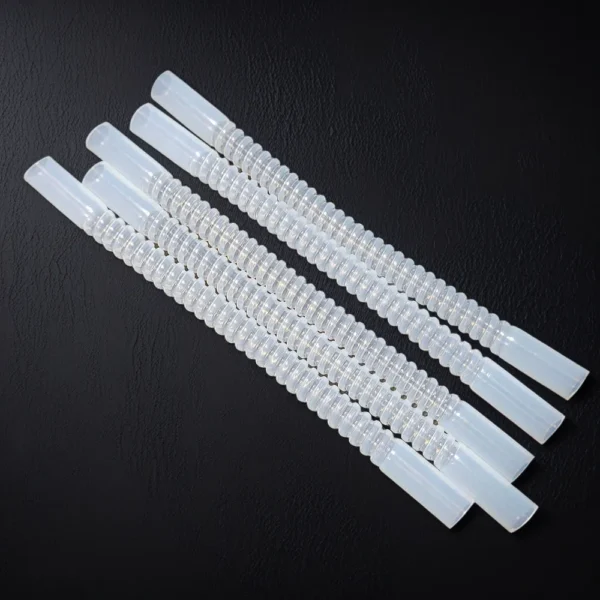
産業機械用コルゲート燃料チューブ
PTFEコルゲート燃料ホースから作られたコルゲート燃料チューブは、EMIシールドと熱安定性を備え、産業機械をサポートします。テフロン製燃料ホース構造は、極端な温度や化学物質にも耐性があります。柔軟な設計により、位置ずれを補正し、メンテナンスの手間を軽減し、長寿命を実現します。
How to Choose the Right OEM Partner
If you are looking for a manufacturer, ask them these questions:
- “Can you provide the DOT registration number?”
- “What is the burst pressure rating of your -3 AN line?”
- “Do you use 304 or 316 stainless?” (304 is fine for most, 316 is better for marine/salted roads).
If they hesitate, run.
At Teflon X, we are open about our specs. We know that brake line durability isn’t just about passing a test; it’s about keeping a family safe in their minivan or a racer safe at 150 mph.
FAQ: Common Questions About PTFE Brake Lines
Q: Are PTFE brake hoses street legal?
A: Yes, provided they are manufactured to FMVSS 106 standards and assembled by a registered manufacturer. A generic DIY line made in a garage is technically not street legal for highway use. Always look for the DOT stamp on the fitting or hose.
Q: Do stainless steel braided hoses need to be replaced?
A: Unlike rubber, which has a shelf life, PTFE doesn’t degrade from age. However, you should inspect them regularly. If the stainless braid is frayed from rubbing against a shock absorber, the hose is compromised and must be replaced immediately.
Q: Will switching to PTFE make my brakes stop the car faster?
A: technically, the friction stops the car. However, PTFE lines reduce the reaction time. By eliminating hose expansion, the time between your foot hitting the pedal and the caliper clamping the rotor is reduced. This can shave precious feet off your stopping distance during panic braking.

高圧テフロン編組ホース - 工業用PTFEライニングフレキシブルホース
これ PTFEライニングフレキシブルホース 300℃の短期暴露および極低温条件に耐えます。 複雑なホース 振動ストレスを軽減する設計により、油圧システム、燃料ライン、溶融塩輸送などに最適です。非粘着性表面により汚れが付着しにくく、半透明オプションにより流量監視も可能です。
Ready to Upgrade Your Product Line?
Look, the automotive market is crowded. To stand out, you need to offer quality that people can feel the second they touch the pedal.
If you are tired of dealing with inconsistent rubber hoses or want to launch a private label stainless steel braided hose line that meets strict DOT compliance, we need to talk.
Don’t settle for “good enough” when safety is on the line.
Contact Teflon X today. Let’s engineer a solution that fits your brand and your budget.
- Email me directly: アリソン・イェ@teflonx.com
- Get a Quote: お問い合わせ
