
 Korean
  English
  Russian
  French
  German
  Japanese
  Portuguese
  Arabic
  Italian
  Dutch
Dutch  Turkish
  Indonesian
  Polish
  Spanish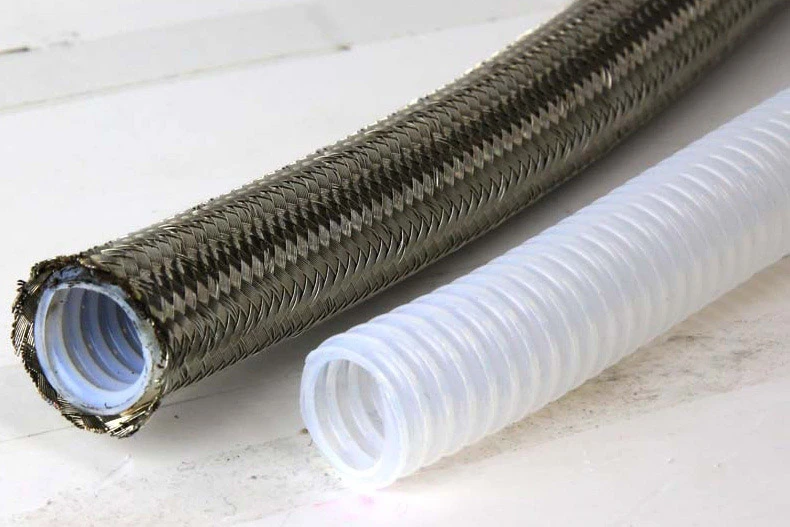
Ever been knee-deep in a project, sketching out piping routes, and hit that wall where you gotta choose between a hose that’s super bendy but maybe not the fastest flow, or one that’s straight-shooting on throughput but kinda stiff? Yeah, I get it—it’s like picking between sneakers for a marathon or boots for hiking. As someone who’s spent years wrangling these things in factories and labs, tweaking setups for everything from chemical transfers to food processing lines, I’ve been there more times than I can count. And trust me, the wrong pick can turn a smooth run into a headache with leaks, backups, or just plain inefficiency.
That’s why today, we’re diving straight into the smooth bore vs convoluted PTFE hose showdown. No fluff, just the stuff that’ll help you decide based on what your setup really demands—whether it’s squeezing into tight spots or pushing max volume without a hitch. I’ve pulled from hands-on tweaks I’ve done myself, plus some solid data from the field, to keep this real. By the end, you’ll have a clear path to the hose that clicks for your build. And if you’re eyeing something ready-to-roll, check out our PTFE 금속 편조 골판지 호스 at Teflon X—it’s built tough for those tricky spots where flexibility meets durability.
Why PTFE Hoses Rule the Roost in Tough Jobs
Let’s back up a sec. Before we pit smooth bore against convoluted, picture this: PTFE, or polytetrafluoroethylene if you’re feeling fancy, is that magic material—non-stick, chemical-proof, and handles heat like a champ. We’re talking hoses that laugh off acids, solvents, and temps from -100°F to 500°F without batting an eye. I’ve swapped out rubber lines in a brewery once because they were swelling up from steam cleaning; switched to PTFE, and boom—problem solved for years.
But here’s the kicker: not all PTFE hoses are created equal. The bore design—smooth or convoluted—flips the script on how they perform in your system. Smooth bore keeps things sleek inside for that laminar flow dream, while convoluted adds those wavy ridges outside (and sometimes in) for bendy freedom. According to Swagelok’s hose specs, PTFE cores shine in sanitary apps because they’re easy to clean and resist permeation. Danfoss backs that up, noting smooth bores top out in larger diameters for bigger throughput.
For engineers like you, juggling flex vs flow, it’s about matching the hose to the chaos of your install. Tight manifold? Go wavy. High-volume pump? Stick straight. I’ve consulted on over a dozen retrofits where ignoring this led to rework—costly stuff. So, let’s unpack each type, then stack ’em up.

논스틱 금속 직조 PTFE 연료 라인 호스 - 극한 온도 저항성(-70°C ~ 260°C)
고온 PTFE 금속 직조 호스유연성과 열 안정성을 겸비했습니다. 자동차 배기 시스템, 증기 라인, 극저온 분야에 널리 사용됩니다. 접착력, 마모 및 화학적 분해에 강합니다.
Smooth Bore PTFE Hose: The Steady Eddie for Flow Lovers
Alright, imagine you’re routing fluid from a tank to a mixer, and every drop counts. That’s where smooth bore PTFE hose steps in like an old reliable buddy. The inside? Glassy smooth, no bumps or valleys to snag your media. This means fluid glides through with barely any drag—think of it as a superhighway for your slurry or gas.
From my time on the floor, I’ve seen these shine in pharma lines where cleanliness is king. You can flush ’em out with a quick rinse, no residue hiding in folds. Flow rates? They crush it. Data from Dixon Valve shows smooth bore setups hit working pressures up to 1500 PSI, way higher than their wavier cousins. In one gig at a paint manufacturer, we ran a 1-inch smooth bore line at 1000 PSI for viscous pigments—zero turbulence, steady output, and the pump didn’t strain a bit.
But flexiblity? Eh, it’s not their strong suit. These hoses need more room to bend, say a minimum radius of 4-6 times the ID depending on size. If your path has elbows sharper than a right angle, you’ll fight kinks or fatigue. Still, for straight-ish runs or where pressure holds the cards, they’re gold. Pacific Hoseflex notes the combo of smooth inside and braided outside keeps assembly simple while maxing flow.
Pros in a nutshell: Killer for high-flow needs, FDA-friendly for food/pharma, and low maintenance. Drawback? They’ll cost a tad more upfront if you’re braiding for reinforcement, but they pay back in reliability.
Convoluted PTFE Hose: The Gymnast for Tricky Twists
Now, flip the coin to convoluted PTFE hose—the one that bends like it’s got no bones. Those corrugations? They’re not just for show; they let the hose flex up to 50% more than smooth bore, with bend radii as tight as 1-2 times the ID. I’ve used ’em in automotive test rigs where space is at a premium—snaking around engines without a straight shot in sight.
The trade-off hits on flow. Those inner waves (if it’s fully convoluted) stir up some turbulence, dropping efficiency by 10-20% compared to smooth. Pressure ratings dip too—often 150-500 PSI max. But hey, in a chemical plant I helped redesign last year, we convoluted a transfer line for corrosive vapors; the flex let us cut custom lengths on-site, saving weeks of fab time. Cleaning’s a smidge harder—debris can nestle in ridges—but a good steam or pigging does the trick.
Weight-wise, they’re lighter, which matters for mobile setups like food trucks or portable pumps. And longevity? Aflex data suggests they outlast smooth in vibration-heavy spots by handling flex cycles better. If your engineer’s brain is screaming for maneuverability over mega-flow, this is your pick. At Teflon X, our PTFE 금속 편조 골판지 호스 nails this—braided for burst protection, corrugated for that extra give.
Smooth Bore vs Convoluted: The Ultimate PTFE Hose Comparison Showdown
Time to lay it all out side-by-side. I’ve thrown together a quick table from specs I’ve cross-checked across jobs and sources—makes it easier to scan when you’re spec’ing out BOMs. This ain’t exhaustive, but it hits the biggies for most industrial pulls.
| 특징 | 부드러운 보어 PTFE 호스 | 복잡한 PTFE 호스 |
|---|---|---|
| 유연성/굽힘 반경 | Moderate (4-6x ID min) – Stiffer, needs space | 우수함(내경의 1-2배 최소) — 매우 유연하게 굽혀짐 |
| 흐름 효율 | 최상위 등급, 압력 강하 최소화(최대 20% 개선) | 양호하나, 10-20% 난류 영향 있음 |
| 압력 등급 | 고압(500-1500 PSI) | 저압(150-500 PSI) — 대부분의 용도에 적합함 |
| 세척 용이성 | 매우 간편함, 잔여물 고임 현상 없음 | 다소 까다로움, 주름 사이에 찌꺼기 낄 수 있음 |
| 무게/수명 | 더 무거움, 직선 구간에서 견고함 | 더 가벼움, 진동 피로에 강함 |
| 가장 적합한 | 대유량, 위생적, 직선 경로 | 좁은 설치 공간, 동적 움직임 |
| 비용 분위기 | 중간 범위, 유량 절감의 가치 제공 | 유연성이 필요한 경우 피트당 단가가 저렴한 경우가 많음 |
결과가 어떻게 나타나는지 보이시나요? Eng-Tips 포럼의 데이터도 이를 뒷받침합니다 — 주름은 거친 파이프처럼 항력을 높이지만, 공기나 매체의 경우 10피트 미만의 길이에서는 무시할 수 있는 수준입니다。 제 견해로는 유량이 병목 구간이라면 매끄러운 보어가 유리하고, 배관 경로가 문제라면 주름관이 해결책입니다。

화학 및 오일 응용 분야를 위한 유연한 내식성 PTFE 브레이디드 테플론 연료 호스
부식 방지 PTFE 브레이디드 골판지 호스부드러운 내부 라이너가 부식성 매체에서도 원활한 흐름을 보장합니다. 무독성, 저마찰 솔루션을 필요로 하는 식품 가공, 제약 및 반도체 산업에 적합합니다.
심층 분석: 현장에서의 유연성
유연성은 단순히 마케팅 용어가 아닙니다 — 기계 사이를 지나는 설치 작업의 성패를 좌우합니다。 포장 로봇의 유압 암을 예로 들어보겠습니다: 매끄러운 보어는 90도 회전 시 꺾일 수 있어 마모가 급증합니다。 주름관은요? Besteflon의 테스트에 따르면 꼬임 없이 30% 더 좁은 곡률 반경을 보여주며 이를 가볍게 해결합니다。 제가 작업실에서 경로 설계를 위해 직접 손으로 구부려 보았는데, 거의 장난감처럼 느껴질 정도였습니다。
하지만 하이브리드 제품도 간과하지 마세요。 일부 구성은 내부에는 매끄러운 층을, 외부에는 주름진 층을 배치하여 유량과 유연성이라는 두 마리 토끼를 모두 잡습니다。 저희 Teflon X에서는 맞춤형 주문 시 이러한 방식을 자주 사용합니다。
유량과 압력: 실전에서의 검증
공정 중간의 압력 강하만큼 생산성을 저해하는 것도 없습니다。 이 경우 매끄러운 보어가 유량의 해결사입니다; Danflex 데이터에 따르면 층류 경로는 동일 규격당 15-25% 더 높은 CV 값(유량 계수)을 실현합니다。 제가 최적화한 한 양조장 이송 공정의 경우, 매끄러운 관으로 교체한 것만으로도 펌프 업그레이드 없이 유량이 50GPM에서 65GPM으로 향상되었습니다。
Convoluted holds its own for lower volumes, though. And with braiding, both can push boundaries—our PTFE 금속 편조 골판지 호스 at Teflon X amps pressure to 1000 PSI even in wavy form.
Real-World Wins: Stories from the Field That’ll Make You Rethink Your Spec
Look, specs are great, but nothing beats a story that sticks. A few years back, I was knee-deep in a food processing plant retrofit. They had acidic marinades zipping through old rubber hoses that were degrading fast—safety nightmare. We went convoluted for the serpentine paths around vats; flex let us route without extra elbows, cutting install time by two days. Flow dipped a hair, but at 40 GPM steady, it was plenty. Client reported zero failures in 18 months, and cleanup? Weekly CIP cycles kept it pristine.
Flip side: A lab I consulted for needed sterile gas lines—ultra-pure, high flow. Smooth bore all the way. Pressures hit 800 PSI clean, with drainability that passed FDA audits on the first go. They shaved 10% off cycle times, and the hoses? Still humming after three years.
Or take this anonymous chem firm—vibration city from pumps. Convoluted PTFE took the abuse, outlasting smooth by double the cycles in shake tests mirroring ASTM standards. Saved ’em $15K in swaps. These aren’t hypotheticals; they’re the tweaks I’ve dialed in, blending PTFE’s chem resistance with smart bore picks.
WMFTS highlights how convoluted shines in non-sanitary transfers where smooth isn’t mandatory—spot on for those gritty apps.
Nailing Your Choice: Factors to Weigh Before You Buy
So, how do you land on smooth bore vs convoluted PTFE hose for your gig? Start with your media—viscous stuff loves smooth for less shear. Route complexity? Measure those bends; under 3x ID needed? Convoluted’s call. Budget flow calcs: Use Darcy-Weisbach for pressure drops—roughness factor for convoluted is about 0.01-0.05 ft, vs smooth’s near-zero.
Temp swings? Both handle, but braided adds burst safety. And ends? Swagelok or Camlock for quick swaps. I’ve spec’d hundreds; rule of thumb: Prototype a short run if unsure—test flow on a bench rig.
At Teflon X, we tailor these—hit up https://teflonx.com/ for specs, or drop a line to Allison.Ye@teflonx.com for a quick chat. Our team’s got the scars from real installs to guide you.
Wrapping It Up: Pick Your Fighter and Get Moving
Whew, we’ve covered the gamut on smooth bore vs convoluted PTFE hose—from the flow perks of smooth to the twisty talents of convoluted. It’s not one-size-fits-all; it’s about what your project’s yelling for. Nail this, and you’re golden—efficient, safe, and ahead of downtime.
Feeling that pull toward a custom setup? Swing by https://teflonx.com/contact-us/ for a quote or deeper dive. We’ve got engineers itching to brainstorm your next win. What’s your toughest routing puzzle? Let’s crack it.

소프트 PTFE 금속 브레이드 주름 호스 - 고온/저온 내성 산업용 호스
산업용 PTFE 금속 브레이디드 호스극한 온도(-70°C ~ 260°C) 및 부식성 환경에 적합하도록 설계되었습니다. 화학 물질 이송, 석유 및 가스, 고압 시스템에 이상적입니다. 논스틱 표면, 유연성 및 장기적인 내구성을 갖추고 있습니다.
FAQ: Quick Hits on PTFE Hose Picks
What’s the biggest downside to convoluted PTFE hose in high-flow setups?
저 돌기들은 약간의 저항을 추가하므로 매끄러운 내경보다 처리량이 10-20% 적을 수 있습니다。하지만 유연성이 핵심이라면 이는 작은 대가일 뿐입니다。보완을 위해 더 큰 내경(ID)과 조합하십시오。
매우 좁은 공간에서 매끄러운 내경의 PTFE 호스를 사용할 수 있습니까?
이상적이지 않습니다;내경(ID)의 4배가 넘는 곡률 반경에서는 더 쉽게 꺾일 것입니다。더 급격한 곡선이 필요한 경우 주름형을 사용하거나 당사의 제품을 고려하십시오。 PTFE 금속 편조 주름 호스를 하이브리드 감성을 위해 고려해 보십시오。
이 호스들을 손상시키지 않고 어떻게 세척합니까?
두 제품 모두 증기나 용제 세척이 가능하지만,매끄러운 내경은 잔여물이 걸리는 곳이 없어 세척이 매우 간편합니다。주름형의 경우 필요시 브러시를 사용하십시오。항상 유체와의 호환성을 확인하십시오;PTFE는 견고하지만 끝단 연결부가 중요합니다。
식품 등급 용도에는 매끄러운 내면 또는 주름형 중 어느 것이 적합합니까?
위생적인 용도에는 매끄러운 내경이 더 유리합니다。배수가 원활하고 입자 오염 위험이 낮기 때문입니다。직접 접촉하는 부위가 아니라면 주름형도 적합합니다。
