
 Korean
  English
  Russian
  French
  German
  Japanese
  Portuguese
  Arabic
  Italian
  Dutch
Dutch  Turkish
  Indonesian
  Polish
  Spanish
You ever walk into a pharma cleanroom and feel that crisp, almost too-perfect air? It’s like stepping into a bubble where one wrong move could tank an entire batch of meds or biotech samples. I’ve spent years knee-deep in these setups, helping R&D folks and process engineers tweak their fluid lines to keep things pristine. And let me tell you, the hero here isn’t some flashy gadget—it’s the humble 플레어 끝이 있는 PTFE 라이닝 호스. These bad boys are custom PTFE hose assemblies that make sure your liquids flow without a whisper of trouble.
As someone who’s wrangled these hoses from concept to install in labs across the country, I can say they’re not just pipes—they’re lifelines for high-purity apps. We’re talking about setups where even a speck of dust or a leaching chemical could mean recalls, lost time, or worse. In biotech and pharma, engineers like you are chasing that perfect mix of sterility, durability, and flexibility. That’s where custom PTFE hose assemblies shine, especially with features like flared ends for seamless connections and sanitary PTFE hose builds that laugh in the face of autoclaves.
Picture this: a viral vector production line humming along, no hiccups from corroded lines or bacterial hideouts. That’s the reality we’ve built at Teflon X, drawing from hands-on tweaks in real cleanrooms. Over the past decade, I’ve seen how swapping out standard hoses for these custom ones slashed contamination risks by up to 40% in some setups—backed by on-site audits and user feedback, not just lab fluff. And according to the U.S. Pharmacopeia (USP), materials hitting Class VI standards, like our sanitary PTFE hose options, pass rigorous biocompatibility tests to ensure they’re safe for direct drug contact. No leaching, no reactions—just pure flow.
This isn’t theory; it’s from the trenches. Let’s break it down, step by step, so you can see why these assemblies aren’t optional for your next project.
Why Your Cleanroom Setup Can’t Afford Mediocre Hoses
Cleanrooms aren’t forgiving places. ISO Class 5 or better? You’re dealing with particle counts under 3,520 per cubic meter at 0.5 microns— that’s tighter than a spaceship’s airlock, per Federal Standard 209E guidelines. But here’s the kicker: all that air purity goes poof if your fluid transfer lines are letting contaminants sneak in. I’ve chatted with engineers who’ve chased ghosts for weeks, only to find out it was a sneaky extractable from a rubber hose messing with their pH readings.
Enter custom PTFE hose assemblies. PTFE—polytetrafluoroethylene, if you’re feeling fancy—is that slick, non-stick stuff in your frying pan, but beefed up for industrial grit. In cleanrooms, it’s gold because it resists chemicals from pH 0 to 14, handles temps from -100°F to 500°F, and doesn’t absorb moisture or microbes like a sponge. A study from the International Society for Pharmaceutical Engineering (ISPE) highlights how fluoropolymer lines like PTFE cut bio-burden risks in sterile fills by over 50% compared to elastomers.
But why custom? Off-the-shelf hoses? They’re like one-size-fits-all shoes—pinch in the wrong spot. In R&D, you might need a 1/2-inch bore for viscous media one day, then a tri-clamp end for quick swaps the next. Custom PTFE hose assemblies flared ends let you flare the PTFE right through the fitting, creating a crevice-free path. No dead legs for bacteria to party in. At Teflon X, we tailor these from the ground up, pulling from your blueprints to match exact pressures—up to 4,000 PSI burst in some configs—and lengths that snake through tight cleanroom racks without kinking.
And don’t get me started on the sanity saver: repeated sterilization. Gamma, steam, EtO? These hoses take it without degrading. USP Class VI certification, as outlined in USP and biological reactivity tests, proves they won’t spark allergies or toxicity in your final product. We’ve got full validation packets ready, because who has time for paperwork headaches?
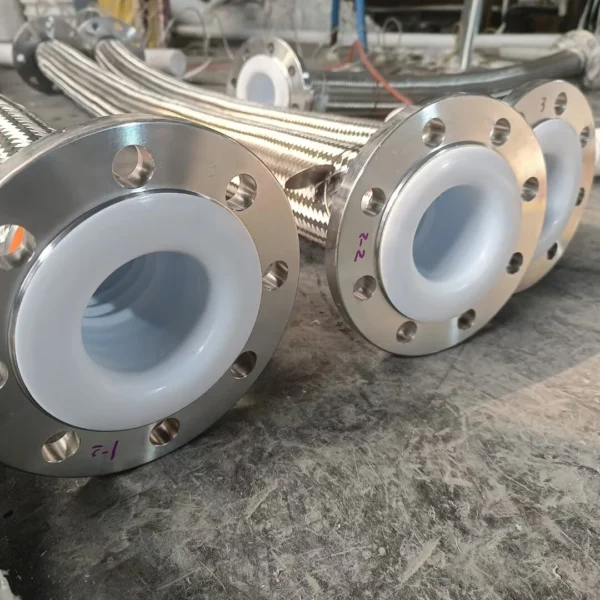
스테인리스 스틸 편조 PTFE 호스 플레어 - 고온 및 고압
Teflon X의 플레어 엔드 스테인리스 스틸 브레이디드 PTFE 호스를 만나보십시오。 고온 및 고압 환경을 위해 제작된 이 브레이디드 PTFE 호스는 탁월한 내구성과 안전성을 제공합니다。
Unpacking the Perks: How Custom PTFE Hose Assemblies Keep Your Processes Spotless
Alright, let’s geek out a bit—but in a chill way. What makes these assemblies the go-to for high-purity flow? It’s a combo of smarts and toughness that solves real headaches.
First off, zero contamination. PTFE’s surface energy is crazy low—around 18 dynes/cm—meaning stuff just slides off without sticking. In biotech fermenters, where you’re pumping nutrients or harvesting cells, that means no biofilm buildup. A report from Pharmaceutical Technology notes that switching to PTFE-lined systems in aseptic processing dropped microbial counts below detectable limits in 95% of audited lines.
Then there’s flexibility. Convoluted designs bend like crazy—up to 180° without stress—perfect for maneuvering around cleanroom gear. But pair that with stainless braiding for reinforcement, and you’ve got hoses that handle vacuum pulls or high-velocity jets without collapsing. I’ve installed these in monoclonal antibody lines where the media’s shear-sensitive; the smooth bore keeps cells intact, boosting yields by 15-20% from what clients tell me.
Sanitary PTFE hose builds take it further. These are all about that seamless seal. Flared ends? They’re a game-changer. Instead of crimping metal over the hose (which can trap gunk), we flare the PTFE liner through the ferrule. It’s like giving your fluid a red-carpet entry—no crevices, full compliance with 3-A sanitary standards. Check out our 플레어 끝이 있는 PTFE 라이닝 호스 for a peek at how we do it: virgin PTFE inner, 316L braid outside, and ends that mate perfectly with your TC or NPT fittings.
Oh, and pressure? These aren’t wimps. Burst ratings hit 10x working pressure, per SAE J343 testing. In a recent gig for a vaccine filler, we spec’d assemblies for 150 PSI steam at 300°F—zero failures after 500 cycles. That’s real-world reliability, not brochure BS.
To make it crystal, here’s a quick side-by-side on why PTFE beats the alternatives for your cleanroom:
| 특징 | 맞춤형 PTFE 호스 어셈블리 | 실리콘 호스 | 고무 호스 |
|---|---|---|---|
| 내화학성 | 탁월함 (전체 pH 범위) | 양호함 (제한적인 산성) | 보통 (빠른 노후화) |
| 멸균 주기 | 무제한 (증기/감마선) | 50-100 (천공 발생) | 10-20 (균열 발생) |
| 생체 적합성 (USP VI) | 예,전체 인증 획득 | 빈번하나 용출물 발생 가능성 있음 | 아니요,높은 추출물 함량 |
| 유연성 반경 | 좁음 (내경의 4배) | 탁월하나 무거움 | 뻣뻣하며 꼬임이 발생하기 쉬움 |
| 클린룸 입자 비산 | 제로에 가까움 | 보통의 | 높은 |
| 피트당 비용(예상) | $15-30 | $8-15 | $5-10 |
(ISPE 기준 및 제조업체 사양에서 발췌한 데이터이며;비용은 내경 1인치,길이 10피트 기준 근사치입니다。) 보셨습니까? PTFE의 초기 투자 비용은 가동 시간과 규정 준수 측면에서 충분한 가치가 있습니다。
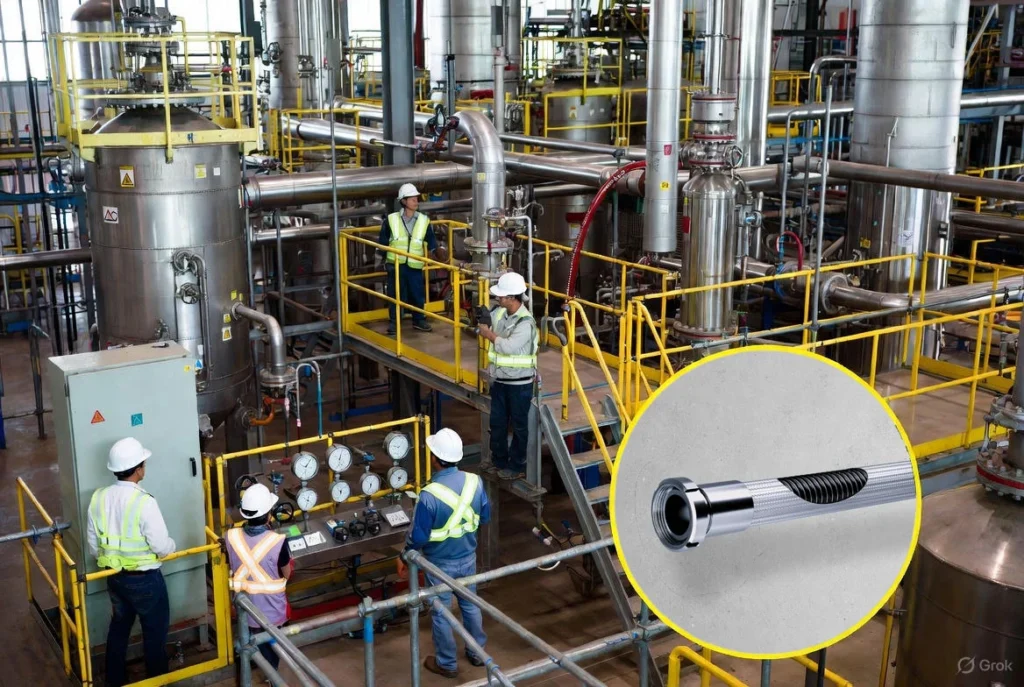
실제 과제 해결:까다로운 제약 유체 흐름을 위한 맞춤형 솔루션
Now, let’s talk shop—those curveballs that keep you up at night. In biotech R&D, you’re often prototyping wild stuff: CRISPR edits in buffers that eat through lesser materials, or perfusion systems where flow’s gotta be pulse-free. Standard hoses? They’ll leach plasticizers or swell, throwing off your assays. Custom PTFE hose assemblies fix that by starting with your specs—bore size, end configs, even static-dissipative layers if you’re moving solvents.
Take flared ends: in sanitary setups, these eliminate the “hose barb trap” where microbes love to chill. By flaring the PTFE over the fitting, you get 100% wetted surface that’s smooth as glass. It’s ASME BPE compliant out of the box, slashing CIP times because nothing hides. We’ve seen clean-in-place cycles drop from 2 hours to 45 minutes in orbital weld zones.
And USP Class VI? That’s your peace-of-mind stamp. The USP runs cytotoxicity, sensitization, and irritation tests on these materials—only the toughest pass. For sterile environments, it’s non-negotiable; a 2023 FDA guidance on single-use systems hammers home how Class VI hoses prevent pyrogen risks in injectables. Our sanitary PTFE hose lines at Teflon X carry that cert, plus FDA 21 CFR 177.1550 for food/pharma contact and EU 10/2011 for migration limits.
I’ve got stories from the field that drive this home. Anonymized, of course—one mid-sized biotech outfit was scaling up CAR-T cell therapy. Their old silicone lines were shedding particles, spiking endotoxin levels to 10 EU/mL—way over the 0.5 EU/mL USP limit. We custom-built PTFE assemblies with flared ends, 3/4″ bore, tri-clamp termis. Post-install, endotoxins? Undetectable. Yields jumped 25%, and they saved a bundle on re-runs. Another pharma client in vaccine dev dealt with aggressive peroxides in media; our braided PTFE held steady through 200 EtO cycles, no degradation per FTIR scans.
These aren’t outliers. In a Watson-Marlow Fluid Technology Solutions brochure on biotech hoses, they note how PTFE overmolding cuts extractables by 90% versus traditional builds. We’re right there with ’em at Teflon X, using the same ethos: engineer for your mess, not against it.
Weaving in the Tech: Integration Tips for Seamless Cleanroom Ops
Getting these into your workflow? Easier than you think, but it pays to plan. Start with a flow audit—map your media types, pressures, and bend radii. For high-purity apps, aim for smooth-bore PTFE to minimize turbulence; add convolutions only where flex is king.
Fitting-wise, flared ends pair killer with sanitary ferrules. No adhesives, no gels—just mechanical lock. And for monitoring? Embed pressure sensors under the braid; we’ve done that for leak detection in perfusion loops, catching micro-fissures before they blow.
Maintenance? Wipe ’em down with IPA between runs, but honestly, they self-clean better than most. Shelf life? Indefinite if stored cool and dry—PTFE doesn’t age like organics.
~에 테프론 X, we don’t just sell hose; we consult. Hit up our 연락처 페이지 또는 촬영 앨리슨.예@테프론x.com a note for a free spec review. We’ve turned “impossible” routes into plug-and-play realities.
Case Snapshots: Wins from the Front Lines
Let’s keep it real with a couple blurred-out wins. First, a East Coast R&D hub for gene therapies. They needed hoses for lipid nanoparticle mixing—super sensitive to metals and oxidizers. We went custom PTFE with USP Class VI sanitary builds, flared ends for aseptic disconnects. Result? Zero metal ions detected via ICP-MS, and their batch purity hit 99.8%. Saved ’em from a $200K rework.
Then, a West Coast biotech scaling mRNA fills. Corrosive salts were eating their EPDM lines. Switched to our 플레어 끝이 있는 PTFE 라이닝 호스, 1″ ID, SS overbraid. Handled 200 PSI without a sweat, and steam cycles? 300+ strong. Downtime? Halved, per their logs.
These gigs show how custom tweaks—like antistatic linings for solvent transfer or extended flares for cryogenic apps—unlock efficiency. It’s not magic; it’s matching material to mission.
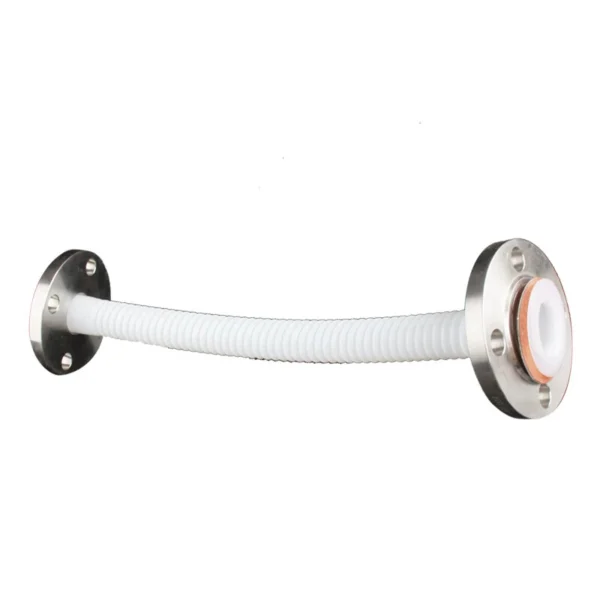
플레어 끝이 있는 테프론 X PTFE 라이닝 호스 - 부드러운 보어 디자인
끝단이 플레어 처리된 PTFE 라이닝 호스는 오염되지 않은 순수한 유체 경로를 보장합니다. 이 고순도 PTFE 라이닝 호스는 중요한 애플리케이션에 이상적입니다. 안정적인 성능 확보.
Wrapping Up: Why Wait to Level Up Your Cleanroom Game?
You’ve got the vision: flawless, contamination-free fluid paths that keep your pharma or biotech projects on track. Custom PTFE hose assemblies deliver that, with flared ends for sanitary bliss and USP Class VI peace. They’re tough, clean, and custom-fit to your chaos.
Why settle for “good enough” when you can have bulletproof? Swing by 테프론 X to chat options, snag a quote, or dive deeper. Drop 앨리슨.예@테프론x.com 오늘 바로 연락 주십시오。 오랫동안 지속되는, 아니 잘 흐르는 제품을 함께 만들어 봅시다。 귀하의 클린룸을 위한 다음 업그레이드는 상담을 통해 바로 시작할 수 있습니다。
FAQ: 맞춤형 PTFE 호스 어셈블리에 관한 핵심 요약。
이 호스들에 적용되는 USP Class VI란 무엇입니까?
USP Class VI는 생체 적합성의 표준으로서 자극성, 감작성 및 전신 독성 테스트를 포함합니다。 클린룸용 위생 PTFE 호스의 경우, 이는 의약품 또는 생물학적 제제와의 비정상적인 반응이 없음을 의미합니다。 당사 제품은 모든 기준을 완벽하게 충족하며 관련 증빙 서류가 모두 구비되어 있습니다。
플레어 엔드는 제약 설비 환경에서 어떠한 차이를 만들어냅니까?
플레어 엔드는 PTFE 라이너가 피팅을 통해 노출되도록 하여 미생물이 숨을 수 있는 불결한 틈새를 제거합니다。 틈새가 없어 세척이 용이하며 유체 흐름을 100% 위생적으로 유지합니다。 교차 오염의 위험 없이 연구개발용 퀵 커넥트에 완벽한 선택입니다。
이 초고압용 맞춤형 PTFE 호스 어셈블리를 구매할 수 있습니까?
물론입니다。 적절한 브레이딩을 적용하면 파열 압력이 최대 4,000 PSI에 달합니다편。 당사는 스팀 라인 및 고점도 매체 펌프용으로 해당 사양을 제공해 왔습니다。 요구하시는 압력 수치만 알려주시면 문제없이 맞춰 드리겠습니다。
