
 Korean
  English
  Russian
  French
  German
  Japanese
  Portuguese
  Arabic
  Italian
  Dutch
Dutch  Turkish
  Indonesian
  Polish
  Spanish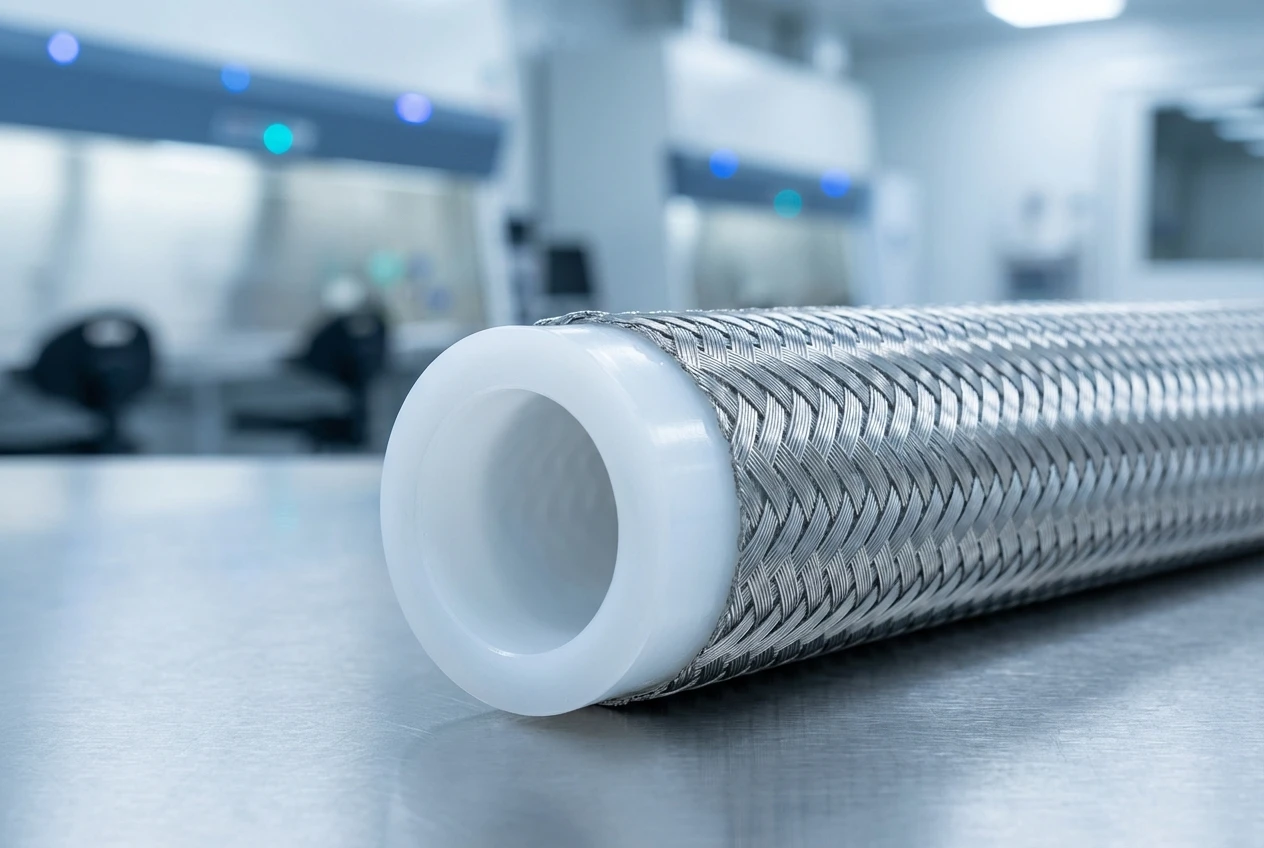
Look, if you are managing a fab or dealing with facility engineering in a semiconductor plant, I don’t need to tell you how stressful yield rates are. You lose sleep over particulate counts. You worry about metal ions leaching into the Ultra-Pure Water (UPW) loop. One spike in parts-per-trillion (ppt) contamination, and suddenly, millions of dollars of wafers are essentially trash.
I’ve been in this industry long enough to see people cut corners on “minor” components like hoses, only to pay for it ten times over during the etching process. Today, we aren’t talking about generic tubing. We are talking about the lifeline of your chemical distribution system: PTFE lined hoses.
~에 테프론 X, we have seen the shift from 28nm nodes down to 3nm. The tolerance for error? It’s basically zero. So, let’s get real about why your choice of hose material matters more than you think, and why PTFE (Polytetrafluoroethylene) is basically the superhero of the cleanroom.
The “Silent Killer” in Semiconductor Manufacturing
Here is the deal. When we pump aggressive acids like Hydrofluoric (HF) or Sulfuric acid through a system, or even just 18.2 mega-ohm UPW, the fluid is hungry. It wants to eat whatever it touches.
If you are using lower-grade PFA or, heaven forbid, standard stainless steel in the wrong application, that fluid is going to strip ions right off the pipe wall. We call this “leaching.”
~ 안에 semiconductor manufacturing, leaching is the silent killer. You can’t see it with the naked eye. But your yield management software will definitely see it when the defects start piling up.
Why Smoothness is Everything
The inner surface of a hose isn’t just a wall; it’s a landscape. Under a microscope, cheap tubing looks like the Rocky Mountains. Those peaks and valleys are perfect hiding spots for bacteria, particles, and chemical residue that didn’t get flushed out during the cleaning cycle.
We focus heavily on surface roughness, measured in Ra (Arithmetic Average Roughness). For high-end semi-apps, you need an Ra value that is incredibly low.
The Logic:
- Lower Ra = Smoother surface.
- Smoother surface = Less surface area for chemicals to bite into.
- Less biting = Less leaching and zero particle entrapment.
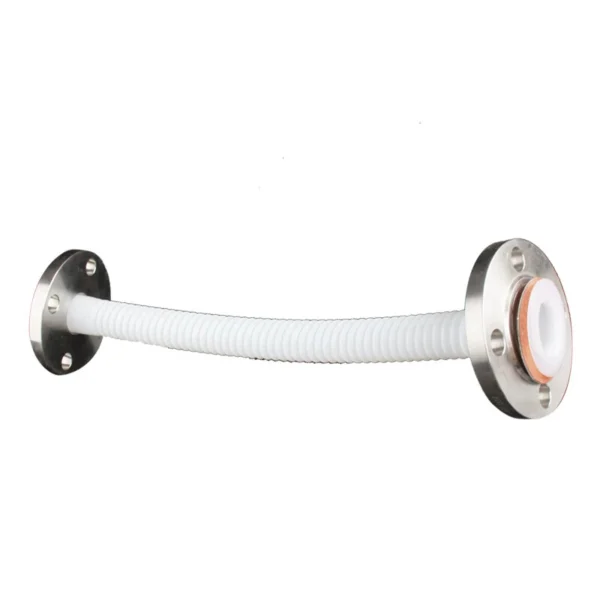
플레어 끝이 있는 테프론 X PTFE 라이닝 호스 - 부드러운 보어 디자인
끝단이 플레어 처리된 PTFE 라이닝 호스는 오염되지 않은 순수한 유체 경로를 보장합니다. 이 고순도 PTFE 라이닝 호스는 중요한 애플리케이션에 이상적입니다. 안정적인 성능 확보.
Chemical Resistance: The PTFE Superpower
Let’s get technical for a second, but keep it simple. The Carbon-Fluorine bond in PTFE is one of the strongest in organic chemistry. It’s a stubborn bond. It doesn’t want to break up.
This is why PTFE lined hoses offer such insane 내화학성. Whether you are running Piranha etch (Sulfuric Acid + Hydrogen Peroxide) or BOE (Buffered Oxide Etch), a high-quality PTFE liner acts like a shield.
I remember visiting a fab in Taiwan a few years back. They were replacing hoses every three months because the solvent they were using caused the liner to swell. Swelling changes the flow rate and pressure—nightmare stuff. We switched them to a high-density, paste-extruded PTFE liner. Last I checked? They haven’t swapped those hoses in two years.
Material Comparison: Who Wins?
Everyone asks me, “Why not just use Stainless Steel 316L for everything?” Well, stainless is great, but it hates chloride ions. HF eats it for breakfast.
Here is a breakdown of why we lean on fluoropolymers:
| 특징 | Stainless Steel 316L | PVDF (Kynar) | PTFE (Teflon X) |
|---|---|---|---|
| Acid Resistance (HF) | Poor (Corrodes) | 좋은 | 훌륭한 |
| Solvent Resistance | 훌륭한 | 공정한 | 훌륭한 |
| 온도 범위 | High (>500°C) | Moderate (~150°C) | High (~260°C) |
| 유연성 | 낮은 | Low (Rigid) | High (with braiding) |
| Surface Smoothness | Electropolished (Good) | Extruded (Good) | Paste Extruded (Superior) |
| Ion Leaching Risk | High (Metal Ions) | 낮은 | Near Zero |
You see the pattern? For mixed-use chemical distribution systems (CDS), PTFE is often the only material that checks every box.
The Physics of Flow: Don’t Ignore the Pressure Drop
Okay, I’m going to throw some math at you. Don’t worry, it’s useful.
When you are designing a tool hookup, you need to know if the pump can handle the hose length. PTFE is smooth, which helps, but you still need to calculate the pressure drop (Delta P) to ensure your flow rate stays consistent at the dispense nozzle.
We generally use the Darcy-Weisbach equation for this. Since I can’t write fancy LaTeX here, here is the plain text version you can use for your calculations:
Pressure Drop Formula:
Delta_P = f * (L / D) * (rho * V^2) / 2
Where:
- Delta_P: Pressure Drop (Pa)
- f: Darcy friction factor (dimensionless – low for PTFE!)
- L: Length of the hose (m)
- D: Inner diameter of the hose (m)
- rho: Density of the fluid (kg/m^3)
- V: Flow velocity (m/s)
Why this matters:
If you undersize your hose ID (Inner Diameter), ‘V’ goes up. Since ‘V’ is squared in the formula, your pressure drop skyrockets. This causes cavitation or micro-bubbles in ultra-pure water systems, which is a massive no-no for wafer processing.
Always slightly oversize your ID if you are on the fence. It keeps the velocity down and the flow laminar.

정전기 방지 PTFE 브레이디드 호스 - 스테인리스 스틸 브레이드가 있는 유연한 가스 라인
우리의 정전기 방지 PTFE 브레이디드 호스 에 이상적입니다 유연한 가스 라인 응용 분야. 스테인리스 스틸로 강화된 이 브레이디드 연료 라인 내구성과 안전성을 보장합니다. 전도성 편조관 정전기를 분산시켜 유해한 환경에 적합합니다. 스테인리스 스틸 브레이디드 테프론 호스 옵션.
A Real-World Headache: The “Permeation” Problem
Here is something a lot of suppliers won’t tell you. PTFE is magical, but it isn’t perfect. It suffers from permeation.
Gas molecules (like HCl vapor) can actually migrate through the plastic wall over time. If you use a standard rubber hose with a thin PTFE liner, that gas gets through the liner, hits the rubber or the stainless steel braid, and starts corroding the hose from the inside out.
I’ve seen stainless steel braids turn to rust dust because acid vapor permeated the liner.
How we fix this at Teflon X:
We use specific manufacturing techniques to increase the crystallinity of the PTFE.
- Higher Crystallinity = Denser structure.
- Denser Structure = Harder for gas molecules to wiggle through.
We also recommend specific thickness grades depending on the molecule size of the chemical you are pumping. If you aren’t sure what thickness you need, just shoot an email to 앨리슨.예@테프론x.com. Seriously, don’t guess on this.
Cleanroom Standards & “The First Wash”
You buy a “Clean” hose. You install it. Your particle counter goes crazy. What happened?
Just because a hose is made of clean material doesn’t mean the inside is clean. Dust from the factory, extrusion oils, or cutting debris can be stuck in there.
~에 테프론 X, we treat the washing process like a religious ritual. We use DI water (Deionized Water) rinses and pack everything in Class 1000 cleanroom environments.
But here is a tip from experience: Always flush your lines before production.
Run UPW through the new loop for at least 24 hours if possible. Measure the TOC (Total Organic Carbon) and resistivity. Only when resistivity hits that magic 18.2 M-ohm-cm mark do you open the valve to the tool.
Installation: Don’t Kink the Hose!
I feel like a broken record saying this, but installation is where 50% of failures happen.
PTFE is tough, but if you exceed its “Minimum Bend Radius,” you kink the liner. A kink is a stress point. Over time, with thermal cycling (hot water, cold chemicals), that stress point becomes a crack.
Rule of Thumb:
If the catalog says the Bend Radius is 5 inches, don’t try to force it into a 4-inch loop. It might look fine today, but in three months, you’ll have a leak.
Also, watch out for “Torque twist.” When you tighten the fitting (JIC, NPT, or Flare), make sure you aren’t twisting the hose itself. A twisted hose under pressure is a ticking time bomb. Use two wrenches—one to hold the hose, one to turn the nut.
Case Study: The Logic Chip Manufacturer
Let me share a quick story (names removed for NDA reasons).
We had a client making logic chips for smartphones. They were seeing random yield drops in their wet bench cleaning process. They traced it back to trace amounts of Iron (Fe) and Chromium (Cr).
They checked their tanks. Clean.
They checked their filters. Clean.
They checked their PTFE lined hoses.
Turns out, they were using a competitor’s hose that used a “conductive black” PTFE liner to prevent static buildup. The carbon black filler in that liner wasn’t high purity. The aggressive chemistry was leaching metals from the carbon filler itself.
The Fix:
We swapped them to 테프론 X high-purity PFA/PTFE conductive hoses that use a specialized, ultra-pure carbon striping method rather than mixing dirty carbon throughout the whole liner.
결과:
Iron levels dropped below detection limits. Yield went back to normal. The ROI on that hose swap was calculated in hours, not days.
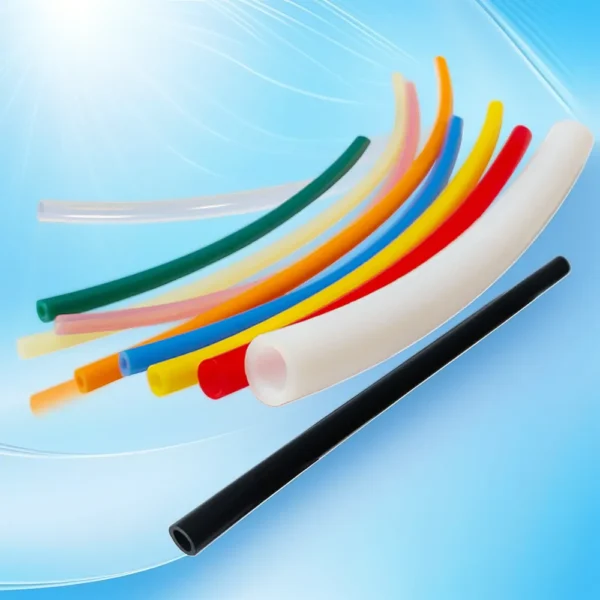
고강도 PTFE 라이닝 호스 | 혹독한 환경용 다층 테프론 튜빙
고내구성 PTFE 라이닝 호스는 광산 및 화학 공정에서 내마모성을 높이기 위해 다층 구조를 사용합니다. PTFE 코어는 자외선으로 인한 열화 및 산화에 강하고, 외부 편조는 인장 강도를 높여줍니다. 연속 사용 시 10년 이상의 사용 수명을 자랑합니다.
Choosing the Right Fittings
The hose is only half the battle. The connection point is usually the weak link.
For semiconductor applications, please stop using standard NPT threads if you can avoid it. NPT creates entrapment zones (dead legs) where bacteria grow.
Recommended Fittings:
- Flare Fittings: These flare the PTFE liner over the face of the fitting. The fluid only touches PTFE. No metal contact. Perfect for PFA tubing and PTFE lined hoses.
- Sanitary Tri-Clamp: Great for larger bore lines. Easy to clean.
- Camlock (PTFE Lined): Good for bulk transfer, but make sure the gasket is chemically compatible.
If you check our product category, you’ll see we prioritize connections that maintain that smooth, uninterrupted flow path.
Why “Good Enough” Isn’t Good Enough
In other industries, maybe you can get away with a generic hose. “It holds water, right?”
But in Semi, “good enough” gets you fired. As nodes get smaller (we are talking Angstrom era soon), the sensitivity to contamination increases exponentially.
You need a partner, not just a vendor. You need someone who understands Zeta Potential, who knows what a hydrophobic surface does to flow dynamics, and who actually cares if your TOC levels spike.
~에 테프론 X, we aren’t just selling plastic tubes. We are selling process integrity.
FAQs: Things We Get Asked A Lot
Q1: Can PTFE hoses handle high-temperature sulfuric acid?
Absoutely. PTFE is rated up to 260°C (500°F). However, you need to check the pressure rating at that temperature. As heat goes up, pressure capability goes down. We provide derating charts to help you calculate this safely.
Q2: What is the difference between conductive and non-conductive PTFE liners?
Great question. If you are pumping non-conductive fluids (like solvents or fuels) at high speed, static electricity builds up. If it arcs, it can burn a pinhole through the liner (we call this static discharge). For those fluids, you must use a conductive (black lined) hose to ground the charge. For UPW, standard non-conductive (white) is usually preferred to ensure max purity.
Q3: How often should we replace our chemical hoses?
It depends on the chemical. For benign UPW, they can last years. For hot HF or Ozone, we recommend a preventative maintenance schedule—usually inspecting every 6-12 months. Don’t wait for a leak. If the outer braid shows corrosion or the hose loses flexibility, replace it immediately.
Q4: Do you offer custom lengths and fittings?
Yes, that’s our specialty. In fab utility loops, one size never fits all. We build assemblies to your exact length with the specific flare or flange you need.
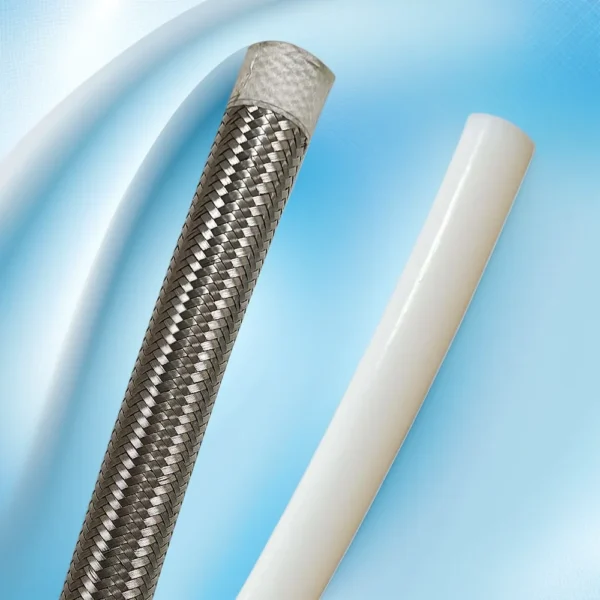
스테인리스 스틸 브레이디드 테플론 호스 | 고압 PTFE 라이닝 튜빙
스테인리스 스틸 편조 PTFE 호스는 뛰어난 화학적 불활성과 강화된 기계적 강도를 결합하여 고압 유압 시스템 및 항공우주 냉각 라인에 이상적입니다. PTFE 내부층은 산, 알칼리 및 용제에 대한 내성을 갖추고 있으며, 금속 편조는 최대 1.6MPa의 내구성을 향상시킵니다. 1~200mm 내경으로 제공되어 설치가 유연합니다.
Ready to Secure Your Process?
Don’t let a $100 hose ruin a $100,000 wafer lot. It’s just not worth the risk.
Whether you are retrofitting an old fab or building a new cleanroom from scratch, let’s talk about your fluid transfer needs. We can help you select the right diameter, the right liner thickness, and the right fittings to ensure zero contamination.
Check out our full range of PTFE Tubes here.
Got a tricky chemical application? Send the specs to me directly at 앨리슨.예@테프론x.com. Or, if you want to browse more about what we do, hit up our 문의하기 페이지.
Let’s keep those particle counts down and those yields up.
