
 Dutch
Dutch  English
  Russian
  French
  German
  Japanese
  Korean
  Portuguese
  Arabic
  Italian
  Turkish
  Indonesian
  Polish
  Spanish
If you’ve ever dealt with hoses in a food plant or pharma setup, you know that leftover liquid sitting around is a real headache. It can lead to bacteria growing where you don’t want it, or worse, contaminating your whole batch. That’s where zelflozende slang designs come in handy—they help everything flow out completely, keeping things clean without extra effort.
I’ve seen this firsthand over the years working with different tubing setups. A hose that doesn’t drain properly might look fine at first, but over time, that fluid retention builds up trouble. In industries like food processing or drug manufacturing, where hygiene is everything, the pitch—or the angle and shape of the convolutions—makes all the difference.
Think about it: smooth hoses are great for flow, but they can trap stuff if not installed perfectly. On the flip side, convoluted ones, especially with a helical design, guide liquids out naturally. That’s why pitch design isn’t just some technical detail; it’s key to staying compliant and avoiding recalls.
What Happens When Fluid Stays Trapped in Your Hoses
Fluid retention sounds harmless, but it’s not. Any standing liquid in a hose creates spots for microbes to hang out and multiply. In pharma, the FDA points out issues like non-sterile air or leftover water in pipes after draining leading to contamination risks. They’ve noted problems with flexible hoses being hard to fully sanitize because water sits there.
In food and beverage lines, it’s similar—bacteria can form biofilms in those trapped pockets, resistant to regular cleaning. Studies show that poor drainage contributes to outbreaks, and in pharma, microbial issues from equipment like hoses have led to product recalls.
One time, a client in dairy processing switched from standard smooth bore to better-draining options, and their cleaning cycles got way shorter. No more worrying about hidden residue. Real-world stuff like that shows why getting the design right matters.
Risks of Poor Drainage: A Quick Look
Here’s a simple table comparing common issues:
| Issue | Caused By Fluid Retention | Impact on Food/Pharma Operations | Real Example from Industry Guidance |
|---|---|---|---|
| Bacterial Growth | Ja | Biofilm formation, harder to clean | FDA notes hoses difficult to sanitize fully |
| Product Contamination | Ja | Recalls, safety risks | Microbial outbreaks linked to equipment |
| Longer Downtime | Indirectly | More frequent deep cleans | Extended CIP times reported |
| Regulatory Non-Compliance | Ja | FDA/USDA violations | Issues with standing water in systems |
Avoiding these isn’t complicated if you pick hoses built for drainage.
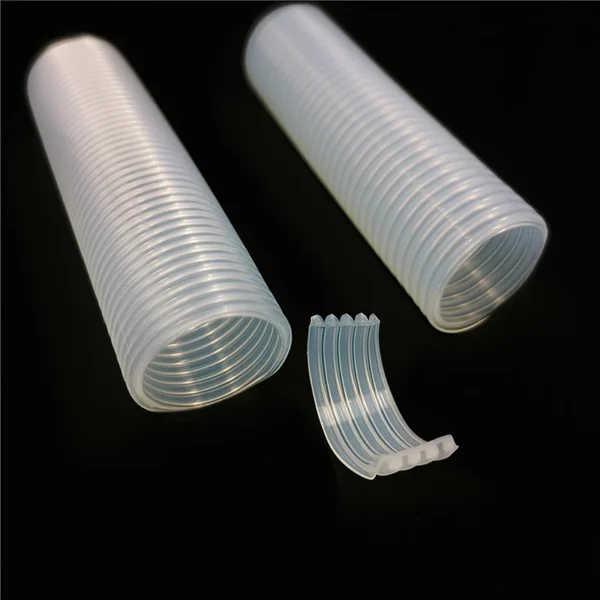
Corrosiebestendige binnen- en buitengegolfde PTFE-slang voor laboratoria
De corrosiebestendige, gegolfde PTFE-slang met binnenvlak en buitenvlak heeft een vlak binnenoppervlak voor nauwkeurige vloeistoftoevoer in het laboratorium en een gegolfde buitenzijde voor optimale wendbaarheid. Deze PTFE-buis met binnenvlak en buitenvlak en gegolfde buitenvlak biedt superieure weerstand tegen zuren en oplosmiddelen in laboratoriumomgevingen.
De Internal Flat External Wave Corrugated Tube is onmisbaar voor onderzoeksfaciliteiten en zorgt ervoor dat de integriteit van het monster behouden blijft tijdens de overdracht.
Vertrouw op deze Inner Smooth Bore Outer Corrugated PTFE-buis voor consistente resultaten. Het ontwerp, dat lijkt op PTFE Inner Flat Outer Corrugated Tubing, verbetert de efficiëntie in het laboratorium.
How Hose Pitch Design Helps with Self-Draining
Pitch refers to the spacing and angle of those convolutions in the hose wall. In helical convoluted tubing, it’s a continuous spiral shape, unlike annular rings. That helical pitch lets gravity pull liquids along the spiral path, so nothing pools at the bottom.
Smooth bore hoses drain well if sloped right, but they kink easier and need perfect installation. Convoluted, especially helical, adds flexibility without sacrificing drainability. The open pitch allows easy flow out, and many designs are made to be self-draining even in tricky setups.
Manufacturers often use wider pitch angles (like 0°-120° in some models) to boost self-cleaning. It’s not just theory—helical designs promote better downstream flow and reduce eddies that trap stuff.
At Teflon X, we’ve used these in client lines for transferring sensitive fluids, and the difference is night and day. Less residue means quicker validation for CIP processes.
Helical vs. Annular Convoluted Tubing: Drainage Comparison
| Functie | Helical Convoluted Tubing | Annular Convoluted Tubing | Smooth Bore |
|---|---|---|---|
| Drainage Ability | Excellent – spiral guides full drain | Good, but can have flat spots | Best if sloped, but no built-in aid |
| Flexibiliteit | High, tight bend radius | Hoog | Lower, prone to kinking |
| Self-Cleaning | Strong due to continuous spiral | Decent | Relies on smooth surface |
| Common in Food/Pharma | Yes, for sanitary transfer | Sometimes | Yes, but needs careful install |
Helical often wins for applications needing no standing liquid.
Why Self-Draining Hoses Are a Must in Food and Pharmaceutical Lines
FDA guidelines stress that equipment must prevent contamination, including proper drainage to avoid bacterial risks. In high-purity water systems, they’ve flagged hoses where water remains as problem areas.
For food, things like the Pasteurized Milk Ordinance and general sanitary standards push for designs that drain fully. No one wants standing fluid breeding issues.
Ons Corrugated PTFE Hose at Teflon X combines an inner flat (almost smooth) with outer corrugations for flexibility, but the helical style ensures great drainage. It’s PTFE, so non-stick and chemical-resistant, perfect for pharma transfers or food lines.
We’ve had pharma clients report easier compliance checks after switching—validators love seeing no fluid left after flush.
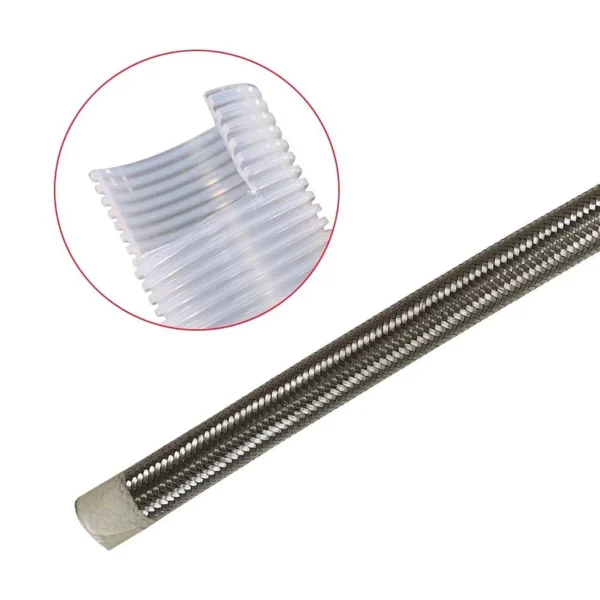
Duurzame, gladde, gegolfde PTFE-buis met binnen- en buitenkant voor vloeistoffen met hoge temperaturen
Onze duurzame, gladde en gegolfde PTFE-buis met binnen- en buitenzijde is ontworpen voor extreme omstandigheden en heeft een vlakke binnenwand voor naadloos transport van vloeistoffen bij hoge temperaturen en een gegolfde buitenzijde voor extra duurzaamheid. Deze PTFE-buis met binnen- en buitenzijde met vlakke en gegolfde buitenzijde blinkt uit in zijn weerstand tegen thermische degradatie en chemische aantasting.
In de automobiel- en luchtvaartsector biedt de Internal Flat External Wave Corrugated Hose betrouwbare prestaties onder druk.
Kies voor deze variant van Inner Smooth Bore Outer Corrugated PTFE Tube vanwege de robuustheid. Door het herhalen van het PTFE Inner Flat Outer Corrugated Tubing-ontwerp is een langdurige efficiëntie in systemen met hete vloeistoffen gewaarborgd.
Real-Life Applications and Success Stories
In one setup (keeping it anonymous), a pharmaceutical company transferring active ingredients had recurring low-level contamination. Traced it back to fluid retention in older smooth hoses. Switched to helical convoluted PTFE, adjusted the pitch for better slope, and issues vanished. Cleaner runs, happier audits.
Another food client handling viscous sauces found their lines clogging from residue. A self-draining design with proper pitch cut cleaning time in half.
These aren’t rare—many facilities see gains from focusing on pitch and convolution style.
Tips for Choosing and Installing Self-Draining Hoses
- Go for helical convoluted if flexibility and drainage both matter.
- Check materials: PTFE is gold standard for non-stick, FDA-compliant.
- Install with slight slope if possible—1/4 inch per foot helps gravity.
- Use sanitary fittings to avoid dead legs.
- Validate your CIP/SIP with the new hose.
If you’re dealing with fluid retention worries, it’s worth reviewing your current setup.
Veelgestelde vragen
What makes a hose truly self-draining?
It’s mostly the design—helical convoluted tubing with open pitch lets liquid spiral out fully, no pooling. Materials like PTFE help too, since nothing sticks.
Does pitch angle really affect cleanliness that much?
Yeah, it does. Wider or optimized pitch reduces spots where fluid can sit, making cleaning easier and reducing bacteria risks.
Are self-draining hoses more expensive?
Upfront maybe, but they save on downtime, cleaning chemicals, and avoid recalls. Pays off quick in regulated industries.
Can I use any convoluted hose for food or pharma?
Not all—need FDA-compliant materials, like our Corrugated PTFE Hose. Check certifications.
If this hits home for your operations, feel free to reach out. At Teflon X, we help folks find the right fit for no-residue transfers. Drop us a line at Allison.Ye@teflonx.com of bezoek onze contactpagina for a quote. Or check more on our site at https://teflonx.com/.
We’ve got experience sorting these issues—let’s chat about what’d work best for you.
