
 Polish
  English
  Russian
  French
  German
  Japanese
  Korean
  Portuguese
  Arabic
  Italian
  Dutch
Dutch  Turkish
  Indonesian
  Spanish
Look, if you work in new energy R&D, specifically with PEM (Proton Exchange Membrane) fuel cells, you know the pain. You build a beautiful stack, everything looks perfect on the CAD model, and then you hit the test bench.
Pressure drop.
Hydrogen is leaking. Again.
It’s the smallest molecule in the universe. It wants to get out. And if you are still using standard rubber elastomers or cheap sealing solutions, it’s going to get out. I’ve seen projects delayed by months just because the engineering team underestimated the “sealability” of hydrogen gas.
Today, I’m going to walk you through why PTFE gaskets for hydrogen fuel cells are pretty much the only serious option for long-term durability. We’re going to get into the chemistry, the “creep” issues (and how to fix them), and look at some real data. No fluff, just what works.
The Invisible Enemy: Understanding Hydrogen Permeation
Before we talk about Teflon X, we have to talk about the gas itself. Hydrogen ($H_2$) is tricky. It doesn’t just leak through gaps; it permeates through the material itself.
Think of a rubber seal like a sponge. To water, it looks solid. To hydrogen, that rubber looks like a chain-link fence. The hydrogen molecules just wiggle right through the polymer chains.
Here is the basic math on permeation that we use when calculating seal integrity. I’m not using fancy code here so you can copy this straight into your notes:
Permeation Flux (J) = P * (p1 – p2) / d
Gdzie:
- J is the flux (amount of gas moving through).
- P is the Permeability Coefficient of the material.
- p1 – p2 is the pressure difference across the seal.
- d is the thickness of the seal.
The killer here is P (Permeability). Most elastomers have a high P value for hydrogen. PTFE, however, has a much denser molecular structure. The Carbon-Fluorine bond is one of the strongest in organic chemistry, and the way these chains pack together makes it incredibly hard for hydrogen to slip through.
When we test this at Teflon X, we consistently see that Uszczelki PTFE offer permeation rates that are orders of magnitude lower than standard silicones or EPDM.

Uszczelka PTFE do zaworów kulowych o wysokiej temperaturze | Rozwiązania w zakresie pierścieni uszczelniających i arkuszy teflonowych
Uszczelka PTFE (uszczelka teflonowa) zapewnia wyjątkową odporność chemiczną dla systemów uszczelniających zaworów kulowych. Zaprojektowane do mediów korozyjnych pod wysokim ciśnieniem, te uszczelki PTFE zachowują integralność w temperaturze 260°C. Idealne jako uszczelki zaworów kulowych PTFE w zakładach petrochemicznych. Nasze arkusze uszczelek PTFE umożliwiają niestandardowe wycinanie matrycowe separatorów cyklonowych i maszyn przemysłowych. Dostępne jako płaskie pierścienie, tuleje lub uszczelki teflonowe w kształcie 3D.
Why Not Just Use Metal Seals?
Good question. Metal seals are great for stopping permeation. But fuel cell stacks, especially in automotive applications, vibrate. A lot.
Metal seals have zero compliance. If your stack expands and contracts (thermal cycling) or vibrates, a metal seal can loose contact or damage the delicate bipolar plates. You need something that can squish a little but blocks gas like a wall. That’s the sweet spot where PTFE lives.
The Acid Test: Surviving the PEM Environment
Here is where things get nasty. Inside a PEM fuel cell stack, it’s not just hydrogen gas. It’s warm, humid, and acidic.
The membrane requires hydration to conduct protons. This creates a hot, wet environment. Plus, the chemistry involved can create slightly acidic conditions (HF formation if membrane degradation occurs).
I’ve seen standard NBR (Nitrile) seals turn brittle and crack after just 500 hours in a test rig because they couldn’t handle the chemical environment.
PTFE (Polytetrafluoroethylene) is chemically inert. You could practically boil it in acid and it wouldn’t care. In the context of hydrogen fuel cell seals, this means:
- No Leaching: The seal doesn’t break down and release ions into the stack. This is huge. If your seal leaches ions, you poison the catalyst. Game over for the stack efficiency.
- Long-term Stability: It doesn’t degrade over time due to chemical attack.
Here is a quick comparison table I whipped up based on general material properties we see in the lab:
| Funkcja | Uszczelki PTFE | FKM (Viton) | Silikon |
|---|---|---|---|
| H2 Permeation Resistance | Doskonały | Umiarkowany | Słaby |
| Obojętność chemiczna | High (0-14 pH) | Wysoki | Umiarkowany |
| Ion Leaching Risk | Skrajnie niska | Umiarkowany | Wysoki |
| Ściśliwość | Low (unless expanded) | Wysoki | Wysoki |
| Koszt | Umiarkowany | Wysoki | Niski |
You can see why R&D teams eventually switch to PTFE. It’s the safety net against catalyst poisoning.
The “Creep” Controversy: Dealing with Cold Flow
Okay, I’m going to be honest here. Regular, virgin PTFE has a flaw. It flows.
If you clamp it down under high load, over time, the material moves away from the pressure. This is called “cold flow” or “creep.” In a fuel cell, if your gasket creeps, you lose bolt load. If you lose bolt load, you get leaks.
This is why some engineers are scared of PTFE. They tried it once in 1995, it leaked after a week, and they swore it off.
But technology has changed.
Enter Expanded PTFE (ePTFE) and Filled Grades
Na Teflon X, we rarely recommend pure, skived virgin PTFE for high-compression fuel cell stacks. Instead, we use modified versions.
Rozszerzony PTFE (ePTFE) is the game changer. By stretching the material in a controlled way during manufacturing, we create a multidirectional fibrous structure.
- It’s soft: It conforms to the bipolar plates (which might not be perfectly flat).
- It stops creeping: The structure locks in place.
- It seals with less force: You don’t need to torque the bolts until they snap.
If you are looking for specific product specs on this, check out our PTFE Gaskets category. We have grades specifically designed to resist creep while maintaining that critical hydrogen barrier.
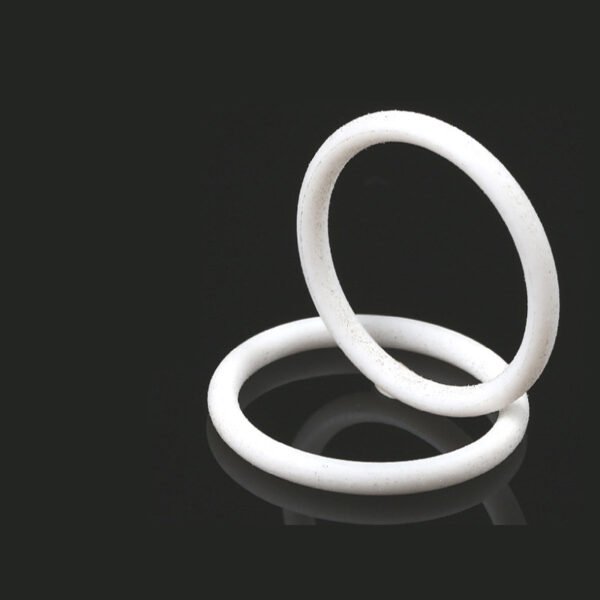
Uszczelka PTFE o wysokiej temperaturze i pierścień uszczelniający z teflonu | Uszczelka PTFE odporna na działanie chemikaliów
Uszczelka PTFE o wysokiej temperaturze i teflonowy pierścień uszczelniający zapewniają doskonałe uszczelnienie w ekstremalnych temperaturach i agresywnych chemikaliach. Uszczelka PTFE i teflonowa są odporne na korozję i zapewniają długą żywotność. Idealne dla przemysłu chemicznego, farmaceutycznego i przetwórstwa spożywczego wymagającego bezpiecznych, czystych uszczelnień.
Case Study: The 50kW Stack Project
Let me tell you about a project we worked on last year. I won’t name the client, but they are a mid-sized player in the hydrogen drone market.
Problem:
They were building a 50kW stack for a heavy-lift drone. They were using FKM (fluoroelastomer) seals. The seals were working fine on the bench, but during flight tests, the stack efficiency was dropping.
We analyzed the used MEAs (Membrane Electrode Assemblies) and found traces of contaminants. The FKM was leaching slightly under the high-temperature operation (80°C), and the vibration was causing micro-leaks.
Rozwiązanie:
We switched them to a custom-cut Teflon X ePTFE gasket with a specific filler to improve thermal conductivity.
Rezultat:
- Contamination: Gone. Zero evidence of seal degradation after 1000 hours.
- Efficiency: Stabilized.
- Maintenance: They actually extended their service interval because they weren’t worried about the seals drying out or cracking.
This isn’t magic; it’s just matching the right material to the physics of the application.
Practical Advice: Designing Your Seal
If you are designing the groove for a hydrogen fuel cell seal, here are a few tips from the trenches.
1. Surface Finish Matters
Hydrogen is unforgiving. If your bipolar plate has a scratch across the sealing surface, hydrogen will find it.
With ePTFE, you have some forgiveness because the material flows into the imperfections. But aim for a surface finish better than Ra 3.2 micrometers (roughly 125 micro-inches).
2. Don’t Over-Torque
I see this all the time. Guys with big wrenches thinking “tighter is better.”
With PTFE, once you reach the minimum seating stress, going tighter doesn’t help much and might warp your plates. Use a torque wrench. Please.
3. Calculating Seating Stress
You need to hit the “Minimum Seating Stress” (y-value in ASME code, though for fuel cells we use slightly different metrics).
For soft ePTFE, this might be as low as 15-20 MPa. Make sure your clamping system can deliver this uniformly. A lopsided stack leads to… you guessed it, leaks.
Dlaczego Teflon X?
There are a lot of gasket suppliers out there. Why come to us?
Because we don’t just sell sheets of plastic. We understand the permeacja wodoru data. We know what a fuel cell stack needs to survive 5,000 or 10,000 hours of operation.
Nasz zespół w Teflon X works directly with your CAD files to cut prototypes that fit perfectly. We can handle the tight tolerances required for compact stacks.
Plus, we are fast. R&D moves quick. You can’t wait six weeks for a seal prototype.

Uszczelka pierścieniowa teflonowa | Uszczelka PTFE i uszczelnienie teflonowe do zastosowań przemysłowych
Uszczelka teflonowa typu o-ring i uszczelka ptfe są szeroko stosowane do uszczelniania przemysłowego. Te rozwiązania uszczelniające z teflonu gwarantują szczelność i tolerancję na wysokie temperatury. Uszczelka PTFE i uszczelka teflonowa nadają się do pomp, zaworów i wrażliwych rurociągów w wymagających sektorach.
FAQ: Common Questions About PTFE gaskets for hydrogen fuel cells
P1: Czy uszczelki z PTFE mogą wytrzymać temperaturę wysokotemperaturowych ogniw paliwowych PEM?
A: Zdecydowanie tak. PTFE zachowuje stabilność do temperatury 260°C (500°F). Większość ogniw HT-PEM pracuje w zakresie od około 160°C do 180°C. PTFE z łatwością radzi sobie w tych warunkach bez ulegania degradacji, w przeciwieństwie do wielu elastomerów, które w takich temperaturach zaczynają tracić swoje właściwości termiczne.
Q2: Czy ePTFE nadaje się do ponownego użytku po demontażu stosu?
A: Zasadniczo nie. Po ściśnięciu ePTFE dopasowuje się on do powierzchni i trwale traci część swojej grubości. W przypadku otwarcia stosu w celu konserwacji, należy zawsze wymienić Uszczelki PTFE aby zapewnić niezawodne uszczelnienie. To niedrogie zabezpieczenie, prawda?
Q3: Jak PTFE wypada w porównaniu z uszczelnieniami grafitowymi w przypadku wodoru?
A: Grafit dobrze znosi wysokie temperatury, lecz jest materiałem kruchym i przewodzącym prąd. W ogniwach paliwowych uszczelnienie często musi być izolatorem elektrycznym, aby zapobiec zwarciom pomiędzy płytami. PTFE jest doskonałym izolatorem elektrycznym. Grafit wymaga dodatkowych etapów izolacji, co zwiększa złożoność konstrukcji.
Ready to Stop the Leaks?
Look, building a fuel cell is hard enough without worrying if your gaskets are going to fail. You need a partner who gets the science and can deliver the parts.
If you are tired of pressure drops and want to discuss how Teflon X can secure your stack, let’s talk.
You can check out our range of solutions on our website: https://teflonx.com/
Or, if you have a specific drawing or a technical headache you need solved right now, shoot an email directly to Allison.Ye@teflonx.com. Allison is our lead on these projects and knows her stuff.
Don’t let a $5 seal ruin a $50,000 prototype. Reach out today.
