
 Russian
  English
  French
  German
  Japanese
  Korean
  Portuguese
  Arabic
  Italian
  Dutch
Dutch  Turkish
  Indonesian
  Polish
  Spanish
Hey, if you’re a product designer hunting for that perfect thin film material that’s super soft yet stands up to harsh chemicals without breaking a sweat, let’s chat about ultrathin PTFE film. I’ve been knee-deep in materials for flexible tech for years now, watching how stuff like this has quietly become a game-changer for next-gen wearables and bendy displays. No fluff—just real talk on why this stuff works so well and how it fits what you’re probably dealing with right now.
Why Ultrathin PTFE Film Stands Out in Flexible Tech
Look, when you’re designing something that needs to bend, twist, or hug the body—like a smartwatch strap that actually feels comfy or a foldable screen that doesn’t crack after a few folds—you can’t just grab any old film. Ultrathin PTFE film (that’s polytetrafluoroethylene, or Teflon to most folks) hits a sweet spot that’s hard to beat.
First off, it’s incredibly thin. Commercial options dip down to around 10-12 microns, sometimes even thinner like 5-10 um for R&D pushes, while still holding up in real production. Thicker ones go up to 50-80 um when you need a bit more robustness, but the magic happens in that sub-30 um range for truly flexible stuff. It’s light, almost weightless, so it doesn’t add bulk to your device.
But thickness ain’t everything. What gets me excited is how this material laughs at chemicals. Acids, bases, solvents—you name it, PTFE shrugs them off. That’s huge for wearables that might hit sweat, lotions, or even cleaning agents in medical-ish setups. And don’t get me started on the dielectric properties. Low dielectric constant around 2.0-2.1, super low loss (like 0.0002 or better at high frequencies), which means signals zip through without much distortion. Perfect when you’re layering it in flexible displays or sensors where every bit of signal integrity counts.
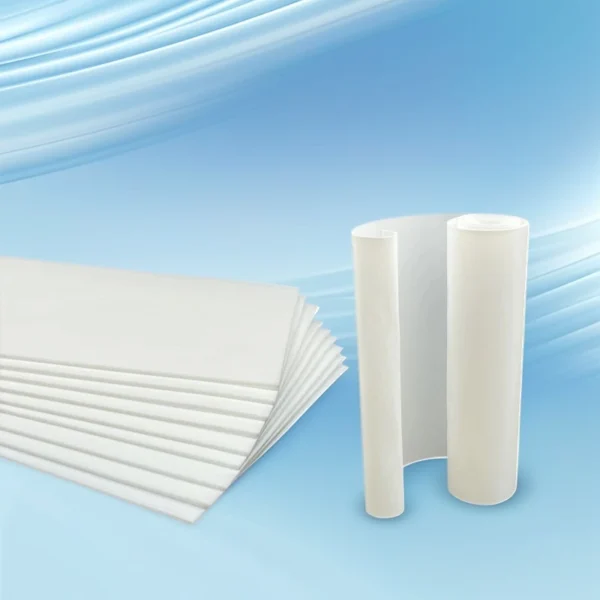
Высокотемпературная строганная пленка из ПТФЭ для промышленных уплотнений и прокладок
PTFE Skived Film обеспечивает исключительную химическую стабильность и термостойкость (от -200°C до +260°C), идеально подходит для промышленных уплотнений в насосах, клапанах и оборудовании для химической обработки[4]. Его низкий коэффициент трения (0,04) обеспечивает долговечность в динамических приложениях, а микропористая структура (пористость 85%) обеспечивает устойчивость к жидкостям и частицам.
Приложения: Коррозионностойкие прокладки, покрытия для авиакосмических двигателей и фильтрующие мембраны медицинского назначения.
Key Properties That Make Ultrathin PTFE Film Ideal for Your Designs
Let’s break it down simple-like with a table so you can scan it quick.
| Свойство | Typical Value/Range | Why It Matters for Flexible Displays & Wearables |
|---|---|---|
| Толщина | 5-30 μm (ultrathin), up to 80 μm | Enables extreme bend radii without cracking; keeps devices slim |
| Flexibility/Bend Radius | Can handle <3mm bends in composites | Survives thousands of folds—think rollable screens or skin-like patches |
| Химическая стойкость | Inert to most acids, bases, solvents | No degradation from body fluids, sweat, or harsh environments |
| Диэлектрическая постоянная | ~2.0-2.1 | Low signal loss for high-frequency circuits in displays/sensors |
| Dielectric Loss | <0.0002 at microwave frequencies | Clear signals in RF-heavy wearables |
| Биосовместимость | FDA-recognized safe for devices | Skin contact OK; low irritation risk in long-wear apps |
| Диапазон температур | -200°C to +260°C continuous | Handles sterilization or extreme use cases |
| Коэффициент трения | Very low (~0.05-0.1) | Smooth layering; reduces wear in moving parts |
These aren’t made-up numbers—pulled from real studies and supplier data on skived or cast PTFE films. For instance, some composites hit tensile strengths around 40-60 MPa even at 80 μm, and they keep shielding or insulation solid after 1000+ bends.
How Ultrathin PTFE Film Fits into Flexible Display Materials
Flexible displays are getting wild—foldables, rollables, curved wearables. The substrate or encapsulation layer needs to protect those delicate OLED or micro-LED bits while letting them bend like crazy.
PTFE shines here as a barrier or dielectric layer. Its low dielectric lets high-res signals flow without crosstalk, and the chemical resistance protects against moisture or oxygen creeping in (big killer for organics in displays). In one setup I know of (anonymized, of course), a team used ~20-30 μm PTFE layers in a composite for EMI shielding in a bendy prototype—held 50+ dB shielding after 2000 bends. Not bad for keeping interference out of your smart glasses display.
And it’s soft—really conforms without adding stiffness like some ceramics do. Product designers tell me that’s the killer feature: you get protection without sacrificing that “feels like nothing” flex.
Ultrathin PTFE Film in Wearable Electronics: Real-World Wins
Wearables are where this stuff gets personal. Think fitness bands, health patches, AR glasses—all need to stick close, breathe (kinda), and not freak out the skin.
Biocompatible films are key. PTFE’s got a long track record—FDA reviews (as recent as 2025) confirm fluoropolymers like PTFE are safe in medical devices, no big red flags on patient issues. It’s used in implants, grafts, you name it. Low surface energy means less biofouling, and it’s hydrophobic so sweat beads off instead of soaking in.
One case sticks out: a wearable heater patch prototype layered Ag networks with thin PTFE cover (~50 nm to few μm). It was self-cleaning, waterproof, and flexed around a finger at low voltage without failing. Kept heating steady even curved. Stuff like that solves the “my device died after one sweaty run” problem designers hate.
Another spot: flexible sensors in health monitors. The film’s dielectric properties help with precise capacitance or piezo sensing, and its softness means better skin conformability—no rigid edges digging in.
At Teflon X, we’ve supplied ultrathin PTFE film rolls for exactly these—custom thicknesses starting super thin, cut to spec. Check our PTFE Film product category for options that match what you’re prototyping.

Тефлоновая пленка с низким коэффициентом трения для аэрокосмических и автомобильных компонентов
Скошенная тефлоновая пленка отлично подходит для применения в аэрокосмической и автомобильной промышленности благодаря своей легкой конструкции и термостойкости до 260°C[5]. Поверхность с низким коэффициентом трения снижает износ топливных систем и компонентов двигателя, а диэлектрические свойства повышают производительность в условиях высокого напряжения.
Приложения: Изоляционные пленки для конденсаторов, печатных плат и конвейерных лент.
Comparing Ultrathin PTFE Film to Other Flexible Display Materials
Quick head-to-head so you see why PTFE often wins for your needs.
- PI (Polyimide): Tough, heat-resistant, but higher dielectric constant (~3.4), stiffer, absorbs more moisture.
- PET: Cheap, flexible, but poor chemical resistance and lower temp tolerance.
- Silicone/PDMS: Super soft and biocompatible, but higher dielectric loss and not as chemically inert.
- Ultrathin Glass: Clear, but brittle—cracks easy on tight bends.
PTFE? Best combo of soft + tough + inert. Not always the cheapest upfront, but saves headaches long-term—no redesigns from corrosion or signal issues.
Overcoming Common Design Challenges with Ultrathin PTFE Film
Designers run into stuff like: “It’s too slippery to bond” or “How do I handle such thin material without tearing?”
Pro tip: surface treatments (plasma or chemical etching) boost adhesion without killing properties. For handling, use release liners or automated dispensing—gets easier with practice.
In one project, we helped tweak a composite where PTFE was laminated hot-press style—ended up with killer flexibility and no delam after cycles.
If chemical attack is your nightmare, PTFE’s your shield. Sweat? Cleaners? No problem.
Ready to Try Ultrathin PTFE Film in Your Next Project?
If you’re fed up with materials that promise the world but flake under real use, give ultrathin PTFE film a shot. It’s not hype—it’s proven in labs and products pushing the edge of flexible tech.
В Тефлон X, we specialize in high-quality ultrathin PTFE film tailored for these exact apps. Soft, chemical-proof, biocompatible—exactly what product designers need.
Want samples? Specs? A quick chat on your design?
Head over to our контактная страница или отправьте письмо по адресу Эллисон.Йе@teflonx.com. We’d love to help nail down the right thickness and grade for you. Let’s get your prototype bending without breaking.
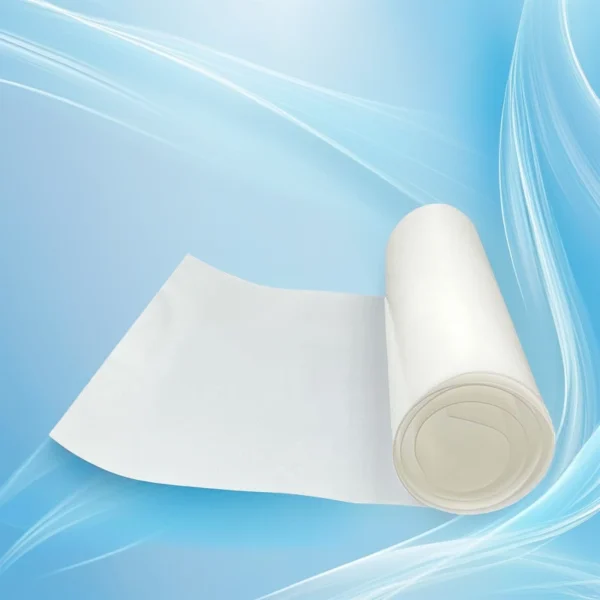
Химически стойкая строганная пленка ПТФЭ для электроники и высокочастотных кабелей
Пленка Skived PTFE обеспечивает стабильные диэлектрические характеристики в высокочастотной и высоковольтной электронике. Благодаря устойчивости к кислотам, щелочам и растворителям она обеспечивает надежность в печатных платах, кабелях и производстве полупроводников.
Основные характеристики: Не стареет, прочность на разрыв превышает прочность стальной проволоки и соответствует стандартам SAE AMS3661D.
Часто задаваемые вопросы
Вопрос: Насколько тонкой может быть ультратонкая пленка PTFE для использования в носимых устройствах?
A: Down to 5-10 microns commercially, sometimes thinner for custom. Thinner means better flex, but handle carefully—it’s delicate till laminated.
Q: Is ultrathin PTFE film truly biocompatible for skin-contact wearables?
A: Yep—PTFE’s got FDA nods for medical devices, inert and low-irritation. Great for long-wear patches or bands without causing issues.
Q: How does it compare cost-wise to other flexible display materials?
A: Bit pricier than basic PET, but you save on failures from chemicals or signals. For high-end wearables or displays, the reliability pays off quick.
