
 Spanish
  English
  Russian
  French
  German
  Japanese
  Korean
  Portuguese
  Arabic
  Italian
  Dutch
Dutch  Turkish
  Indonesian
  Polish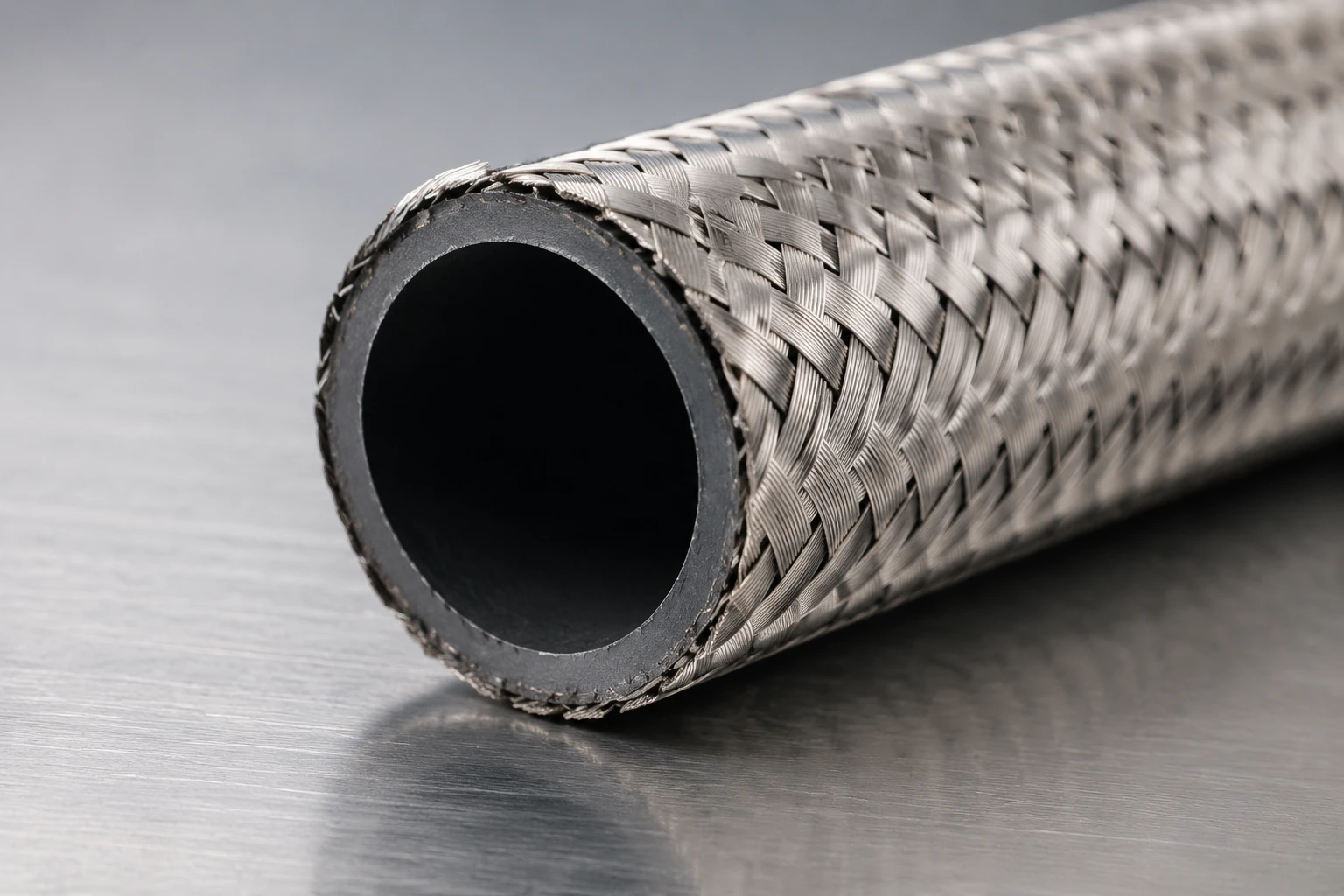
If you have ever spent a shift in a chemical processing plant or managed a pharmaceutical packaging line, you know that safety isn’t just about wearing your hard hat or steel-toed boots. It is about the invisible hazards that you can’t see until it is too late. One of those silent threats is static electricity during fluid transfer.
When you are transfering highly flammable solvents like toluene, heptane, or ethanol at high flow rates, you are essentially creating a giant static generator inside your plumbing. If you are using standard plastic lines, you are playing a risky game. To keep your team and your facility safe, a high-quality manguera de PTFE conductora is not just an option—it is your primary line of defense.
In this guide, we will break down exactly how static builds up in solvent transfer lines, why standard hoses fail, and how a proper manguera de PTFE conductora keeps your operations running without turning your factory into a fireball. Let’s explore why choosing a manguera de PTFE conductora is the smartest engineering decision you can make this year.
Why Standard PTFE Hoses are a Major Risk in Solvent Transfer
PTFE (Polytetrafluoroethylene) is basically the holy grail of chemical transfer. It resists almost every chemical on the planet, handles crazy temperature swings from -70°C to 260°C, and has a super smooth surface that prevents clogs. But standard white PTFE has one massive, glaring weakness: it is a near-perfect electrical insulator.
Standard White PTFE = Extreme Chemical Resistance + Extremely High Electrical Resistance (Insulator)
When non-conductive fluids—like organic solvents—flow through a standard white PTFE tube, they rub against the inner walls. This friction strips electrons, creating a phenomenon known as streaming potential.
Without a manguera de PTFE conductora, this electric charge accumulates on the inner surface of the hose. Because PTFE is such a good insulator, the charge has nowhere to go. It just sits there, building up more and more voltage by the second.
Eventually, that voltage gets so high that it has to find a path to the ground. The charge will literally punch a microscopic hole (a pinhole) right through the PTFE wall to reach the outer stainless steel wire braid. When that happens, you get a double disaster:
- A hot electric spark is generated inside a flammable environment.
- Flammable solvent starts leaking through the new pinhole directly onto that spark.
This is a classic recipe for a catastrophic industrial fire or explosion. This is precisely why a manguera de PTFE conductora is required for any process involving flammable liquids or explosive ATEX zones.
How a Conductive PTFE Hose Solves the Static Problem
So, how do we make an insulator conduct electricity? We do it by adding carbon.
A proper manguera de PTFE conductora does not use standard white PTFE. Instead, it features a co-extruded inner liner containing high-purity, FDA-compliant carbon black. This carbon-filled layer is often referred to as black PTFE.
The carbon black forms a continuous, microscopic conductive pathway along the entire inside of the hose. Instead of letting static build up on the walls, the manguera de PTFE conductora safely carries the charge along the inner liner to the metal end fittings, which are connected to the plant’s ground system.
Static Charge Generated -> Dissipated via Carbon Black Liner -> Channeled to Metal End Fittings -> Safely Earthed to Ground
By ensuring the static electricity is transformed into a harmless current that flows directly to the earth, a manguera de PTFE conductora prevents the voltage from ever reaching the “spark point”.
For any plant EHS (Environmental Health and Safety) officer looking to secure hazardous transfer zones, installing a manguera de PTFE conductora on all solvent lines is the most effective engineering control available.
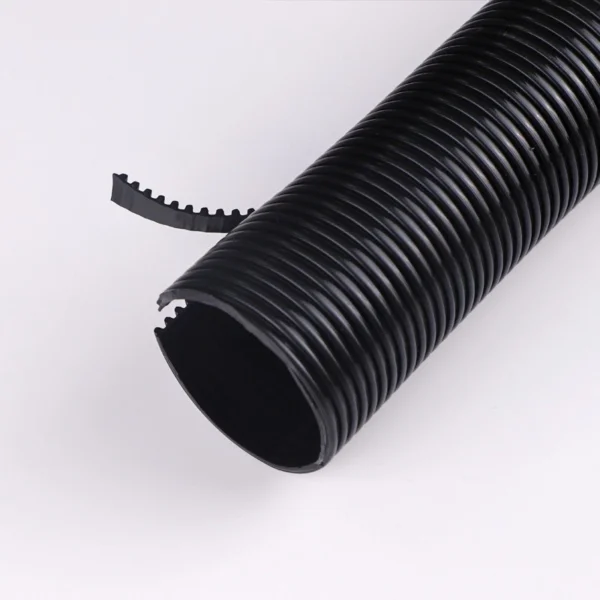
Tubo corrugado flexible de PTFE con interior plano y exterior para procesamiento de alimentos
Nuestro tubo corrugado flexible de PTFE con interior plano y exterior está diseñado con una capa interior lisa para facilitar la limpieza y una capa exterior corrugada para mayor flexibilidad en las líneas de procesamiento de alimentos. Este tubo de PTFE con interior liso y exterior corrugado garantiza la transferencia de comestibles y bebidas sin sustancias tóxicas, conforme a la FDA.
Perfecta para transportar materiales viscosos, la variante de tubo con fuelle de PTFE evita la contaminación por sabor y soporta lavados frecuentes.
Incorpore este tubo corrugado de onda externa plana interna a su configuración; su estructura de tubo corrugado de PTFE interior y exterior plano garantiza higiene y durabilidad.
The Physics of Streaming Current (Plain Text Formulas)
If you are an engineer or a safety officer, you probably want to see the actual math behind this risk. Static charge generation isn’t random; it follows clear physical laws. The streaming current generated when a liquid flows through a pipe can be calculated using empirical formulas.
Here is how the streaming current (I) is generally calculated in a straight pipe or hose:
Streaming Current (I) = c * (v^2) * (d^1.5)
Dónde:
- I is the generated streaming current in Amperes.
- c is an empirical constant that depends on the specific fluid properties (like its dielectric constant and resistivity).
- v is the fluid velocity through the hose in meters per second (m/s).
- d is the internal diameter of the hose in meters (m).
Looking closely at this formula, you can see that the streaming current is proportional to the square of the velocity (v^2). This means if you double your solvent transfer speed to meet a tight production deadline, you aren’t just doubling the static risk—you are quadrupling it!
Without a manguera de PTFE conductora, that extra charge has nowhere to run. If you are running high-velocity pumps, a standard white hose is a ticking time bomb. With a manguera de PTFE conductora, however, the streaming current (I) is safely absorbed by the carbon-filled inner wall and bled off before any high voltage can develop.
To keep the resistance low enough to prevent sparks, industrial safety standards like ISO 8031 and EN 12115 require the electrical resistance of the hose assembly to be tightly controlled.
Maximum Allowed Resistance End-to-End = 1,000,000 Ohms (10^6 Ohms)
A certified manguera de PTFE conductora easily meets this requirement, keeping the resistance well below 10^6 ohms to ensure that any charge is instantly grounded.
Standards and Compliance for Anti-Static Hoses
When sourcing a manguera de PTFE conductora for your facility, you cannot just take a supplier’s word for it. You need to ensure the product meets globally recognized safety and material standards. Here are the key certifications to look for:
1. ISO 8031 Compliance
This is the international standard that dictates how the electrical resistance and conductivity of rubber and plastic hoses are measured. A compliant manguera de PTFE conductora undergoes rigorous testing to prove that its electrical resistance from the inner tube to the metal end fittings does not exceed the safe limit of 10^6 ohms.
2. NFPA 77 (Static Electricity Guidelines)
The National Fire Protection Association’s NFPA 77 provides recommended practices for controlling static electricity in hazardous environments. It explicitly recommends using a manguera de PTFE conductora or bonded/grounded hoses when transfering flammable liquids (Class I liquids) like solvents.
3. FDA 21 CFR 177.1550 and 178.3297
If you work in pharmaceutical or food manufacturing, your manguera de PTFE conductora must also be sanitary. The PTFE resin must comply with FDA 21 CFR 177.1550, and the carbon black used to make the hose conductive must meet FDA 21 CFR 178.3297 for food-contact substances.
Comparing Standard PTFE and Conductive PTFE Hoses
To make your decision-making process easier, we have put together a comparison table of these two hose types. This is a great reference for your next safety audit or procurement meeting.
| Feature / Specification | Standard White PTFE Hose | Conductive PTFE Hose (Black PTFE) |
|---|---|---|
| Material del revestimiento interno | Virgin White PTFE | PTFE with Carbon Black Additives |
| Electrical Conductivity | Insulator (Non-conductive) | Fully Conductive / Anti-Static |
| Electrical Resistance | Greater than 10^9 Ohms | Less than 10^6 Ohms |
| Aplicaciones principales | Corrosive acids, non-flammable fluids | Solvents, fuels, ATEX/flammable zones |
| FDA Approval | Yes (Virgin PTFE) | Yes (Using high-purity FDA carbon) |
| Explosion Prevention | No (High risk of static buildup) | Yes (Safely dissipates charge to ground) |
As you can see, while both types offer stellar chemical resistance, only a manguera de PTFE conductora has the physical properties required to keep a solvent transfer line from exploding.
Real-World Case Study: Solvent Fire Averted at a Paint Manufacturing Plant
Let’s look at how this plays out in the real world. A mid-sized paint and coatings plant was transfering toluene from a storage tank to a mixing vessel using a standard, non-conductive PTFE-lined hose. Toluene is notoriously non-conductive, meaning it builds static charges very quickly when pumped.
Because they were running a high-flow pump to hit daily production targets, the static charge inside the hose grew rapidly. One afternoon, a operator noticed a tiny hiss coming from the middle of the hose line. Within seconds, a small spark jumped from the hose’s stainless steel braid to the metal scaffolding, igniting the vaporized toluene leaking from a fresh pinhole.
Fortunately, the plant’s automatic fire suppression system put out the fire before it reached the main tanks. However, the incident resulted in two weeks of downtime, thousands of dollars in lost materials, and a massive safety audit.
The plant’s EHS manager reached out to us for a solution. We replaced every single solvent line in that facility with a custom, high-durability manguera de PTFE conductora de Teflón X.
The new manguera de PTFE conductora assemblies featured a co-extruded carbon liner and heavy-duty AISI 304 stainless steel braiding. Our team also guided them on implementing a strict grounding protocol during maintenance. Since the upgrade, the plant has run at full capacity for over three years without a single static discharge event or pinhole failure.
This is not a unique story. Every month, facilities around the world face fires that could have easily been avoided by swapping out simple plastic tubing for a certified manguera de PTFE conductora.


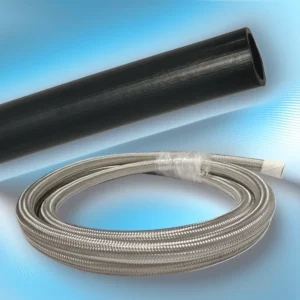


Manguera de combustible trenzada: manguera de PTFE antiestática con refuerzo de acero inoxidable
Actualice a nuestro línea de combustible trenzada para mayor seguridad y rendimiento. El manguera de PTFE antiestática Disipa la acumulación de estática, previniendo explosiones. Esto tubo trenzado conductor Cuenta con un refuerzo de acero inoxidable para mayor resistencia. También es una excelente opción como... línea de gas flexible.
Best Practices for Installing and Grounding Your Hose
Buying a high-quality manguera de PTFE conductora is only half the battle. If you don’t install and maintain it correctly, you are still at risk. Here are some critical, real-world tips we give our B2B clients:
1. Ensure Metal-to-Metal Continuity
A manguera de PTFE conductora can only dissipate charge if it can pass those electrons to the end fittings. When crimping or swaging the fittings onto your manguera de PTFE conductora, make sure there is direct, physical contact between the carbon black inner liner and the metal coupling shank.
2. Connect to a Verified Ground
The metal end fittings of your manguera de PTFE conductora must be connected to a grounded pipe or vessel. If you are attaching the hose to a plastic tank, you must run a dedicated grounding wire from the hose fittings to a verified earthing rod.
3. Conduct Regular Resistance Tests
Over time, physical stress, bending, or chemical wear can degrade the carbon lining in your manguera de PTFE conductora. Implement an annual maintenance schedule to test the end-to-end resistance using a megohmmeter. If the resistance of your manguera de PTFE conductora exceeds 10^6 ohms, it is time to retire it.
If you are looking to source high-grade materials to construct your own assemblies or need pre-made options, exploring our comprehensive category of black carbon-filled PTFE tubes is a great place to start.
Preguntas frecuentes
¿Cuál es la diferencia entre una manguera de PTFE estándar y una manguera de PTFE conductora?
Una manguera de PTFE estándar tiene un tubo interno de color blanco puro que actúa como aislante eléctrico, lo que permite que las cargas estáticas se acumulen hasta niveles peligrosos durante la transferencia de fluidos. Una manguera de PTFE conductora cuenta con un tubo interno negro coextruido con negro de carbón de alta pureza. Esta adición de carbono permite que la manguera de PTFE conductora disipe de manera segura la electricidad estática a tierra, evitando chispas y fugas por poros.
¿Con qué frecuencia debo realizar pruebas de continuidad eléctrica en mi manguera de PTFE conductora?
Recomendamos realizar pruebas en sus manguera de PTFE conductora ensamblajes al menos una vez al año, o con mayor frecuencia si están sometidos a flexión constante, vibración o limpieza química agresiva. Utilice un megóhmetro calibrado para asegurar que la resistencia de extremo a extremo permanezca por debajo de 10^6 ohmios, según lo especificado por la norma ISO 8031.
¿Se puede utilizar una manguera de PTFE conductor en aplicaciones alimentarias y farmacéuticas?
¡Sí, absolutamente! Sin embargo, debe asegurarse de que el negro de humo utilizado en el manguera de PTFE conductora sea de alta pureza y cumpla plenamente con la FDA. Los fabricantes de calidad utilizan negro de humo que cumple con la norma FDA 21 CFR 178.3297, lo que hace que el manguera de PTFE conductora sea seguro para el contacto con alimentos, bebidas e ingredientes farmacéuticos.
¿Por qué se acumula la electricidad estática en las líneas de transferencia de disolventes en primer lugar?
Cuando los solventes no conductores fluyen a través de tubos de plástico no conductores, la fricción desprende electrones del fluido y de las paredes del tubo. Esto se denomina potencial de flujo. Debido a que los solventes como el tolueno, el xileno y el heptano tienen una conductividad eléctrica muy baja, no pueden disipar esta carga de forma natural, lo que provoca una rápida acumulación de voltaje que solo puede resolverse mediante el uso de una conexión a tierra. manguera de PTFE conductora.
Manguera trenzada de PTFE antiestática: línea de gas flexible con trenza de acero inoxidable
Nuestro manguera trenzada de PTFE antiestática es ideal para línea de gas flexible aplicaciones. Reforzado con acero inoxidable, este línea de combustible trenzada garantiza durabilidad y seguridad. El tubo trenzado conductor Disipa la electricidad estática, ideal para entornos peligrosos. Es el... manguera de teflón trenzada de acero inoxidable opción.
Is Your Facility Safe from Static Sparks? Let’s Talk!
Managing plant safety can feel like an endless uphill battle, but solvent transfer does not have to be a source of stress. Upgrading your systems to include a robust, certified manguera de PTFE conductora is a straightforward step that eliminates one of the most hazardous risks in chemical processing.
En Teflón X, we manufacture premium, high-durability fluoropolymer products designed specifically to handle tough, aggressive, and flammable chemical environments. Whether you need custom-fabricated anti-static hose assemblies or bulk black carbon-filled PTFE tubes to integrate into your existing setups, our engineering team has the expertise to guide you to the perfect solution.
Do not wait for a near-miss—or worse, a major accident—to audit your solvent lines. Take action today to protect your team and secure your operations.
Get in Touch:
- Browse our catalog: Take a look at our specialized black carbon-filled PTFE tubes to find the right sizes for your plant.
- Email our lead engineer: Reach out directly to Allison Ye en Allison.Ye@teflonx.com for a technical consultation or a quick quote.
- Send us a message: Ready to upgrade? Go ahead and contact the engineering team today to discuss your custom project specifications, chemical compatibility requirements, and pressure limits. Let’s make your facility a safer place to work.
