
 French
  English
  Russian
  German
  Japanese
  Korean
  Portuguese
  Arabic
  Italian
  Dutch
Dutch  Turkish
  Indonesian
  Polish
  Spanish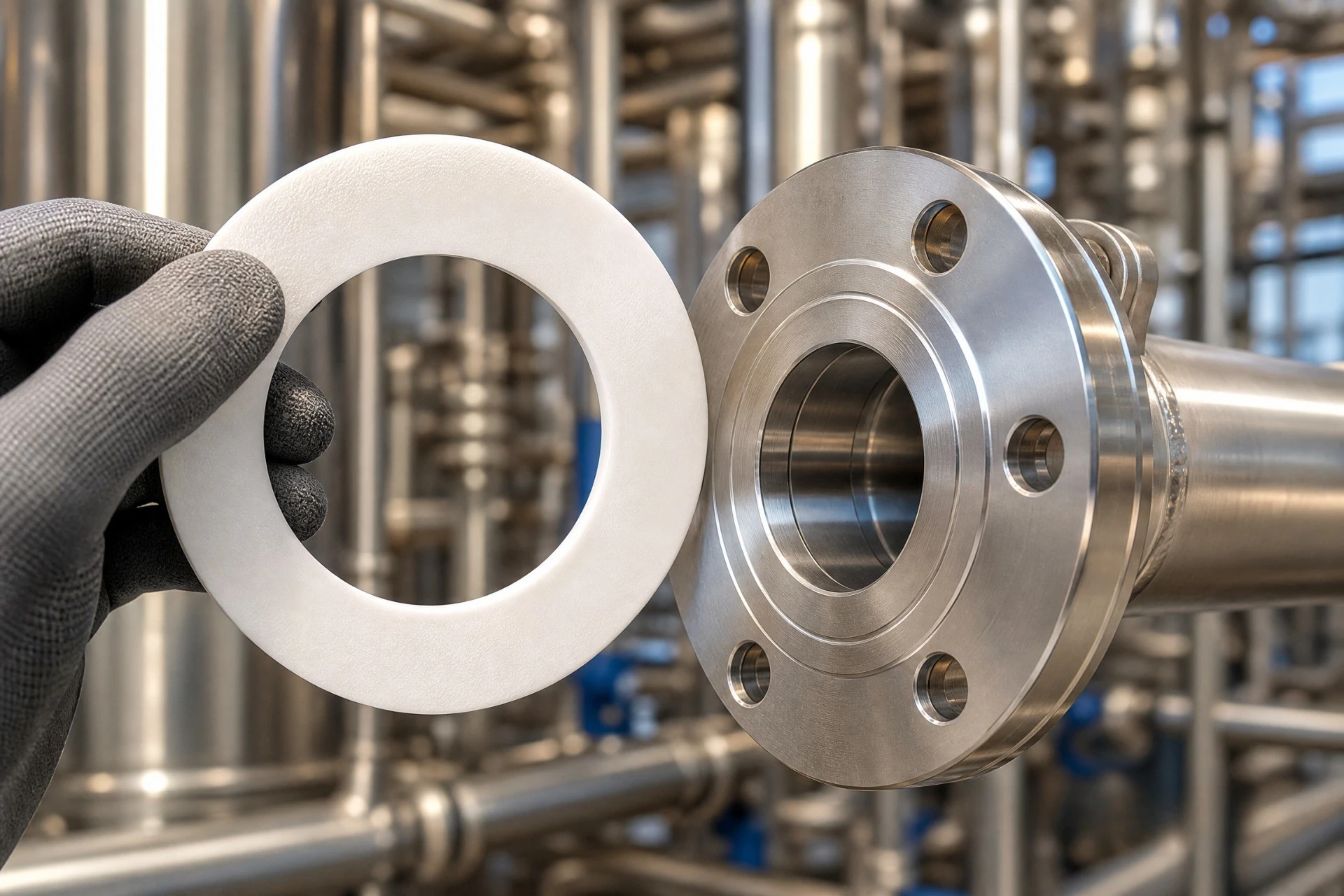
Si vous avez passé plus d'une semaine à travailler dans la maintenance d'une usine chimique, vous connaissez déjà le cauchemar de la fuite de bride chronique. Vous savez, celle sur la ligne d'acide agressif qui semble toujours commencer à suinter juste après un changement d'équipe. Vous envoyez un technicien avec une clé dynamométrique, il serre les boulons, et tout semble rentrer dans l'ordre pendant quelques jours. Puis, sans prévenir, l'écoulement réapparaît.
Lorsqu'il s'agit de conduites de produits chimiques agressifs, la discussion revient toujours au choix de la bonne épaisseur de joint en PTFE. Honnêtement, c'est un casse-tête classique de l'industrie. De nombreuses équipes de maintenance et services d'achat optent par défaut pour un joint plus épais, pensant qu'une plus grande quantité de matériau offre une étanchéité plus tolérante. Mais dans le monde des fluoropolymères haute performance, cette hypothèse n'est pas seulement erronée ; elle est carrément dangereuse. En fait, le choix d'une mauvaise épaisseur de joint en PTFE est la principale cause de défaillance prématurée des brides dans le traitement chimique moderne.
Voyons pourquoi cela se produit, levons le voile sur certains secrets de l'industrie et montrons précisément comment choisir la bonne épaisseur de joint en PTFE pour obtenir une prévention des fuites à long terme et une étanchéité stable des brides.
Le paradoxe de l'étanchéité des brides : pourquoi les joints plus épais échouent
Pour comprendre pourquoi l'épaisseur de votre joint en PTFE est si critique, il faut examiner ce qui se passe à l'intérieur d'un assemblage boulonné. Un raccord à bride n'est pas une pièce de métal statique ; c'est un système de ressort dynamique. Les boulons agissent comme des ressorts robustes serrant les deux faces de la bride l'une contre l'autre, et le joint est l'élément compressible qui remplit les vides microscopiques entre elles.
Lorsque vous installez un joint d'une épaisseur excessive de PTFE, comme 3,2 mm (1/8 de pouce), vous introduisez une quantité massive de matériau hautement sensible au fluage dans ce système de ressort. Le PTFE possède une structure moléculaire unique : il se compose d'une solide chaîne carbonée protégée par des atomes de fluor. Bien que cela lui confère une résistance chimique légendaire, cela signifie également que les chaînes polymères glissent facilement les unes sur les autres sous l'effet de la charge. Ce glissement physique est ce que l'industrie appelle le fluage ou l'écoulement à froid.
Lorsque vous appliquez une charge de serrage sur un joint épais, le matériau commence à s'échapper. Il s'écoule littéralement vers l'extérieur (dans le diamètre extérieur) et vers l'intérieur (dans l'alésage du tuyau). À mesure que le matériau s'éloigne des faces de la bride par fluage, la distance entre les brides diminue, ce qui entraîne une chute de la tension dans vos boulons. Cette perte de tension est appelée relaxation de couple.
Avec une épaisseur de joint PTFE plus faible, telle que 1,5 mm (1/16 de pouce), il y a physiquement moins de matériau susceptible de fluer. L'action de ressort métal sur métal des boulons s'exerce sur une couche de polymère beaucoup plus mince, ce qui signifie que votre joint conserve son couple sur une période beaucoup plus longue.
Voici donc la règle d'or de l'étanchéité des brides : choisissez toujours l'épaisseur de joint PTFE la plus fine capable de s'adapter avec succès aux imperfections de surface de votre bride.
Les mathématiques industrielles derrière la contrainte du joint et le fluage
Examinons la mécanique réelle de la façon dont votre choix d'épaisseur de joint en PTFE modifie les forces physiques à l'intérieur de votre système de tuyauterie. Si vous voulez parvenir à une véritable prévention des fuites, vous devez vous assurer que votre joint maintient sa contrainte d'assise au-dessus d'un seuil spécifique, même après des cycles thermiques.
Pour calculer la contrainte initiale sur votre joint lors de l'installation, nous utilisons une formule d'ingénierie de base :
Contrainte initiale du joint = Force de serrage totale des boulons / Surface de contact du joint
Où :
- Force de serrage totale des boulons = Nombre de boulons * Tension cible des boulons (basée sur vos spécifications de couple)
- Surface de contact du joint = 0,7854 * (Diamètre extérieur au carré – Diamètre intérieur au carré)
C'est ici qu'interviennent les propriétés mécaniques de votre épaisseur de joint en PTFE. Au fil du temps, en raison de la relaxation due au fluage, cette contrainte initiale diminue. Nous pouvons calculer la contrainte résiduelle qui assure réellement l'étanchéité de votre système à l'aide de cette relation :
Contrainte résiduelle du joint = Contrainte initiale du joint * (1 – Taux de relaxation par fluage)
Le taux de relaxation par fluage dépend fortement de l'épaisseur de joint en PTFE choisie. Examinons quelques données de test ASTM F38 réelles. Ce test mesure la charge perdue par un matériau de joint sur une période donnée à une température spécifique.
Si vous utilisez un matériau PTFE vierge standard :
- Une épaisseur de joint en PTFE de 1,5 mm (1/16″) perd généralement environ 35 % à 40 % de sa charge initiale.
- Une épaisseur de joint en PTFE de 3,2 mm (1/8″) peut perdre de 55 % à 60 % de sa charge initiale sous des températures de fonctionnement identiques.
Si la contrainte résiduelle de votre joint tombe en dessous de la pression interne du fluide de votre procédé, le fluide se frayera un chemin à travers l'interface et une extrusion (blowout) se produira. Cette réalité mathématique démontre pourquoi le choix d'une épaisseur de joint en PTFE plus fine est le moyen le plus efficace de prévenir les catastrophes d'extrusion lors de la maintenance des usines chimiques à haute pression.
Au cœur des facteurs de conception ASME : « m » et « y »
Si vous concevez des systèmes conformément au code ASME sur les chaudières et les appareils à pression (Section VIII), vous connaissez probablement les valeurs de conception « m » (facteur de joint) et « y » (contrainte d'assise du joint). Ces chiffres indiquent la force requise pour assurer l'étanchéité du raccord et la maintenir sous pression.
Ce que beaucoup de concepteurs ne réalisent pas, c'est que les facteurs « m » et « y » varient en fonction de l'épaisseur de votre joint en PTFE.
- Une épaisseur de joint en PTFE plus fine nécessite une contrainte d'assise initiale plus élevée (facteur « y ») pour la compression, car le matériau est davantage contraint par les brides métalliques.
- Une épaisseur de joint en PTFE plus importante présente un facteur « y » plus faible, ce qui signifie qu'elle assure l'étanchéité avec un couple de serrage initial des boulons moindre.
C'est pourquoi les équipes de maintenance préfèrent souvent une épaisseur de joint en PTFE plus importante ; il est tout simplement plus facile d'obtenir une étanchéité initiale sur des brides en mauvais état sans avoir recours à des outils à couple élevé. Mais c'est une victoire à court terme. Bien que le joint de 1/8″ assure l'étanchéité facilement le premier jour, son taux de fluage élevé signifie qu'il est beaucoup plus susceptible de céder au quatre-vingt-dixième jour.
Facteurs clés à prendre en compte lors du choix de l'épaisseur d'un joint en PTFE
Pour prendre la bonne décision concernant votre système spécifique, vous devez équilibrer plusieurs variables opérationnelles. Analysons les principaux facteurs qui devraient guider votre choix de l'épaisseur de joint en PTFE appropriée.
1. État de surface et rugosité de la bride
Chaque face de bride possède un état de surface, généralement mesuré en micropouces Ra (Rugosité moyenne). Les brides en acier standard ASME B16.5 présentent un fini phonographique (en spirale) ou strié concentrique, allant généralement de 125 à 250 micropouces Ra.
- Si vos brides sont en excellent état avec des stries nettes et précises, une épaisseur de joint en PTFE de 1,5 mm (1/16″) est le choix absolument parfait. Le matériau s'écoulera juste assez pour remplir les micro-stries sans perdre sa stabilité structurelle.
- Si vos brides sont anciennes, piquées, rouillées ou présentent des rayures profondes dues à des erreurs de maintenance antérieures, vous pourriez être contraint d'utiliser une épaisseur de joint en PTFE de 3,2 mm (1/8″) pour combler ces cavités profondes.
2. Matériau de la bride et limites de couple
Toutes les brides ne sont pas en acier au carbone robuste. Dans de nombreux environnements de maintenance d'usines chimiques, vous trouverez des tuyauteries en acier émaillé, en plastique (PVC, CPVC) ou en plastique renforcé de fibres (PRV). Ces matériaux sont très fragiles. Si vous appliquez le couple élevé requis pour sceller un joint mince, vous fissurerez la bride.
Pour ces applications à faible couple, vous devez utiliser un joint plus épais et hautement compressible. Une épaisseur de joint en PTFE expansé de 3,2 mm (1/8″) est généralement la norme industrielle ici. Le PTFE expansé (ePTFE) est hautement adaptable et assure l'étanchéité sous une fraction de la charge de boulonnage requise pour le PTFE solide, vous permettant d'obtenir une excellente étanchéité de bride sans endommager votre équipement fragile.
3. Pression et température (la valeur P x T)
À mesure que les pressions de fonctionnement internes augmentent, la force tentant d'expulser le joint hors du raccord (la force d'extrusion) augmente. La force d'extrusion est directement proportionnelle à la surface du joint exposée à la pression interne.
Étant donné qu'un joint PTFE plus mince présente une surface de section transversale plus petite exposée à l'intérieur de la conduite, il est naturellement beaucoup plus résistant à l'éclatement. Si votre système fonctionne à des pressions supérieures à 15 bars (217 psi), vous devriez examiner attentivement l'épaisseur de votre joint PTFE et essayer d'éviter les joints de 3,2 mm (1/8″), à moins qu'ils ne soient constitués de matériaux hautement renforcés.
Tableau comparatif des épaisseurs de joints PTFE
Voici une comparaison pratique pour vous aider à évaluer rapidement le pour et le contre des dimensions les plus courantes utilisées dans les environnements industriels.
| Épaisseur du joint PTFE | Applications courantes | Résistance au fluage | Compressibilité | Aptitude à la pression maximale |
|---|---|---|---|---|
| 0,8 mm (1/32″) | Brides d'instruments de haute précision, faces totalement plates, cycles thermiques faibles. | Exceptionnel | Très bas | Excellent (jusqu'à la Classe 600) |
| 1,5 mm (1/16″) | Brides en acier standard ASME, acides agressifs, conduites de services à haute pression. | Excellent | Modéré | Fortement recommandé (jusqu'à la Classe 300) |
| 3,2 mm (1/8″) | Réacteurs émaillés, tuyauterie PRV, brides voilées ou mal alignées. | Faible à modéré | Haut | Limitée (idéale pour la Classe 150 ou inférieure) |
| 6,4 mm (1/4″) | Grands conduits, boîtiers non métalliques à basse pression, joints très inégaux. | Extrêmement faible | Extrêmement élevé | Dangereux (ne pas utiliser dans les conduites à haute pression) |
Comme vous pouvez le voir d'après la comparaison, la standardisation de votre installation sur une épaisseur de joint PTFE de 1,5 mm (1/16″) dès que vous travaillez avec des brides en acier est la stratégie la plus sûre et la plus rentable pour la prévention des fuites à long terme.
La controverse : pourquoi le PTFE vierge est surutilisé (et pourquoi vous devriez l'éviter)
Discutons d'un secret d'initié du secteur dont de nombreux fournisseurs de joints n'aiment pas parler. Une quantité massive du « PTFE vierge » vendu aujourd'hui sur le marché n'est pas réellement un polymère pur à 100 %, fraîchement synthétisé. Pour économiser de l'argent, de nombreux fabricants bas de gamme y mélangent du « broyé », qui est essentiellement de la poudre de déchets de PTFE recyclée.
Lorsque vous achetez un joint bon marché, quelle que soit l'épaisseur de joint PTFE spécifiée, la présence de matériau broyé ruine complètement ses propriétés mécaniques. Cela augmente le taux de fluage, diminue la résistance à la traction et rend le matériau très imprévisible sous cycle thermique.
De plus, même le PTFE vierge de haute qualité et véritable est souvent un mauvais choix pour la maintenance des usines chimiques modernes. Ses propriétés de fluage à froid sont tout simplement trop faibles. Si vous voulez une étanchéité fiable, vous devriez presque toujours spécifier du PTFE structuré (chargé) ou du PTFE expansé.
- PTFE structuré utilise des charges inorganiques (comme la silice, le sulfate de baryum ou des microsphères de verre) pour bloquer physiquement le glissement des chaînes polymères, réduisant le fluage jusqu'à 50 % par rapport au matériau vierge.
- PTFE expansé utilise un processus d'expansion multidirectionnel pour créer une structure hautement fibreuse qui se comprime facilement mais résiste au flux latéral.
En passant du PTFE vierge à un matériau structuré ou expansé, vous pouvez souvent réduire l'épaisseur requise de votre joint PTFE de 3,2 mm à 1,5 mm, ce qui vous donne instantanément un joint plus solide et plus fiable qui ne nécessitera pas de maintenance constante.
Guide étape par étape : comment déterminer l'épaisseur de joint PTFE requise
Si vous êtes confronté à un joint de bride problématique en ce moment, ne devinez pas l'épaisseur dont vous avez besoin. Suivez cette simple liste de contrôle technique pour trouver le profil approprié.
Étape 1 : Évaluer l'état de votre bride
La bride est-elle neuve ou est-elle en service depuis vingt ans ? Vérifiez la présence de piqûres profondes, de rayures et de voilage.
- Si l'écart de surface est inférieur à 0,2 mm, optez pour une épaisseur de joint PTFE de 1,5 mm (1/16″).
- Si la surface présente des rayures plus profondes ou un léger voilage, essayez d'abord un joint en PTFE structuré de 1,5 mm, car la charge aide à combler les petits interstices tout en conservant le couple de serrage.
- Si la bride est fortement voilée ou faite de plastique fragile, utilisez un joint en PTFE expansé de 3,2 mm (1/8″).
Étape 2 : Vérifiez vos outils de serrage
Vos techniciens utilisent-ils des clés dynamométriques calibrées ou comptent-ils sur des clés à chocs et des barres de rallonge ?
- Si votre équipe n'utilise pas d'outils dynamométriques calibrés, elle appliquera presque certainement un couple excessif aux boulons. Un joint de 3,2 mm (1/8″) trop serré s'écrasera et s'extrudera presque immédiatement.
- Dans les environnements où un contrôle précis du couple de serrage est difficile à garantir, le choix d'une épaisseur de joint en PTFE de 1,5 mm offre une marge de sécurité beaucoup plus large contre la surcompression.
Étape 3 : Vérifier les pressions de service
Si votre système fonctionne sous des pressions élevées, un joint plus mince est toujours plus sûr. Si vous devez utiliser un joint plus épais en raison d'un mauvais alignement des brides, assurez-vous de choisir un matériau de qualité supérieure avec charge, capable de résister aux forces d'expulsion élevées.
Étude de cas de dépannage : Résoudre une fuite d'acide chronique en Louisiane
Examinons un exemple concret de la manière dont l'ajustement de l'épaisseur de votre joint en PTFE peut permettre d'économiser des milliers de dollars en temps d'arrêt et en heures de maintenance.
Une importante installation de fabrication chimique en Louisiane exploitait une ligne de transfert d'acide sulfurique très agressive. La ligne utilisait des brides en acier au carbone de classe 150 et fonctionnait à 95 °C et 8 bars de pression. L'équipe de maintenance était constamment confrontée à de petites fuites au niveau des joints.
Pour tenter de résoudre le problème, le service des achats a continué de commander des joints en PTFE vierge de 3,2 mm (1/8″), pensant que l'épaisseur supplémentaire était nécessaire pour gérer le léger désalignement de la tuyauterie. Cependant, le PTFE vierge ayant une résistance au fluage si médiocre, les joints continuaient de se relâcher. Dans les six semaines suivant l'installation, les boulons perdaient jusqu'à 60 % de leur couple, entraînant des suintements d'acide qui endommageaient l'isolation des tuyaux et posaient un risque majeur pour la sécurité.
Nous sommes intervenus et avons recommandé une stratégie simple mais efficace :
- Ils ont ajusté les supports de tuyauterie pour corriger le plus gros du désalignement des brides.
- Ils ont remplacé les joints en PTFE vierge de 3,2 mm (1/8″) par des joints en PTFE structuré de 1,5 mm (1/16″) chargés de silice.
Les résultats ont été immédiats. Parce que l'épaisseur de joint PTFE de 1,5 mm a considérablement réduit la relaxation par fluage du joint, les boulons ont parfaitement maintenu leur couple. L'usine a fonctionné pendant dix-huit mois sans qu'une seule fuite ne soit signalée sur cette ligne, ce qui leur a permis d'économiser des milliers de dollars en main-d'œuvre de maintenance et d'éviter des arrêts de production imprévus.
Pourquoi un partenariat avec Teflon X préserve votre rentabilité
Lorsque vous commandez des joints pour des applications industrielles critiques, vous ne pouvez pas vous permettre de prendre des risques avec des matériaux non vérifiés ou du broyé bon marché. Vous avez besoin de fluoropolymères haute performance conçus spécifiquement pour résister aux produits chimiques agressifs, aux pressions élevées et aux températures extrêmes.
À Téflon X, nous nous spécialisons dans la fabrication de composants d'étanchéité de qualité supérieure. Notre vaste gamme de joints en PTFE comprend des profilés vierges, structurés et expansés conçus pour répondre aux exigences exactes de la maintenance des usines chimiques modernes.
Nous ne vendons pas seulement des produits ; nous travaillons aux côtés de vos équipes d'ingénierie et de maintenance pour vous aider à analyser vos systèmes de tuyauterie, calculer le couple de boulonnage idéal et sélectionner l'épaisseur de joint PTFE parfaite pour vos applications spécifiques. En combinant une fabrication de pointe avec une expertise en ingénierie de terrain, les technologies d'étanchéité Teflon X vous aident à éliminer les fuites chroniques et à maintenir le fonctionnement de votre installation en toute sécurité.
Foire aux questions
1. Quelle est l'épaisseur de joint en PTFE la plus couramment utilisée dans les usines chimiques ?
Pour les brides en acier standard (ASME B16.5) dans le cadre de la maintenance des usines chimiques, une épaisseur de joint en PTFE de 1,5 mm (1/16 de pouce) constitue la norme industrielle. Elle offre l'équilibre idéal entre compressibilité et résistance au fluage, ce qui la rend extrêmement efficace pour les conduites de transfert chimique standard.
2. Puis-je utiliser un joint de 3,2 mm (1/8″) si mes brides sont légèrement désalignées ?
Bien qu'un joint en PTFE plus épais de 3,2 mm puisse aider à assurer l'étanchéité de brides mal alignées en raison de sa compressibilité élevée, ce n'est pas une solution à long terme recommandée. Le joint plus épais subira une relaxation de fluage plus importante et sera plus sujet à l'éclatement au fil du temps. L'approche correcte consiste à aligner les brides aussi précisément que possible et à utiliser un joint de 1,5 mm.
3. Comment la température influence-t-elle mon choix d'épaisseur de joint en PTFE ?
À mesure que les températures de service augmentent, le taux de fluage et d'écoulement à froid du PTFE s'accroît de manière spectaculaire. Comme un joint en PTFE plus épais dispose de plus de matériau à extruder, les températures élevées provoqueront une perte rapide du couple de serrage des boulons. Pour les systèmes fonctionnant au-dessus de 100 °C, essayez toujours d'utiliser un joint de 1,5 mm (1/16″) ou même plus fin, et spécifiez un grade de PTFE structuré ou chargé pour maintenir la stabilité du joint.
4. Pourquoi le PTFE expansé est-il privilégié par rapport au PTFE vierge pour les joints plus épais ?
Le PTFE expansé (ePTFE) présente une structure fibreuse multidirectionnelle unique, dont le comportement diffère de celui du PTFE vierge massif. Sous compression, les microfibres s'entrelacent pour bloquer la structure, empêchant ainsi le fluage latéral du matériau. Cela permet l'utilisation d'un joint en PTFE expansé de 3,2 mm sur des brides fragiles ou nécessitant un faible couple de serrage, sans subir la perte importante de couple constatée avec un matériau vierge massif de même épaisseur.
Prêt à éliminer définitivement les fuites de vos brides ?
Si vous en avez assez de gérer des fuites chroniques, des interventions de maintenance constantes et des gaspillages de produits chimiques coûteux, il est temps d'optimiser votre stratégie d'étanchéité. Spécifier l'épaisseur correcte du joint en PTFE est le moyen le plus simple et le plus rentable d'améliorer la fiabilité et la sécurité de votre installation.
Ne laissez pas une mauvaise sélection de joints mettre vos opérations en péril. Notre équipe d'experts en ingénierie est prête à vous aider à évaluer vos systèmes de tuyauterie actuels et à trouver le profil d'étanchéité exact dont vous avez besoin pour maintenir l'étanchéité de vos lignes.
Voici comment vous pouvez commencer dès aujourd'hui :
- Parcourir nos solutions: Explorez notre catalogue complet de matériaux d'étanchéité haute performance sur notre catalogue de joints en PTFE.
- Consulter nos ingénieurs: Si vous êtes confronté à un joint de bride particulièrement complexe ou si vous avez besoin de dimensions personnalisées, contactez les experts de Teflon X directement via notre page de contact pour obtenir une recommandation professionnelle.
- Demander un devis direct: Vous souhaitez obtenir des tarifs ou des échantillons de matériaux pour votre prochain arrêt technique ? Envoyez un e-mail à Allison.Ye@teflonx.com avec vos spécifications, et nous reviendrons vers vous avec un devis compétitif et une analyse technique sous 24 heures.
Faites de votre prochain arrêt de maintenance le plus réussi à ce jour. Contactez Teflon X dès aujourd'hui et laissez-nous vous aider à obtenir un système de tuyauterie parfaitement étanche et sans souci.
