
 Japanese
  English
  Russian
  French
  German
  Korean
  Portuguese
  Arabic
  Italian
  Dutch
Dutch  Turkish
  Indonesian
  Polish
  Spanish
If you manage a pharmaceutical manufacturing plant, you already know that the cheapest components on your entire production line are the ones most likely to destroy a multi-million dollar batch. I’m talking about your seals.
You can have the most advanced stainless steel bioreactors and precisely calibrated mass flow controllers, but if you slap a sub-par piece of rubber between two ferrules, you are playing Russian roulette with your product purity. I’ve spent years looking at failed batches and ruined equipment, and nine times out of ten, the root cause traces back to someone choosing the wrong sanitary gaskets.
Right now, the regulatory landscape is brutal. Agencies like the FDA and EMA are cracking down hard on Extractables and Leachables (E&L). In fact, recent industry data shows that over 60% of initial E&L submissions get flagged or rejected by regulators. Why? Because the seals degrade under the harsh conditions of Clean-in-Place (CIP) and Sterilize-in-Place (SIP) cycles, shedding microscopic chemical compounds directly into the drug product.
This brings us to a highly debated topic in the industry: material selection. While standard elastomers like silicone and EPDM are everywhere, I’ll say something a bit controversial—they are massively over-trusted in high-temp pharma processing. If you want zero chemical interaction and zero extractables, you need to be looking at high-purity PTFE.
Let’s break down exactly why these specific fluoropolymers are taking over critical pharma processing lines, how to calculate your actual risk, and why not all FDA compliant seals are created equal.
The Dirty Secret of Standard Sanitary Gaskets in Pharma Processing
Walk into almost any food, beverage, or standard biopharma facility, and you’ll see buckets of colored silicone and black EPDM sanitary gaskets. They are flexible, cheap, and very forgiving if a technician overtightens the clamp. But here is the problem: they break down.
When you run a standard CIP cycle, you are usually blasting the line with hot sodium hydroxide (NaOH) at 80°C, followed by acid washes, and finally steam sterilization at 121°C or even 135°C. Silicone hates steam. Over time, it reverts, becomes gummy, and starts shedding siloxanes into your fluid path. EPDM handles steam better but gets absolutely destroyed by certain solvents and animal-derived oils.
When these elastomers break down, they release “extractables”—compounds that can be pulled out of the material under extreme conditions. When those compounds actually migrate into your final drug product during normal operation, they become “leachables”.
This isn’t just a quality control headache; it’s a patient safety issue. Leachables can interact with active pharmaceutical ingredients (APIs), causing them to degrade, precipitate, or even become immunogenic.
The Toxicological Exposure Formula
To understand why regulators are so obsessed with this, you need to look at how toxicologists calculate patient risk. When a lab runs a mass spectrometry test on your process fluids, they use a specific Analytical Evaluation Threshold (AET) to decide if a leached chemical is dangerous.
The baseline calculation for human exposure looks like this:
Daily Exposure Dose (mg/day) = Concentration of Leachable in Product (mg/L) * Daily Administration Volume (L/day)
If that daily exposure dose exceeds the Permitted Daily Exposure (PDE) limit for that specific chemical, your batch is trash. Period. You can’t filter it out. You can’t dilute it. You have to dump it.
Standard elastomers have complex recipes full of curing agents, plasticizers, and antioxidants. PTFE (Polytetrafluoroethylene) does not. It is essentially just carbon and fluorine atoms locked in an incredibly strong bond. There is nothing to leach out.
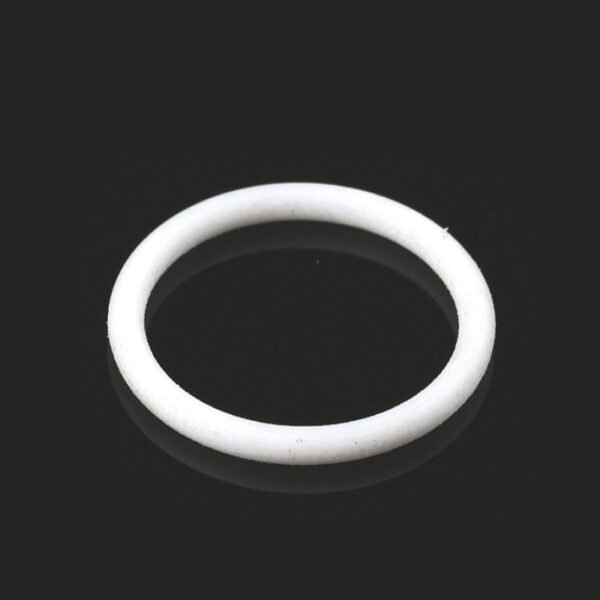
PTFEシールテフロンガスケット | 信頼性の高い高温Oリングとテフロンシーリングソリューション
PTFEシールおよびテフロンガスケット製品は、高温Oリングおよびテフロンシールにおいて最高の性能を発揮します。当社のPTFEガスケットおよびテフロンガスケットは、腐食性化学物質および最高260℃の温度に耐えます。精密機器、製薬、化学用途のエンジニアに高く評価されています。
Why High-Purity PTFE Dominates Tri-Clamp Gaskets
So, if PTFE is so great, why isn’t everyone using it for every single connection?
Well, virgin PTFE has a notorious physical flaw. It suffers from a phenomenon called “cold flow” or creep. Because it’s a thermoplastic and not an elastomer, it doesn’t have a lot of natural memory. When you tighten a tri-clamp over a standard virgin PTFE gasket, the material gets squeezed. Over time, especially under the fluctuating temperatures of SIP cycles, the plastic slowly flows out of the way of the pressure.
You torque it down on Monday, and by Friday, the clamp feels loose. If you don’t go back and retorque it, you get a leak. This creep relaxation is why a lot of maintenance teams hate virgin PTFE.
But material science hasn’t stood still. The industry solved this by developing modified high-purity PTFE.
By adding a microscopic amount (usually less than 1%) of a modifier like perfluoropropyl vinyl ether (PPVE) to the polymer chain, the material’s internal structure changes. The PPVE inhibits crystallization, keeping the molecules tightly packed. The result? You get a denser material that is significantly smoother, less permeable, and most importantly, it has roughly double the creep resistance of standard virgin PTFE.
You get the absolute chemical purity of Teflon, but it actually holds a seal like a proper gasket. If you browse the PTFEガスケット manufactured today, the modified versions are the gold standard for high-stress pharma environments.
Calculating Gasket Creep Relaxation
If you are an engineer trying to predict how often you need to retorque your lines, you have to understand stress relaxation. Here is the basic plain text formula used to model how much sealing force you lose over time:
Remaining Sealing Stress = Initial Applied Stress * e^(-Time / Material Relaxation Constant)
For virgin PTFE, that relaxation constant is relatively small, meaning the “Remaining Sealing Stress” drops rapidly in the first 24 hours. Modified high-purity PTFE has a much higher relaxation constant. The curve flattens out quickly, meaning once you set your clamp torque, it largely stays there, keeping your process boundary totally secure.
Case Study: Saving a $2M Biologics Batch from “Compliant” Seals
Let me share a real scenario from a couple of years ago. I was consulting for a mid-sized biopharma plant that was scaling up a new monoclonal antibody therapy. They were hitting a brick wall during their late-stage validation runs.
Their final drug product kept failing USP <87> (in vitro cytotoxicity) and USP <88> (in vivo systemic toxicity) testing. The lab was detecting trace amounts of an unknown oligomer.
The plant manager was completely baffled. “Everything in our line is FDA compliant,” he told me. “We have the certs for all our FDA compliant seals.”
This is a massive misconception in our industry. “FDA Compliant” (specifically FDA 21 CFR 177.2600 for elastomers) just means the manufacturer used ingredients from a pre-approved list of safe substances. It absolutely does not guarantee that the finished gasket won’t break down and shed those substances when you hit it with 135°C steam and caustic chemicals for 100 cycles.
We traced the line and found the issue. They were using standard peroxide-cured silicone tri-clamp gaskets directly downstream of a high-temperature sterilization node. The silicone was literally cooking, degrading at the surface, and shedding siloxane oligomers into the buffer solution.
We immediately ripped out every elastomer in the critical fluid path and replaced them with modified high-purity PTFE gaskets from テフロンX.
Because modified PTFE is practically immune to thermal and chemical degradation up to 500°F (260°C), the shedding stopped instantly. The next three validation batches passed USP <87> and <88> with zero detectable leachables. They saved millions of dollars in scrapped product just by upgrading a $10 component.

テフロンOリングガスケット | 工業用PTFEガスケットおよびテフロンシーリング
テフロンOリングガスケットとPTFEガスケットは、工業用シーリングに広く使用されています。これらのテフロンシーリングソリューションは、漏れのない動作と高温耐性を保証します。PTFEシールとテフロンガスケットは、要求の厳しい分野のポンプ、バルブ、そして繊細なパイプラインに適しています。
Material Showdown: Comparing Options for Pharma Processing
To make it easier to digest, here is a quick breakdown of how different materials stack up when you push them to the limit in pharmaceutical production lines.
| 素材タイプ | Heat Tolerance | 耐薬品性 | Creep / Cold Flow | E&L Risk | Best Use Case |
|---|---|---|---|---|---|
| Standard Silicone | Up to 200°C | Poor (Breaks down in acids/caustics) | 素晴らしい | High (Siloxanes) | Low-pressure, low-temp buffer prep |
| EPDM | Up to 150°C | Good (Great with steam, poor with oils) | 素晴らしい | 適度 | General utility lines, cold water |
| バージンPTFE | Up to 260°C | Ultimate (Inert to almost everything) | Poor (High creep) | Very Low | Static connections, highly aggressive chemicals |
| Modified PTFE | Up to 260°C | Ultimate (Inert) | Good (Resists creep) | Zero / Undetectable | Critical pharma processing, high-purity API lines |
| PTFE Envelope (FKM Core) | Up to 200°C | Ultimate surface resistance | 非常に良い | Very Low | Areas needing high compressibility and chemical resistance |
Notice the E&L risk column. If you are downstream, close to the final fill-finish, you cannot afford “Moderate” or “High” risk. You need zero.
The Reality of Installing PTFE Tri-Clamp Gaskets
You can buy the best gasket in the world, but if your maintenance techs install it like gorillas, it’s going to fail.
PTFE is tough. It doesn’t squish like rubber. When an operator puts a silicone gasket into a joint, they can tighten the wing nut on the tri-clamp until the threads stop, and the rubber just bulges out into the pipe (which is terrible for flow dynamics, by the way).
If you try to over-torque a PTFE sanitary gasket, you will physically crush the plastic bead. It will permanently deform, and the moment the line heats up and cools down, you will have a massive leak.
Here are the actual rules for installing these seals:
- Alignment is everything. Because PTFE doesn’t easily stretch or compress, the two ferrules must be perfectly aligned. You cannot use the clamp to “pull” misaligned pipes together. If your pipework is sloppy, fix the pipework first.
- Mind the torque specs. You should definately be using a torque-limiting tool, not just hand-tightening based on feel. For most standard 1.5″ to 2″ sanitary tri-clamps using a PTFE seal, you only need about 30 to 50 inch-pounds of torque. That is way less force than most people think.
- Retorque after the first thermal cycle. Even with modified PTFE, you will get a tiny bit of initial settling after the first hot CIP/SIP run. Let the line cool down to ambient temperature, and then quickly verify the torque. Once you do that initial retighten, a modified PTFE seal will usually stay locked in for months.
- Do not reuse them indefinitely. PTFE gaskets take a “set.” Once they are compressed between two specific ferrules, they mold to the microscopic imperfections of that exact joint. If you break the connection to do maintenance, throw the gasket away and put a fresh one in. They are too cheap to risk a $500,000 batch over.
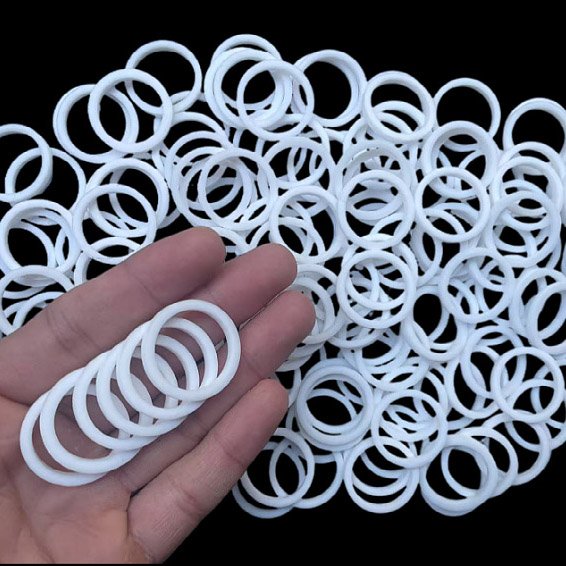
プレミアムテフロンOリングとPTFEガスケット | 耐薬品性テフロンシーリング
プレミアムテフロンOリングとPTFEガスケットは、化学用途および工業用途において優れたテフロンシーリングを提供します。PTFEシールとテフロンガスケットは、非反応性、柔軟性、そして長期的な信頼性で知られています。水処理、実験装置、流体処理機械に最適です。
よくある質問(FAQ)
Engineers and plant managers ask me the same questions all the time when we start discussing upgrading to high-purity fluoropolymers. Here are the big ones:
1. What is the real difference between USP Class VI and FDA compliance?
This trips up a lot of people. FDA 21 CFR 177.1550 (for perfluorocarbons) is a material formulation standard. It basically means the ingredients used to make the plastic are recognized as safe for food and drug contact. USP Class VI is a biological reactivity standard. It involves actually taking the finished material, implanting it into living tissue (usually mice or rabbits), and ensuring it doesn’t cause a toxic reaction. For critical biopharma lines, your gaskets must pass USP Class VI. FDA compliance alone is not enough to guarantee safety against leachables.
2. Can I use PTFE gaskets on misaligned pipe joints?
Absolutely not. As I mentioned earlier, elastomers like EPDM can stretch and deform to accomodate a slightly crooked pipe connection. PTFE is rigid. If your ferrules are offset by even a few millimeters, the hard PTFE face will not sit flush against the steel, and you will get fluid bypassing the seal. Your piping infrastructure must be properly supported and aligned.
3. Are envelope gaskets better than solid modified PTFE?
It depends on the application. An envelope gasket features a solid elastomer core (like FKM/Viton or EPDM) wrapped in a thin layer of PTFE. This gives you the chemical resistance of Teflon on the outside with the squishy, compressible memory of rubber on the inside. They are fantastic for older equipment where the ferrules might be slightly worn or pitted, because they seal easier than solid plastic. However, for the absolute highest purity lines, solid modified PTFE is preferred because there is zero risk of the elastomer core ever bleeding out if the envelope gets nicked or damaged.
4. Why does my PTFE seal leak when the line drops to freezing temperatures?
Metals and plastics expand and contract at different rates. If you torque a joint at room temperature, run hot steam through it (causing the stainless steel to expand), and then immediately flush it with a cryogenic liquid or freezing buffer, the metal shrinks faster than the plastic can recover. This creates a micro-gap. Using modified PTFE drastically reduces this issue compared to virgin PTFE, but extreme thermal shock requires specialized spring-loaded clamps to maintain constant pressure.
Don’t Let Bad Seals Ruin Your Next Batch
Look, dealing with Extractables and Leachables is a massive pain in the neck. The regulations are getting tighter every single year, and the FDA is not going to look the other way if your process equipment is contaminating your product.
You spend incredible amounts of time and money dialing in your formulations, validating your processes, and training your staff. Do not let a generic, off-the-shelf rubber seal be the reason your entire batch goes down the drain. Upgrading to high-purity, modified PTFE tri-clamp gaskets is the easiest, most cost-effective way to instantly bulletproof your fluid path against chemical degradation and creep.
If you are tired of failing purity tests, dealing with reverting silicone, or constantly having to retighten leaking joints after sterilization cycles, it’s time to make the switch.
テフロンX specializes in manufacturing ultra-high-purity seals designed specifically to handle the worst CIP/SIP conditions without losing their integrity. We know exactly what it takes to pass stringent USP and FDA requirements.
Stop guessing with your process boundaries. If you need technical help sizing the right gaskets for your specific temperature and chemical profiles, reach out to our team. You can also email me directly at アリソン・イェ@teflonx.com. Let’s fix your leaking lines so you can get back to focusing on manufacturing great medicine.
