
 Korean
  English
  Russian
  French
  German
  Japanese
  Portuguese
  Arabic
  Italian
  Dutch
Dutch  Turkish
  Indonesian
  Polish
  Spanish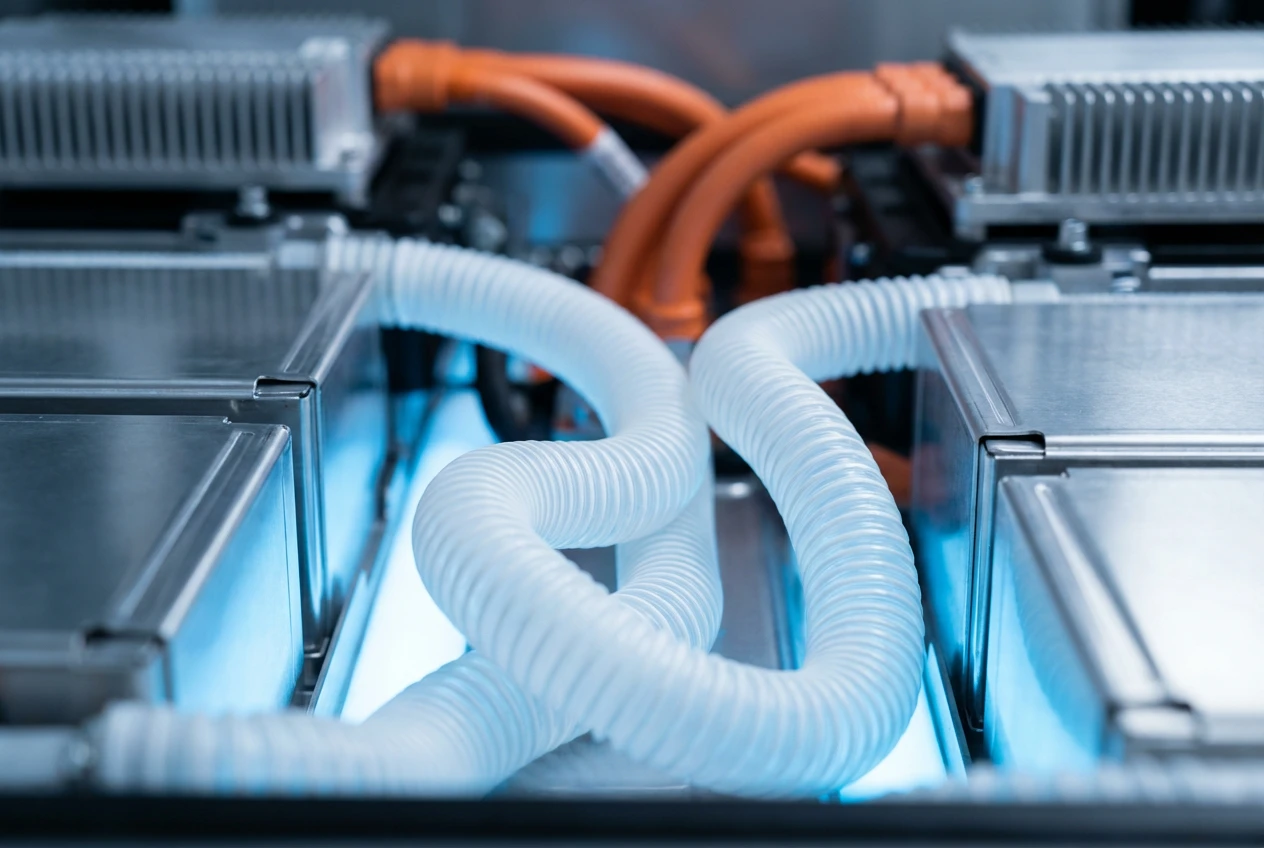
You know that sinking feeling when you walk into the test lab and see a puddle of blue or pink fluid under your prototype battery pack?
Yeah. I’ve been there. It’s a nightmare.
For automotive engineers working on the bleeding edge of EV development, 열 관리 isn’t just a box to check. It is literally the difference between a high-performance vehicle and a thermal runaway headline on the evening news.
We used to get away with standard EPDM rubber in the ICE (Internal Combustion Engine) days. But let’s be honest with ourselves—putting heavy, bulky rubber hoses inside a high-voltage battery pack is becoming an outdated practice. It’s like trying to cool a supercomputer with garden plumbing.
Today, I’m going to walk you through why PTFE 골판지 호스 is quietly taking over the EV sector, specifically for 냉각수 라인. We’ll talk about flow rates, why Nylon isn’t always the answer, and I’ll even share some math that actually works in the real world.
The Problem: Why Your Current Hoses Might Fail
Look, I get it. EPDM is cheap. PA12 (Nylon) is stiff and predictable. But electric vehicles have changed the game rules.
In an EV battery pack, you are dealing with a “Goldilocks” zone. The battery cells need to stay between 15°C and 35°C for optimal life. If they get too hot, degradation accelerates. Too cold, and range drops off a cliff.
Here is where traditional materials struggle:
- Permeation Issues: Rubber is permeable. Over 5 to 10 years, water vapor creeps out, and coolant concentration changes. That messes with your thermal conductivity.
- The “Space” War: You are fighting for every millimeter inside that chassis. Rubber hoses require thick walls and massive bend radii. You try to bend a 1-inch EPDM hose 90 degrees in a tight spot? Good luck. It kinks.
- Chemical Attacks: Modern coolants (usually a 50/50 water-glycol mix) run hot. Over time, they can hydrolyze certain plastics or leach plasticizers out of rubber, gumming up your micro-channels in the cooling plate.
This is where 테프론 X comes in. We realized a while ago that the industry needed something that bends like a slinky but handles chemicals like a lab beaker.

난연성 및 내후성이 있는 테프론 주름 호스 파이프
내구성을 위해 설계된 이 제품은 테프론 주름 호스 파이프 결합하다 난연성 그리고 내후성 혹독한 야외 환경을 견뎌낼 수 있습니다. 붙지 않는 표면 오일과 이물질이 쌓이는 것을 방지하므로 자동차, 항공우주 및 고온 유체 전달 시스템에 적합합니다.
Why PTFE Corrugated Hose is the Engineer’s Choice
Let’s strip away the marketing fluff. Why are OEMs actually switching to PTFE 골판지 호스?
It comes down to the molecular bond. The Carbon-Fluorine bond is one of the strongest in organic chemistry. It basically ignores everything you throw at it.
1. Temperature Range that Actually Matters
EVs generate heat, but they also sit in freezing parking lots in Norway.
Our PTFE hoses handle -70°C ~ +260°C.
PA12 (Nylon) usually taps out around 120°C before it starts losing mechanical strength. If you have a localized hot spot or a pump failure, Nylon can deform. PTFE won’t even blink.
2. Flexibility vs. Kink Resistance
This is the big one.
A smooth bore PTFE tube is stiff. But once we corrugate it (specifically with a helical or concentric profile), the bend radius drops significantly.
Comparison of Bend Radius (10mm ID Hose):
| 재료 | Min Bend Radius (approx) | Risk of Kinking |
|---|---|---|
| EPDM 고무 | 60 – 80 mm | High at tight angles |
| PA12 Smooth | 80 – 100 mm | 매우 높음 |
| Teflon X PTFE Corrugated | 18 – 25 mm | Near Zero |
Table 1: Bend radius comparison based on standard industry specs.
You can snake a PTFE 골판지 호스 through the complex geometry of a battery module without adding stress to the connectors. That is huge for longevity.
Chemical Resistance: The Glycol Factor
We had a client (let’s call them “Company A” to keep the lawyers happy) who was using a specialized elastomer for their coolant lines. They found that after 2,000 cycles of thermal shock with Ethylene Glycol, the hoses started to swell.
Swelling = restricted flow = hotter batteries.
PTFE is chemically inert to all standard automotive fluids.
- Ethylene Glycol? No problem.
- Automatic Transmission Fluid (for direct cooling)? Easy.
- Dielectric fluids? Yep.
It doesn’t age. You could probably dig these hoses up in 50 years and they’d still be mechanically sound.
The Math Section: Calculating Flow & Pressure Drop
Okay, grab your calculator. This is where some engineers get nervous about corrugated hoses.
“But doesn’t the corrugation destroy my flow rate?”
Yes and no. It creates turbulence. But turbulence actually aids heat transfer in some parts of the system, though mostly we are concerned with pressure drop (Delta P) in the transfer lines.
Because WordPress doesn’t like fancy LaTeX code, I’m going to write these formulas out in text so you can copy-paste them into your engineering notes.
The Friction Factor
In a smooth tube, we use the Darcy-Weisbach equation. For corrugated hoses, the friction factor (f) is higher.
Pressure Drop Formula:
Delta_P = f * (L / D) * (rho * v^2 / 2)
Where:
- Delta_P: Pressure Drop (Pa)
- f: Friction factor (dimensionless)
- L: Length of hose (m)
- D: Internal Diameter (m)
- rho: Density of coolant (kg/m^3)
- v: Flow velocity (m/s)
The Trick with Corrugations:
For PTFE 골판지 호스, the friction factor isn’t constant. It depends on the pitch of the corrugation.
A rough rule of thumb we use at 테프론 X for preliminary sizing: assume the pressure drop will be 1.5x to 2.0x higher than a smooth tube of the same ID.
If you are running a high-flow system, you simply step up one size. If you calculated a 10mm smooth tube, use a 12mm or 14mm corrugated hose. The weight penalty is negligible because PTFE is so light.

PTFE 골판지 파이프 - 고압용 유연한 테프론 호스
프리미엄 테프론 X 소재로 제작된 PTFE 주름관은 자동차, 화학, 의료 장비 등의 산업에 탁월한 유연성과 내구성을 제공합니다. 이 주름관형 플렉시블 호스는 매끄러운 내벽으로 유체 배출에 탁월하며, 골 깊이를 줄여 세척이 용이합니다. 나선형 강철 와이어로 보강된 이 검은색 플라스틱 주름관은 꼬임과 고온에 강하여 맞춤형 크기와 혹독한 환경에 적합합니다.
Case Study: The “Spaghetti Monster” Battery Pack
I want to share a quick story about a project we worked on last year. A startup EV maker (B-sample stage) had a battery pack design that was dense. I mean, really dense.
They tried pre-formed rubber hoses. The tooling costs alone were looking to be $50k because every bend required a unique mandrel. Plus, installation was a nightmare; workers had to lube the hoses to slide them into tight gaps, which created a mess.
The Solution:
We switched them to 테프론 X conductive PTFE corrugated hoses.
- No Tooling Costs: Since the hose is flexible, they didn’t need pre-formed shapes. They just cut to length and routed it.
- 정전기 방지: We used a carbon-lined PTFE (black) to prevent static charge buildup from the high-velocity non-conductive coolant.
- Routing: They routed the lines like “spaghetti” (in a organized way) around the modules.
The Result:
They saved 40% on prototyping costs and shaved 1.2kg off the total pack weight.
Installation & Connections: Don’t Screw It Up
You can have the best hose in the world, but if the connection fails, you leak.
For 전기차 배터리 냉각, we usually see two types of connections:
- SAE J2044 Quick Connectors: These are standard. You need a cuff on the end of the corrugated hose to fit the barb. We can thermoform smooth cuffs onto the ends of the corrugated hose. This gives you a leak-proof seal with standard automotive connectors.
- Crimp Fittings: For higher pressures (though coolant loops are usually low pressure, < 2-3 bar), a stainless steel crimp collar is best.
전문가 팁: When routing, ensure you leave a little “slack” for thermal expansion. Even though PTFE doesn’t expand much, the aluminum battery casing does. If the hose is pulled tight like a guitar string, something will snap when the car hits 60°C.
A Controversial Opinion: Is Rubber Dead?
Some of my peers might yell at me for this, but I think for in-pack cooling, rubber is on its way out.
External to the pack? Sure, use EPDM. It’s cheap and exposed to rock strikes where thick rubber helps.
But inside the delicate, high-voltage environment of a battery module? Rubber is too risky. It outgasses, it ages, and it takes up too much room.
If you are building a budget city car, maybe you stick with rubber. But if you are building a performance EV or a heavy-duty truck where reliability is key, you need fluoropolymers.
Specification Cheat Sheet
If you are drafting a print right now, here are the specs you should be looking for in a quality supplier (like us):
- 재료: 100% Virgin PTFE (Teflon) resin.
- Wall Thickness: Usually 0.5mm to 1.0mm depending on pressure needs.
- Corrugation Profile: Omega style (better flexibility) or U style (easier cleaning).
- Burst Pressure: Should be at least 4x your operating pressure.
- Conductivity: < 10^6 Ohms for conductive requirements (to meet SAE J1645).
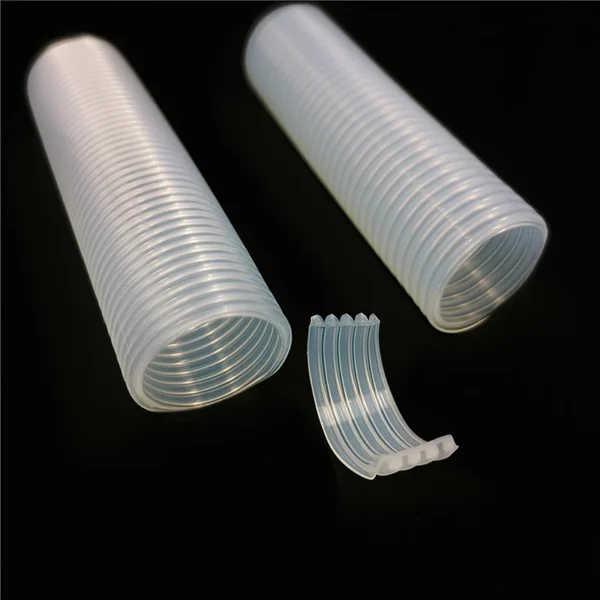
실험실용 내식성 내부 플랫 외부 주름 PTFE 호스
내부식성 내측 평탄 외측 주름관 PTFE 호스는 정밀한 실험실 유체 공급을 위한 평평한 내면과 기동성을 위한 주름관 외측을 제공합니다. 이 PTFE 내측 평탄 외측 주름관 파이프는 실험실 환경에서 산과 용매에 대한 탁월한 내성을 제공합니다.
연구 시설에 필수적인 내부 평면 외부 파형 골판지 튜브는 샘플 이동 중 샘플의 무결성을 유지합니다.
일관된 결과를 위해 이 내부 매끄러운 보어 외부 주름 PTFE 튜브를 사용하세요. PTFE 내부 평평한 외부 주름 튜빙을 반영한 디자인으로 실험실 효율성을 높여줍니다.
Why Work With Teflon X?
We aren’t just a warehouse pushing boxes. We are engineers.
When you send an inquiry to 앨리슨.예@테프론x.com, you aren’t getting a bot. You’re getting a team that understands fluid dynamics.
We test our 냉각수 라인 rigorously. We pressure test every batch. We don’t guess.
자주 묻는 질문(FAQ)
Q1:PTFE 주름 호스는 EPDM보다 훨씬 더 비쌉니까?
에이: 원자재 비용이 더 높은 것은 사실입니다。 하지만 성형 형상을 위한 금형 비용 절감, 피팅 수 감소「엘보 대신 호스를 구부려 사용할 수 있기 때문」, 그리고 수명「교체 불필요」을 고려할 때, 총 소유 비용 은 복잡한 전기차 애플리케이션에서 흔히 비슷하거나 더 낮습니다。
Q2:주름 호스에 표준 웜 기어 클램프를 사용할 수 있습니까?
에이: Please don’t. A worm gear clamp on a corrugated surface is a recipe for a leak. The clamp can crush the ridges. You need a hose with “cuffs” (smooth ends) if you want to clamp it, or use specific crimp fittings designed for corrugated walls. We provide those 커프스형 솔루션.
Q3:파형에 침전물이나 슬러지가 퇴적됩니까?
에이: 적절히 유지관리되는 냉각 루프 내에서는 유속이 입자를 부유 상태로 유지시키므로 이는 거의 문제가 되지 않습니다。 그러나 PTFE는 비점착성 재질입니다「결국 테플론 소재이기 때문입니다」。 슬러지는 시간이 지남에 따라 점착성이 생길 수 있는 고무와 달리 벽면에 부착되기가 매우 어렵습니다。
Ready to Upgrade Your Thermal Management?
Look, the EV market is moving fast. You don’t have time to deal with leaks or thermal failures six months into production.
You need a cooling line solution that is flexible, tough, and chemically invincible.
Don’t leave your battery cooling to chance.
Check out our full range of PTFE 골판지 호스 here: https://teflonx.com/product-category/ptfe-corrugated-hoses/
Or better yet, send us your CAD drawings or rough sketches. We can help you figure out the routing and bend radii.
Contact Teflon X:
Let’s build something that runs cool and lasts forever.
