
 Turkish
  English
  Russian
  French
  German
  Japanese
  Korean
  Portuguese
  Arabic
  Italian
  Dutch
Dutch  Indonesian
  Polish
  Spanish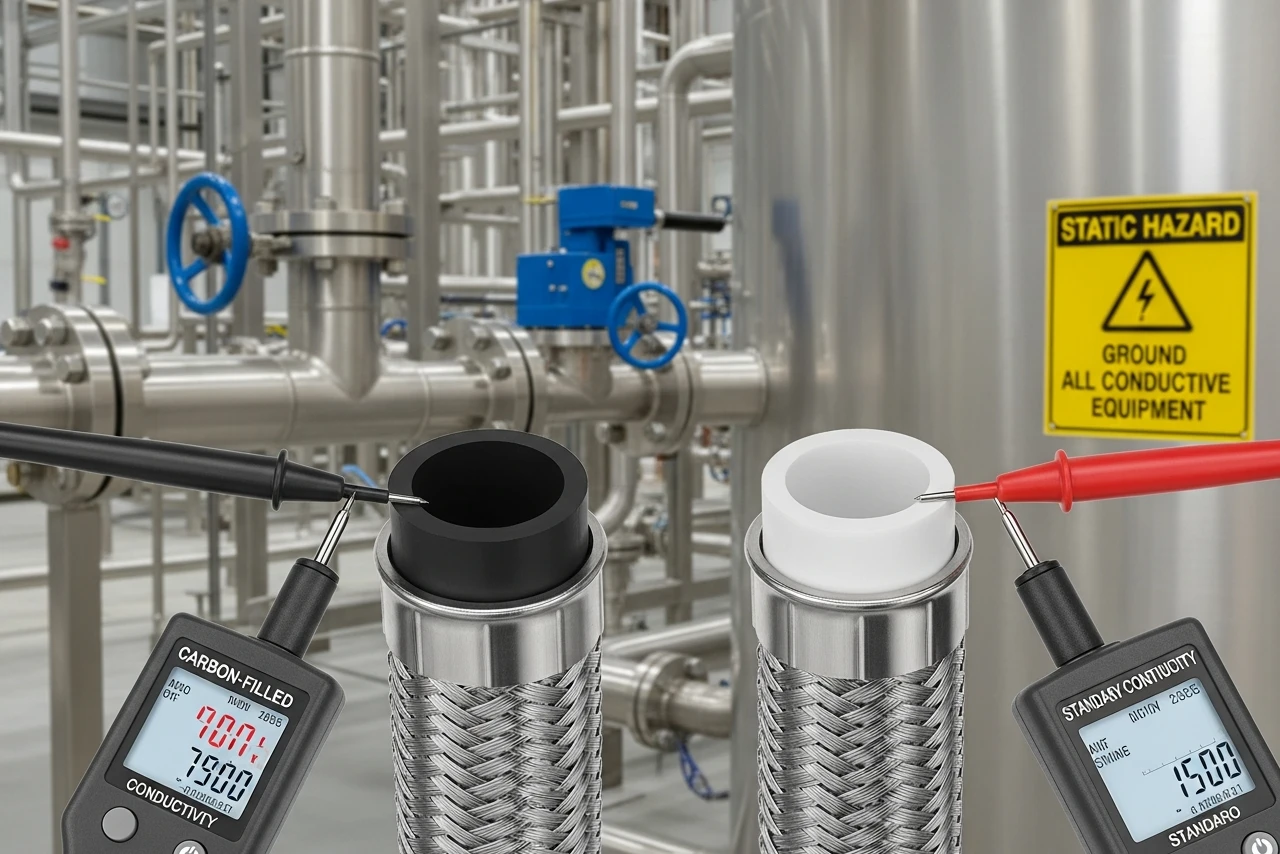
If you’ve ever stared at two PTFE hoses—one plain white inside, the other black—and wondered why one costs way more, you’re not alone. I’ve been knee-deep in this stuff for years at Teflon X, helping folks figure out if that pricier carbon-filled version is really worth it or if the standard one will do the job just fine. Truth is, it boils down to what you’re pumping through it and how much risk you’re willing to take with static buildup. Let’s break it down like we’re chatting over coffee, no fancy jargon, just real talk from someone who’s seen hoses fail (and succeed) in the wild.
Most buyers I talk to are in the same boat: they’ve got a setup handling chemicals, fuels, solvents, or steam, and they’re trying to avoid overspending on something “fancy” when the basic PTFE hose seems tough enough. PTFE is awesome—handles crazy temperatures from like -70°C up to 260°C, laughs at almost every chemical, super low friction so stuff flows smooth. But the catch? Pure PTFE is a fantastic insulator. Like, ridiculously good at holding onto static electricity. Flow a non-conductive fluid fast through a long hose, and bam—charge builds up inside the liner.
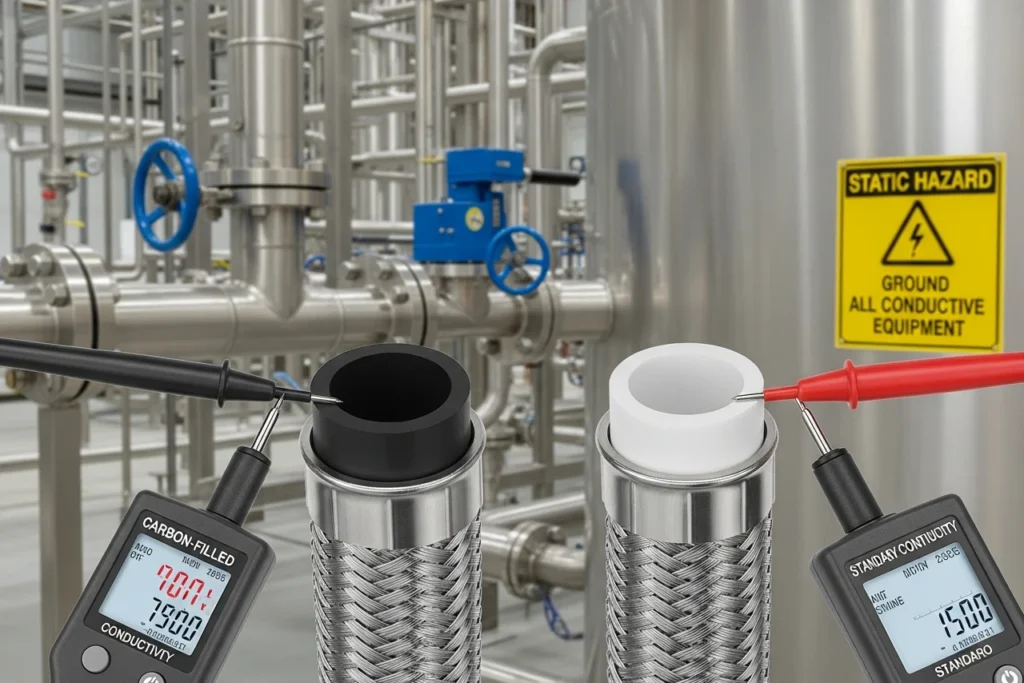
That’s where conductive vs non-conductive hose comes in. Standard PTFE (the white one) is non-conductive. Carbon-filled (usually black inside) has carbon black mixed in to make it dissipative. It safely bleeds off that static to the metal braid and fittings, which you ground properly. No spark, no pinhole burn-through, no surprise fire.
Why Static Electricity in Hoses is a Bigger Deal Than You Think
Picture this: fluid rushes through the hose, rubbing against the smooth PTFE wall. If the fluid has low electrical conductivity (most solvents, fuels, pure chemicals), it generates static just like shuffling your feet on carpet. In a non-conductive hose, that charge has nowhere to go. It builds until—zap—it arcs through the liner wall to the stainless braid. That arc can melt a tiny hole. At best, you get a leak. At worst, if the fluid is flammable and there’s vapor around… well, you get the idea.
I’ve seen photos from labs where they deliberately tested this—non-conductive PTFE hoses develop pinholes after high-flow tests with low-conductivity fluids. Real-world? There are documented cases in chemical plants and fuel transfer where static discharge ignited vapors. One report from a big manufacturer showed a hose failure leading to a flash fire because they skimped on conductive liner for acetone transfer. Scary stuff, and totally avoidable.
Industry folks aren’t making this up. Guidelines from places like Pacific Hoseflex and Swagelok say: if your fluid’s conductivity is below 10,000 pS/m (picoSiemens per meter)—think acetone, toluene, hexane, alcohols, most hydrocarbons—go conductive, especially at high flow rates or long hose runs. Even steam or compressed air can be an issue if it’s dry.
Quick Comparison: Carbon-Filled (Conductive) vs Standard (Non-Conductive) PTFE Hose
Here’s a simple table I throw together for customers—makes it way easier to see side-by-side:
| Özellik | Standard PTFE Hose (Non-Conductive) | Carbon-Filled PTFE Hose (Conductive/Anti-Static) |
|---|---|---|
| Inner Liner Color | Usually white/natural | Black (from carbon black) |
| Electrical Resistivity | Super high (>10^17 ohm-cm) | Low enough for dissipation (<10^6 ohm/sq typically) |
| Static Buildup Risk | High with low-conductivity fluids | Safely grounds out |
| En İyisi İçin | Water-based stuff, food/pharma (non-flammable), brakes/clutch lines | Flammable solvents, fuels, chemicals, steam, high-velocity transfers |
| Price | Cheaper (20-50% less usually) | More expensive because of the carbon additive |
| Wear/Friction | Slightly slicker sometimes | Tiny bit higher friction, but still excellent |
| Common Standards Met | FDA, USP for clean apps | Same + ATEX/explosion-proof zones often |
Yeah, the conductive one costs more upfront, but if it prevents one incident… you do the math.
Real-World Stories (Without Naming Names)
Had a customer a couple years back running toluene in a paint factory. They started with standard white PTFE hoses because “it’s just solvent, right?” Flow rates were decent, hoses about 20 meters long. After a few months, one hose started weeping tiny leaks. Turned out pinhole from static arc. Switched to our black carbon-filled convoluted stuff—like our Flexible Corrugated Pipe—and zero issues since. Saved them a shutdown that would’ve cost way more than the upgrade.
Another one: pharma plant transferring ethanol blends. They thought non-conductive was fine since it’s “clean” work. But ethanol’s conductivity is low-ish, especially if it’s pure. High flow from pumps built charge fast. We recommended conductive, tested electrical continuity end-to-end, and they’ve been running smooth for years. No sparks, happy inspectors.
Or the automotive shop doing race fuel lines—methanol, E85. Those guys learned quick: non-conductive PTFE can arc and blow pinholes. Carbon-filled is the go-to now in most performance builds.
When Do You Actually Need the Carbon-Filled Version?
Ask yourself these during PTFE hose selection:
- Is the fluid flammable or explosive? (solvents, fuels, gases)
- Low electrical conductivity? (under 10,000 pS/m—google your fluid’s spec sheet)
- High flow velocity? (over 5 m/s usually flags it)
- Long hose assemblies? (more length = more charge)
- In an explosive atmosphere? (ATEX zones, dusty/flammable areas)
If you answer yes to two or more, grab the conductive. Better safe than explaining to insurance why you cheaped out.
For water, coolants, food-grade stuff, or where you want insulation (like some hydraulic returns), standard is perfect and saves cash.
A Few Extra Tips From the Trenches
- Always test electrical continuity on conductive hoses—should be under 100 ohms end-to-end if braided properly.
- Ground everything. The braid and fittings carry the charge away.
- Convoluted vs smooth bore? Convoluted (like our Flexible Corrugated Pipe) flexes better, easier to route, but smooth has less pressure drop if that’s critical.
- Don’t mix— if one section is non-conductive, the whole assembly might as well be.
We’ve got both at Teflon X, and honestly, most folks end up with the black conductive once they hear the risks. But we won’t upsell if you genuinely don’t need it.
Wrapping It Up – Which One Do You Need?
If you’re moving anything that can go boom or has low conductivity, spend the extra on carbon-filled conductive PTFE hose. It’s not about being fancy; it’s about not having a bad day. Standard works great for safe, non-flammable stuff and keeps your wallet happier.
Still on the fence? Shoot me an email at Allison.Ye@teflonx.com ya da bizim iletişim sayfası. Tell me what fluid, temp, pressure, flow rate—and I’ll tell you straight what makes sense. We can even quote both options side-by-side.
Or check out our black conductive Flexible Corrugated Pipe—it’s one of our best-sellers for exactly these scenarios.
Stay safe out there.
FAQ – Carbon Filled vs. Standard PTFE Hose
1. What’s the main difference between conductive vs non-conductive hose?
The big one is static dissipation. Non-conductive (standard white PTFE) lets charge build up. Conductive (carbon-filled, black) safely drains it away through the hose wall to the braid. Use conductive whenever you’re worried about sparks.
2. Will a standard PTFE hose really cause an explosion?
Not always, but yeah—it can. If static arcs through the liner and ignites flammable vapors, absolutely. Seen it in labs and heard from plants that learned the hard way. Low risk isn’t zero risk.
3. Is carbon-filled hose worth the extra cost?
Almost always if your application matches the “risky” list above. The price jump is usually 30-50%, but replacing a failed hose (or dealing with a fire) costs way more. Plus peace of mind.
4. Can I use non-conductive PTFE for fuel lines?
In small, low-flow automotive stuff like brakes? Sure, lots do. For actual fuel transfer, especially race fuels or high-volume? Nope—go conductive. Most pros won’t touch white liner for fuel anymore.
5. How do I know if my fluid needs conductive hose?
Quick check: look up its electrical conductivity. Below 10,000 pS/m + flammable = conductive. When in doubt, go black.
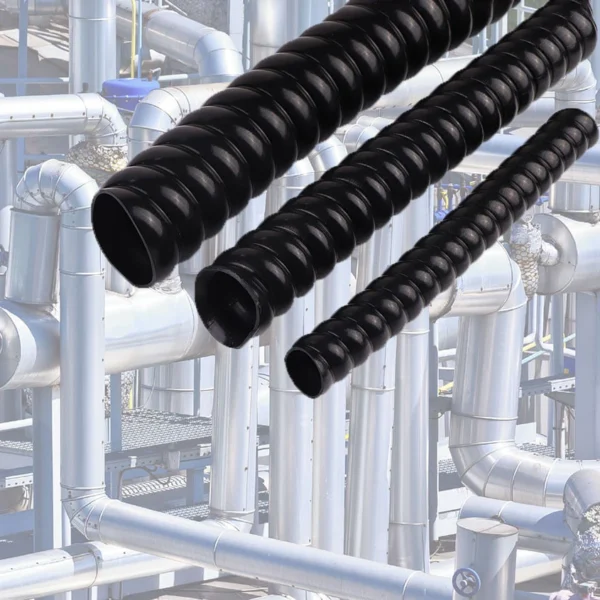
Esnek Oluklu Boru – Yüksek Sıcaklık İçin Siyah PTFE Hortum
Teflon X'ten üretilen esnek oluklu borular, otomotiv ve kimya sektörleri gibi yüksek sıcaklık ve basınç ortamlarında mükemmeldir. Bu siyah ptfe hortumlar, rafine edilmiş iç duvarıyla düzgün sıvı akışı ve kolay temizlik sağlar. Spiral takviye dayanıklılık katar ve bu oluklu hortumu özelleştirilebilir ve güvenilir hale getirir.
Head over to teflonx.com if you want more tech sheets or just wanna chat hoses. We’re here to help.
