
 English
  Russian
  French
  German
  Japanese
  Korean
  Portuguese
  Arabic
  Italian
  Dutch
Dutch  Turkish
  Indonesian
  Polish
  Spanish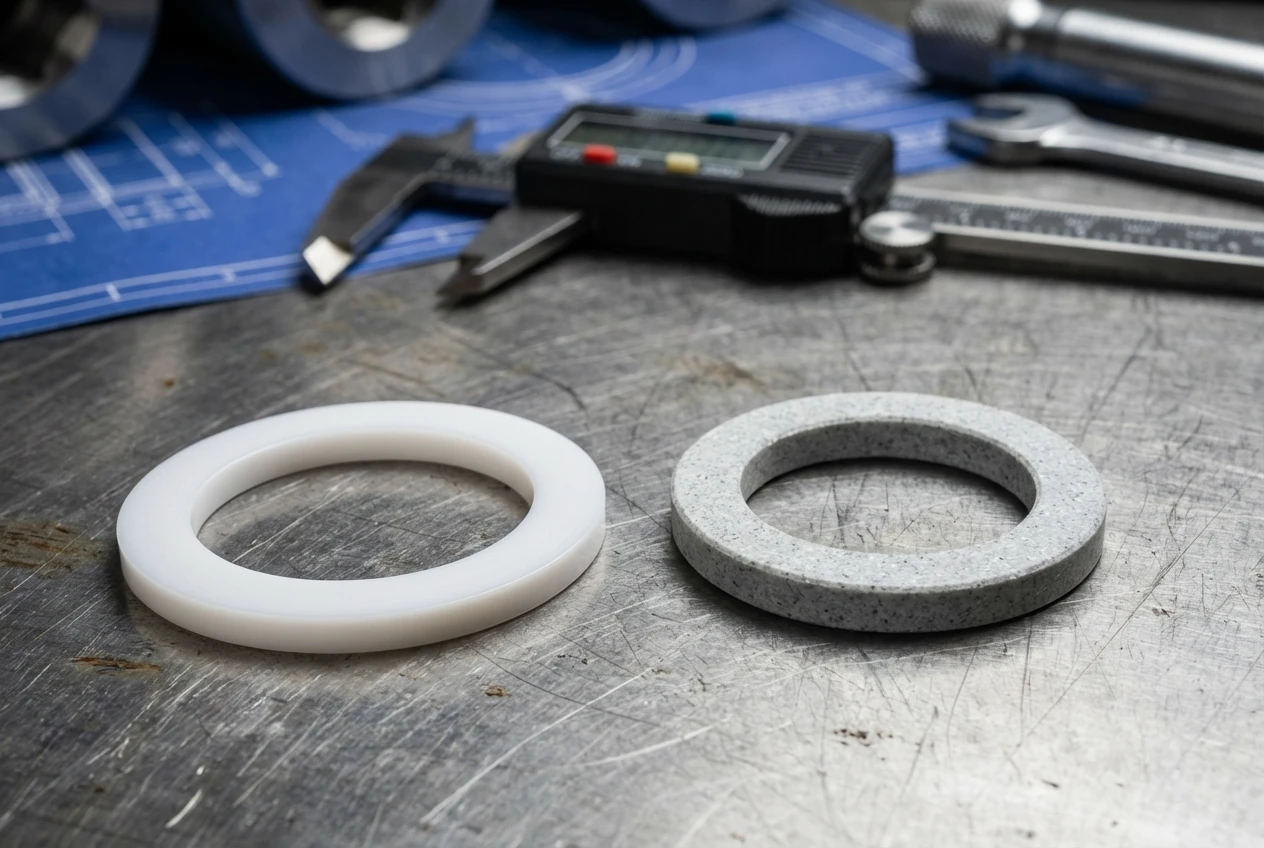
There is nothing worse than a call from a client saying a seal failed on the test bench three days before production start. The oil leak is messy, the shouting is loud, and the solution needs to happen yesterday.
If you are a material engineer in the automotive game, you know the drill. You’re looking at a standard PTFE seal and wondering, “Did I ask for the wrong stuff?”
The debate of Virgin vs. Filled PTFE isn’t just about color or cost. It’s about physics. It’s about how a material behaves when you smash it with 1,000 psi and spin a shaft against it at 5,000 RPM.
At Teflon X, we’ve seen enough melted, extruded, and shredded seals to know that “standard” specs usually don’t cut it. Today, I’m going to walk you through the nitty-gritty differences, strip away the marketing fluff, and look at the actual engineering data. We’ll figure out when you can get away with the pure stuff and when you absolutely need to bulk it up.
The Baseline: What is Virgin PTFE Actually Good For?
First off, let’s stop bashing Virgin PTFE. It’s an incredible material. It has that slippery, non-stick magic (coefficient of friction around 0.05 to 0.10) that makes it legendary.
Chemically? It’s a beast. You can throw almost any automotive fluid at it—ATF, brake fluid, ethanol blends—and Virgin PTFE just laughs. It doesn’t swell, it doesn’t dissolve.
But here’s the problem.
Virgin PTFE has the structural integrity of stiff cheese. I’m serious. It suffers badly from “Cold Flow” (creep). If you bolt a flange down on a Virgin PTFE gasket, come back in 24 hours. The bolts will be loose. Why? Because the material flowed away from the pressure.
The Weakness in Numbers
Let’s look at the tensile strength. Standard Virgin PTFE usually sits around:
- Tensile Strength: ~20-30 MPa
- Elongation: ~200-400%
Great for stretching, terrible for holding a tight tolerance under a heavy dynamic load. In an engine or transmission environment, pure PTFE wears out incredibly fast if there’s any rubbing. We call this the Specific Wear Rate (k).
For Virgin PTFE, the wear rate is astronomically high compared to filled grades. We are talking about a wear factor of roughly:
k ~ 500 x 10^-10 mm³/Nm
That’s… not good for a rotary shaft seal.
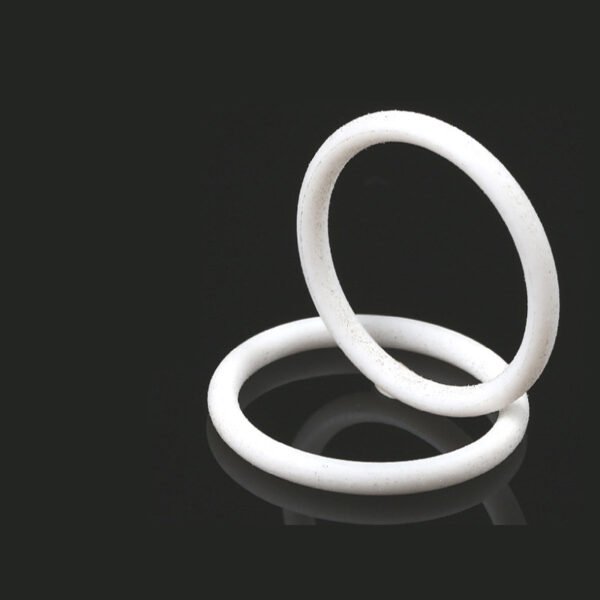
High Temp PTFE Gasket & Teflon O Ring | PTFE Seal for Chemical Resistance
High temp PTFE gasket and teflon o ring deliver excellent sealing in extreme temperatures and aggressive chemicals. PTFE seal and teflon gasket resist corrosion and provide long service life. Perfect for chemical, pharmaceutical, and food processing industries needing safe, clean seals.
The Challenger: Filled PTFE (The “Muscle”)
So, how do we fix the soft cheese problem? We add fillers. Think of this like adding rebar to concrete. You keep the chemical resistance (mostly), but you skyrocket the mechanical strength.
When we talk about automotive seals comparison, we are usually looking at three main contenders to replace the virgin stuff:
- Glass Filled PTFE
- Carbon/Graphite Filled PTFE
- Bronze Filled PTFE
Adding these fillers changes the game. You drop the deformation under load significantly.
The Physics of the Filler
Here is where it gets interesting. The filler takes the load. When the seal is pressed against a shaft, the PTFE acts as the lubricant, smearing a thin transfer film onto the metal, while the glass or bronze particles support the weight.
This increases the PV Limit (Pressure x Velocity).
- Virgin PTFE PV Limit: ~ 1,800 PSI-fpm
- Filled PTFE PV Limit: ~ 10,000+ PSI-fpm
That is a massive difference. If your application involves high RPMs, Virgin PTFE isn’t even in the race.
Deep Dive: Comparing the Specifics
Let’s break this down by the properties that actually matter to you when you’re designing a seal.
1. Wear Resistance and Tribology
This is usually the #1 reason engineers switch to our PTFE Gaskets and seals made with fillers.
The formula for wear volume (W) is generally expressed as:
W = k * F * L
Where:
- W = Wear volume (mm³)
- k = Specific wear rate (mm³/Nm)
- F = Normal force (N)
- L = Sliding distance (m)
If you use glass filled PTFE, the ‘k’ value drops dramatically.
- Virgin ‘k’: ~500
- 25% Glass Filled ‘k’: ~2 – 5
You are looking at a material that lasts 100x longer in sliding contact. However, there’s a catch. Glass is abrasive. If you use glass-filled PTFE on a soft shaft (like unhardened aluminum or mild steel), the seal won’t wear out, but the shaft will.
I’ve seen customers destroy a $500 shaft to save $2 on a seal. Don’t be that guy.
2. Creep and Deformation
In automotive applications, temperatures fluctuate wildy. -40°C in winter to 150°C under the hood. Virgin PTFE has a high coefficient of thermal expansion and low creep resistance.
Deformation under load (14 MPa @ 23°C for 24 hrs):
- Virgin: ~15% deformation
- 25% Glass Filled: ~11% deformation
- Bronze Filled: ~7% deformation
If you need the seal to maintain geometry under clamping force, you gotta go filled.
3. Thermal Conductivity
Heat kills seals. Virgin PTFE is a thermal insulator. It traps heat at the sealing interface. This leads to carbonization of the oil or melting of the seal lip.
Carbon filled PTFE is the hero here. It conducts heat away from the contact point.
- Virgin: ~0.25 W/mK
- Carbon Filled: ~0.60+ W/mK
If you have a high-speed rotary application (like a crank seal), moving that heat away is critical.

High-Temperature PTFE Teflon Gasket for Ball Valves & Industrial Sealing
PTFE Teflon Gaskets are engineered for extreme temperature resistance (-200°C to +260°C) and chemical inertness, ideal for sealing high-pressure ball valves and corrosive media systems. These gaskets ensure leak-proof performance in oil & gas, chemical processing, and industrial machinery. Customizable shapes (flat, liner, or ring) adapt to complex mechanical structures.
Specific Fillers: Choosing Your Fighter
Okay, so you know you need filled. But which one? Here is the cheat sheet I use at Teflon X when consulting.
Glass Fiber (The All-Rounder)
Usually 15% or 25% glass fiber.
- Pros: High compressive strength, excellent wear resistance, chemically inert (except to hydrofluoric acid).
- Cons: Abrasive to mating surfaces. Can increase porosity.
- Best for: Static seals, valve seats, gaskets where rotation is slow or the mating metal is hard (Rockwell C 45+).
Carbon / Graphite (The Slick Operator)
- Pros: Self-lubricating, low friction, excellent thermal conductivity. Soft enough not to damage shafts.
- Cons: More expensive than glass. Black color limits visual inspection for cleanliness in some niche apps (rare in auto).
- Best for: High-speed rotary seals, shock absorbers, piston rings.
Bronze (The Heavy Lifter)
- Pros: Highest compressive strength, best thermal conductivity.
- Cons: Attacked by acids/alkalis (chemical resistance drops), expensive.
- Best for: Hydraulic systems, extrusion resistance, heavy-duty transmission seals.
Real World Scenario: The “Leaky” Transmission Case
Let me tell you about a project we handled last year. Let’s call the client “AutoCorp.”
They were designing a new DCT (Dual Clutch Transmission). They specced Virgin PTFE for the internal control piston seals because they wanted lowest possible friction for fast shifting.
The Failure:
During the 100-hour durability test, the shifting got sloppy. Eventually, the pressure dropped, and the transmission failed.
The Diagnosis:
We pulled the seals. They looked like pancakes. The heat generated by the rapid actuation, combined with the hydraulic pressure, caused the Virgin PTFE to cold flow. The seal lip flattened out, loss of contact pressure -> leak.
The Fix:
We switched them to a custom 15% Glass + 5% MoS2 filled PTFE.
- Glass stopped the cold flow.
- MoS2 (Molybdenum Disulfide) lowered the friction coefficient back down near Virgin levels.
Result? Passed the 500-hour test with zero leakage. Sometimes you have to mix and match. If you have a tricky application like this, shoot an email to Allison.Ye@teflonx.com. We love solving these puzzles.
Quick Comparison Table
I know engineers love tables. Here is the snapshot.
| Property | Virgin PTFE | Glass Filled PTFE | Carbon Filled PTFE | Bronze Filled PTFE |
|---|---|---|---|---|
| Color | White | Off-White / Gray | Black | Brown / Bronze |
| Friction Coeff. | Excellent (0.05) | Good (0.15) | Excellent (0.10) | Fair (0.20) |
| Wear Resistance | Poor | Excellent | Very Good | Excellent |
| Shaft Wear | Low | High (Abrasive) | Low | Low-Medium |
| Creep Resistance | Low | Medium | Medium | High |
| Thermal Cond. | Low | Low | High | Very High |
| Cost | $ | $$ | $$$ | $$$ |
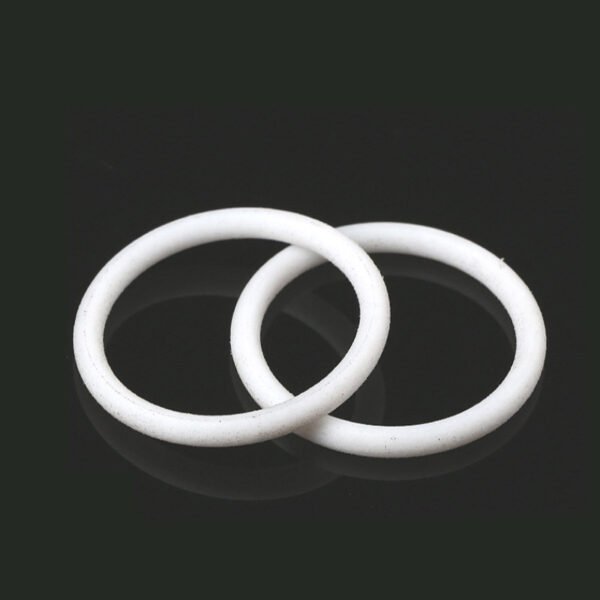
PTFE Teflon O Ring Gasket | High Temp Sealing PTFE Seal & Teflon Gasket Supplier
PTFE teflon o ring and teflon gasket are perfect for high temp sealing in harsh chemical environments. Teflon gasket and ptfe gasket offer outstanding chemical resistance and durability. Our ptfe seal ensures reliable performance. Ideal for industrial applications and fluid systems.
Cost vs. Performance: The Trade-off
Look, I get it. Procurement is breathing down your neck to cut costs. Virgin PTFE is cheaper.
But calculating cost based on the price per gram of material is a trap. You need to calculate the Cost of Failure.
If a $0.50 Virgin seal fails and causes a warranty claim on a $2,000 transmission, that math doesn’t work out.
However, don’t over-engineer if you don’t have to. If you are designing a static dust boot or a cap that sees no load and no friction, Virgin PTFE is perfect. It looks clean, it’s cheap, and it works.
But for automotive seals comparison in dynamic environments (crankshafts, cam shafts, transmission pistons, suspension struts), the filled grades pay for themselves by surviving the warranty period.
A Note on Surface Finish
This is something people forget. If you switch from Virgin to Filled, you might need to adjust your shaft surface finish.
- Virgin PTFE: Likes a very smooth finish (Ra 0.2 – 0.4 µm).
- Filled PTFE: Can actually benefit from a slightly rougher finish (Ra 0.4 – 0.8 µm) to help establish that transfer film I mentioned earlier.
If the shaft is too smooth, the filled PTFE might just slide over it without depositing the transfer film, leading to higher friction and heat. It’s a delicate balance.
Wrapping It Up
Choosing between Virgin vs. Filled PTFE isn’t about which material is “better.” It’s about matching the material to the abuse it’s going to take.
- Use Virgin for static, chemical-heavy, low-load spots.
- Use Glass Filled for general wear resistance and heavy loads (watch the shaft hardness!).
- Use Carbon/Bronze for high heat and high pressure.
Don’t guess. The wrong choice leaks.
If you are staring at a CAD drawing right now wondering which compound to specify, stop guessing. We have the data, and we have the materials. Check out our range of PTFE Gaskets to see what’s possible.
Or, just skip the browsing and ask us directly. We can run the PV calculations for you.
Contact us here: https://teflonx.com/contact-us/
Email: Allison.Ye@teflonx.com
Let’s make sure your seals actually seal.

Chemical-Resistant PTFE Gasket Sheet for Cyclone Systems & Valves
Designed for cyclone separators and industrial valve systems, PTFE Gasket Sheets provide unmatched resistance to acids, alkalis, and solvents. Their non-stick surface prevents material buildup, enhancing equipment longevity. Available in standard sheets or custom-cut designs for seamless integration.
FAQ: Common Questions on PTFE Seals
Q: Can I use glass filled PTFE on an aluminum housing?
A: You have to be careful. Glass is harder than aluminum. If there is relative motion (rubbing), the glass fibers in the PTFE will act like sandpaper and eat into the aluminum. For soft mating metals, we usually recommend Carbon filled or a specialized polymer blend that is non-abrasive.
Q: Why is my Virgin PTFE seal extruding into the gap?
A: That’s classic “cold flow.” Virgin PTFE has low resistance to deformation under load. If the pressure is high and the clearance gap is even slightly too big, the material will squeeze out like toothpaste. You need to switch to a filled grade (like Bronze or Glass) to increase compressive strength, or use a backup ring.
Q: Is Filled PTFE chemically resistant like Virgin PTFE?
A: Mostly, yes, but the filler is the weak link. For example, Virgin PTFE is immune to Hydrofluoric Acid (HF), but Glass Filled PTFE is NOT, because the acid attacks the glass. Bronze filled is not compatible with certain oxidizing acids. Always check the chemical compatibility of the filler, not just the PTFE.
Q: What is the maximum temperature for Glass Filled PTFE?
A: The matrix is still PTFE, so the theoretical max is around 260°C (500°F). However, the mechanical properties degrade as you get close to that limit. In automotive applications, we usually try to stay under 200°C for continuous service to maintain seal integrity and life.
