
 English
  Russian
  French
  German
  Japanese
  Korean
  Portuguese
  Arabic
  Italian
  Dutch
Dutch  Turkish
  Indonesian
  Polish
  Spanish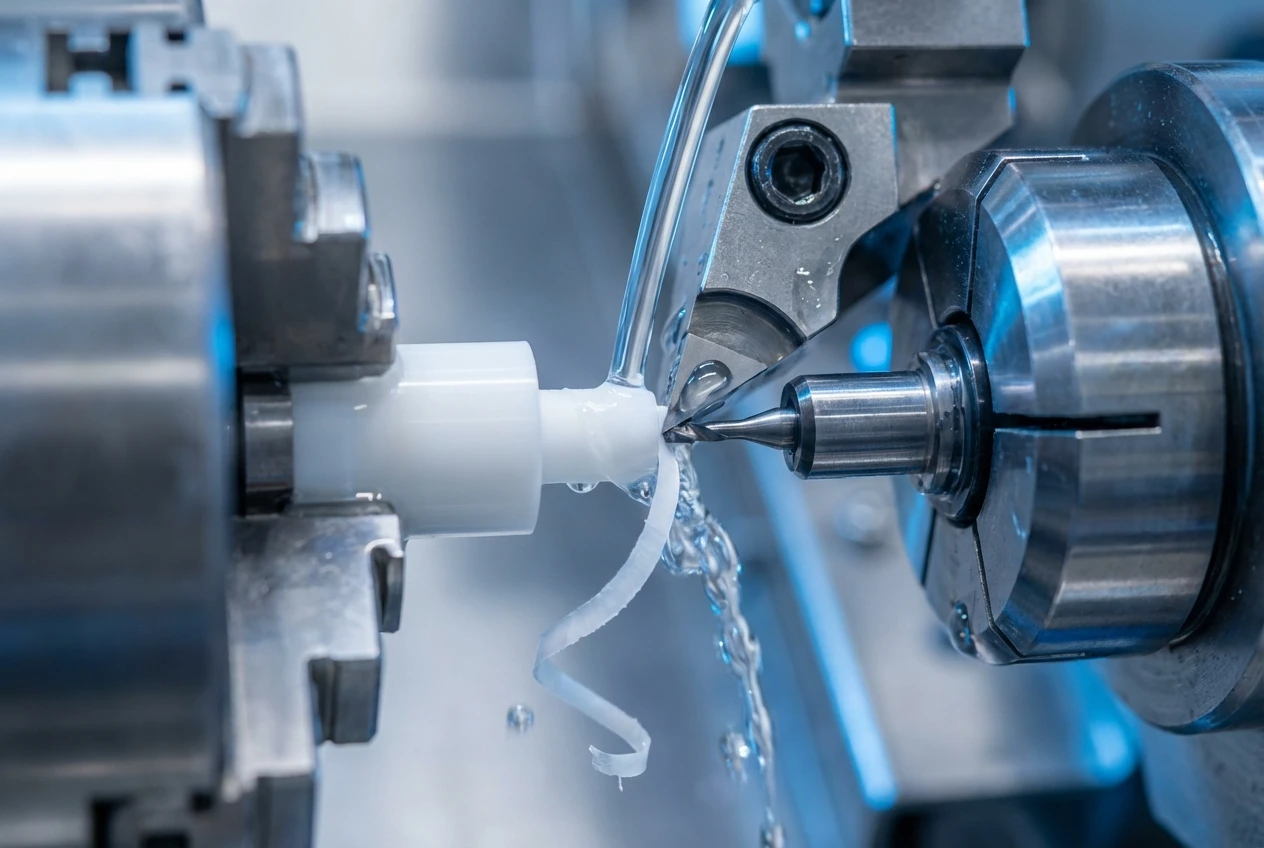
So you’ve been tasked with designing the next generation of robotic surgery equipment. Awesome. You’re looking at your CAD assembly, you realize you need a highly lubricious electrical insulator for an articulating joint, and you slap a +/- 0.005mm tolerance on a tiny PTFE component.
I’m just gonna stop you right there.
Designing surgical robot parts is hard enough. But demanding a tight tolerance on a piece of plastic that acts like a wet bar of soap when you cut it? That requires some serious experince. If I had a dollar for every time an engineering team sent me a print for micro machining PTFE with metal-like tolerances, I’d probably be on a beach instead of writing this.
Don’t get me wrong. At Teflon X, we hit crazy tight tolerances on fluoropolymers every singel day. But you gotta realize that polytetrafluoroethylene (PTFE) is a completely different beast compared to stainless steel, titanium, or even PEEK.
The surgical robotics market was valued at about $4.4 billion back in 2022 and is expected to grow at a massive 18% CAGR through 2030. With that kind of growth, companies are racing to make tools smaller, smarter, and less invasive. Miniaturization is the name of the game. But as parts get smaller, the material science gets infinitely more difficult.
Let’s dig into how we actually make swiss turning PTFE work at the micro scale, without losing our minds.
The Invisible Enemy: Thermal Expansion
Most machinists think they know plastics. They throw a stick of Delrin into a lathe, cut it, and it measures fine. Then they try the exact same thing with PTFE, and the parts are failing Quality Control before lunch.
Why? Because of heat.
The coefficient of thermal expansion (CTE) for PTFE is massive. It sits somewhere around 100 to 160 x 10^-6 K^-1. To put that in plain English: PTFE expands roughly ten times faster than stainless steel when things get warm.
Let’s do some quick shop math
I know you don’t want a physics lecture, but we need to look at the numbers. The formula for thermal expansion is simple:
ΔL = L_initial × α × ΔT
Where:
- ΔL = the amount your part grows or shrinks (Change in length)
- L_initial = the starting dimension of your feature
- α = the CTE of the material
- ΔT = the tempertaure swing in Celsius
Imagine you have a 15mm long insulator for a robotic cautery tool. It gets machined in a shop enclosure that’s running a bit warm, say 30°C. The machinist measures it, packs it up, and ships it to your QA lab, which is strictly climate-controlled at 20°C. That’s a 10-degree drop.
Let’s plug the numbers in using an average CTE of 0.000150 for PTFE:
ΔL = 15mm × 0.000150 × 10°C
ΔL = 0.0225 mm (or 22.5 microns)
Your part just shrunk by over 20 microns simply by traveling from the shop floor to an air-conditioned room. If your drawing asked for a +/- 10 micron tight tolerance, the part literally fails inspection without anyone even touching it. This happens constantly with inexperienced suppliers.

PTFE Rod Manufacturers – Acid Resistant Teflon Rod
Our PTFE rods, crafted by expert manufacturers, resist acids and alkalis, making them ideal for harsh industrial use. This teflon rod ensures high performance in instruments and machinery. Custom options available.
Swiss Turning PTFE: The Secret to Tight Tolerances
Standard CNC lathes are practically useless for micro machining PTFE. The material is way too soft. If you try to stick a 2mm diameter PTFE rod out of a standard chuck and push a cutting tool against it, the material just bends. It deflects away from the tool.
That’s why we rely entirely on Swiss-style CNC lathes.
In swiss turning, the material slides through a “guide bushing,” and the cutting tool is positioned right next to the bushing’s face—usually within a millimeter. Because the tool cuts right where the material is supported, deflection is basically zero. This is how we can machine surgical robot parts with paper-thin walls.
But swiss turning PTFE has its own set of nightmares.
The “Extrusion Effect” in the Guide Bushing
The guide bushing has to be adjusted perfectly. If it’s too loose, the PTFE rod chatters, and your surface finish looks like garbage. If it’s too tight, the bushing actually compresses the soft PTFE rod as it feeds through.
You end up cutting the part while the material is squished. The moment the part drops off the machine and is freed from the bushing’s grip, it expands back to its natural state. Suddenly, your perfectly machined outside diameter (OD) is oversized. Figuring out exactly how much tension to put on that guide bushing is an art form we’ve spent years perfecting.
Sharp Tools and the “Bird Nest” Problem
When you cut steel, the chip breaks off into nice little number-9 shapes and falls away.
PTFE doesn’t do that. It’s incredibly slippery and refuses to break. Instead, it forms long, continuous strings. If you aren’t careful, those strings wrap around the micro part and the tooling, creating a massive “bird nest.” Because PTFE acts as an insulator, that nest traps heat against the part, causing it to melt or deform.
To fix this, we ditch standard carbide inserts. Most carbide inserts have a microscopic hone (a rounded edge) to make them durable. But a rounded edge doesn’t cut PTFE; it plows it. Plowing creates friction. Friction creates heat.
Instead, we use custom-ground High Speed Steel (HSS) or ultra-polished Polycrystalline Diamond (PCD) tools. We grind them with razor-sharp edges and high positive rake angles. They slice through the plastic like a scalpel, generating almost zero heat. We combine that with specialized macro-programming—using micro-pecks in the feed rate to physically force the stringy chips to break.
Stop Treating PTFE Like PEEK (A Controversial Take)
Here’s something most machine shops won’t tell you because they just want to secure your purchase order: stop over-tolerancing your PTFE components.
I see engineers treating PTFE like it’s PEEK (Polyetheretherketone) or Delrin. It’s not.
If you need a rigid, structural part for a robotic arm that will hold a 5-micron tolerance all day long, use PEEK.
But if you are using PTFE, you are doing it because you desperately need its unmatched chemical resistance, its extreme electrical insulation properties, or its near-zero coefficient of friction. PTFE is soft. It creeps under load. It has a low heat deflection temperature—around 54°C under moderate stress.
If a specific dimension on your PTFE part doesn’t physically mate with another component in the surgical assembly, open that tolerance up. Demanding a +/- 0.005mm tolerance on a feature hanging in free space is just burning money and extending your lead times. Give your supplier breathing room where it doesn’t matter, so they can focus all their effort on the dimensions that actually do.

PTFE Round Bar with Corrosion Resistance – Custom Sizes
PTFE round bars provide unmatched corrosion resistance for chemical and petrochemical industries. This teflon rod excels in tough conditions with customizable specs. A top choice for long-lasting equipment solutions.
Quick Comparison: Micro Machining Materials for Medical Robots
To make my point clearer, here’s a quick cheat sheet on how these materials behave when you shrink them down to the micro-scale:
| Feature | PTFE (Teflon) | PEEK | 316L Stainless Steel |
|---|---|---|---|
| Machinability at Micro Scale | Tricky (deflects, creeps) | Excellent | Good (but wears tools fast) |
| Thermal Expansion (CTE) | Huge (~150 x 10^-6 K^-1) | Moderate (~47 x 10^-6 K^-1) | Low (~16 x 10^-6 K^-1) |
| Electrical Insulation | Incredible | Great | Conductive (Poor) |
| Friction / Lubricity | Unmatched (Lowest friction) | Good, but not PTFE level | High friction |
| Best Robotics Use Case | Catheter liners, jaw insulators | Structural links, gears | Load-bearing shafts, pins |
A Real-World Nightmare: The 0.15mm Wall Insulator
Let me share a quick anonymized story that proves why experience matters here.
A top-tier medical device company came to us after their previous supplier threw in the towel. They needed a microscopic electrical isolator that goes into the tip of an articulating robotic grasper. The outside diameter (OD) was 2.5mm, and the inside diameter (ID) was 2.2mm.
That leaves a wall thickness of just 0.15mm. And they wanted a tight tolerance of +/- 0.005mm on the OD.
The previous shop was shipping parts that looked like warped potato chips. They couldn’t figure out why. When we took on the project, we identified two massive problems immediately.
First: Material memory. PTFE is extruded under immense pressure. The resulting rod stock is full of internal residual stress. The second you machine away the outer skin, the internal stresses release, and the part warps like a banana. We fixed this by putting the raw PTFE rods through a proprietary 24-hour thermal annealing cycle in an oven before they ever touched our Swiss lathes.
Second: Inspection methodology. The previous shop was trying to measure a 0.15mm PTFE wall with a standard micrometer. You simply can’t do that. Just the spring pressure from the micrometer’s thimble was compressing the soft plastic by 15 microns. They were getting false readings, adjusting their machine offsets based on bad data, and chasing their own tails.
We moved the entire inspection process to an OGP SmartScope vision system. No touching. No probe pressure. Just high-resolution edge-detection algorithms measuring the part optically in a tempertaure-controlled room.
The result? We nailed the tolerance and scaled them up to production volumes.
How Teflon X Handles Your Micro Machining Headaches
If you’re reading this, you are probably dealing with a supply chain issue right now. Maybe your current vendor is scrapping 40% of their run, or maybe they just completely no-quoted your latest CAD print.
At Teflon X, we don’t just “also do plastics.” We specialize in the weird, the tiny, and the seemingly impossible. We know the exact spindle speeds, tool geometries, and temperature controls needed to make swiss turning PTFE a repeatable science, not a guessing game.
We utilize chilled, high-pressure oil systems to keep the cutting zone exactly at 20°C, totally eliminating the thermal expansion variables that ruin tight tolerance parts. And we handle everything from prototyping to full-scale manufacturing.
Don’t let a 50-cent plastic insulator delay your million-dollar medical device launch.
Check out our full range of capabilities on our PTFE Products page. If you’re ready to get your project moving, send your prints directly to Allison.Ye@teflonx.com or reach out through our Contact Us page. We’ll give you honest feedback on your tolerances and get you a quote that actually makes sense.

Teflon Rod for Machinery Parts – PTFE Round Bar Suppliers
Teflon rods, also known as PTFE round bars, are perfect for machinery components due to their high lubrication and acid resistance. These durable rods enhance performance in demanding applications. Contact reliable PTFE rod suppliers today.
FAQ About Swiss Turning PTFE and Surgical Robot Parts
Q: Can you achieve a +/- 0.0001 inch tolerance on a PTFE part?
Honestly? No. Anyone who tells you they can hold a tenth (0.0001″) on PTFE in a high-volume production run is flat-out lying to you. The material expands and contracts too much just from ambient room tempertaure changes. We can definitely hold some seriously tight tolerances—often down to +/- 0.005mm (around two tenths) under strictly controlled environments—but we always recommend opening up the tolerances where they don’t impact the function of the robot.
Q: Why do my micro machined PTFE parts keep warping weeks after they arrive?
Usually, it comes down to two reasons. First, your supplier probably didn’t anneal the rod stock before machining it, so the internal extrusion stresses are slowly warping the part over time. Second, PTFE has what we call “elastic memory.” If the parts got warm during shipping, or if they were packed too tightly in a bag, they might deform. The plastic naturally wants to return to its original shape, which causes unpredictable warping. We use specialized foam matrix packaging for our micro parts to ensure zero stress during transit.
Q: Is water-soluble coolant or straight oil better for micro machining PTFE?
We strictly use chilled cutting oil for micro swiss turning. Water-soluble coolant is fantastic for dissipating heat, but it doesn’t provide the raw lubricity you need for the guide bushing in a Swiss lathe. The trick to making oil work is that we run our oil lines through a high-end chiller system to keep the fluid tempertaure locked exactly at 20°C. If your cutting oil gets hot, your PTFE gets hot, and you completely lose dimensional control.
Q: How do you inspect micro PTFE parts if you can’t touch them?
We refuse to use physical contact probes (like CMM touch probes or micrometers) on thin-walled PTFE surgical robot parts. The material is too soft, and the probe will squish the part, giving you fake data. Instead, we use advanced non-contact optical comparators and automated vision systems. These machines use high-definition cameras and automated backlighting to detect the physical edges of the part, allowing us to measure down to the micron without ever applying physical force to the component.
